N.T. Wright, Bishop of Durham and theologian, seems very confused. First of all he rightly rejected out of hand the recent remarks by Jeffrey John, Dean of St Albans (a notorious homosexual) which in the following critique. Jeffrey John simply repeats the old threadbare idea that penal substitution makes God out to be a torturer and murderer of His own son. “In other words, Jesus took the rap and we got forgiven as long as we said we believed in him,” he says. “This is repulsive as well as nonsensical. It makes God sound like a psychopath. If a human behaved like this we’d say that they were a monster.” He prefers to suggest that Christ was crucified so he could “share in the worst of grief and suffering that life can throw at us.”
Bishop N. T. Wright “accused Mr John of attacking the fundamental message of the Gospel.” “He is denying the way in which we understand Christ’s sacrifice. It is right to stress that he is a God of love but he is ignoring that this means he must also be angry at everything that distorts human life".
So far, so good but then the bishop goes on in the same article to protect Steve Chalke, the 'evangelical' who has been pushing exactly the same views in The Lost Message of Jesus and sharply censure those defending penal substitution. Of Chalke he says, “the reality that I and others refer to when we use the phrase ‘penal substitution’ is not in doubt”. A plain reading of Chalke's statements shows that he rejects penal substitution as such, however. His article explaining the book makes everything quite clear. "Those who criticise me for The Lost Message of Jesus hold a particular view of what happened on the cross (or ‘model of the atonement’) commonly known as ‘penal substitution’ – penal referring to punishment, substitution to Christ acting in our place. Initially based upon the writings of Anselm of Canterbury (1033- 1109), penal substitution was substantially formed by John Calvin’s legal mind in the reformation. The model as it is understood and taught today, however, rests largely on the work of the 19th century American scholar Charles Hodge." He also states: "In The Lost Message of Jesus I claim that penal substitution is tantamount to ‘child abuse – a vengeful Father punishing his Son for an offence he has not even committed."
Wright, who wrote a commendation of Chalke's book on its cover, conveniently ignores this and instead takes to task a new book by some conservative Anglicans Mike Ovey, Steve Jeffrey and Andrew Sach, Pierced for Our Transgressions: Rediscovering the Glory of Penal Substitution (IVP, 2007). According to Wright "it is deeply, profoundly, and disturbingly unbiblical" indeed "hopelessly sub-biblical". He makes his own position clearer: "I regard the 'Christus Victor' theme as the overarching one within which substitution makes its proper point." This is the model which Chalke prefers to penal substitution.
We are living in dangerous times.
Wednesday, April 25, 2007
Thursday, April 19, 2007
Why do ordinary people commit evil deeds?
Various people have begun to comment on the dreadful massacre at Virginia Tech University. A particularly insightful one is here. The BBC website has also published an article entitled "Why do ordinary people commit evil deeds?" It's author is Prof Phil Zimbardo, creator of the Stanford Prison Experiment - where a mock prison was run by psychologists. In this experiment "good, young men" became as prison guards involved in "chilling abuse and torture". The conclusion is that "given certain conditions, ordinary people can succumb to social pressure to commit acts that would otherwise be unthinkable". Another conclusion is that "Prejudiced beliefs lead to discrimination, and in turn to abuse." Zimbardo maintains that "rather than dismissing [evil] as a bad deed done by a bad person" we should seek "to identify corrosive social forces" that create the situation that fosters such actions.
This doesn't take us very near to understanding the Virginia Tech massacre - although we should admit that a culture which glorifies sin also encourages it. Our society is at a loss to understand evil because it has persisted in calling evil good and good evil. No doubt, there are certain external restraints (social and otherwise) upon the evil of our own hearts and when these are absent the evil becomes much more likely, but the removal of the restraints certainly doesn't create the evil.
Towards the end of the article, the conclusion is drawn rather starkly that "Anything that any human being has ever done - anything imaginable - is potentially doable by any of us in the same situation." Although this depends on the idea of situational forces practically compelling us to evil, it is still a remarkable observation from a psychologist.
Few have been as eminently holy in their life as Robert Murray M’Cheyne. His frequent prayer was "Lord, make me as holy as a pardoned sinner can be made". Yet he wrote in his Diary, published after his death: "I have begun to realize that the seeds of every known sin still linger in my heart." We should acknowledge that for ourselves with all sincerity: "The heart is deceitful above all things and desparately wicked" - Jeremiah 17:9.
This doesn't take us very near to understanding the Virginia Tech massacre - although we should admit that a culture which glorifies sin also encourages it. Our society is at a loss to understand evil because it has persisted in calling evil good and good evil. No doubt, there are certain external restraints (social and otherwise) upon the evil of our own hearts and when these are absent the evil becomes much more likely, but the removal of the restraints certainly doesn't create the evil.
Towards the end of the article, the conclusion is drawn rather starkly that "Anything that any human being has ever done - anything imaginable - is potentially doable by any of us in the same situation." Although this depends on the idea of situational forces practically compelling us to evil, it is still a remarkable observation from a psychologist.
Few have been as eminently holy in their life as Robert Murray M’Cheyne. His frequent prayer was "Lord, make me as holy as a pardoned sinner can be made". Yet he wrote in his Diary, published after his death: "I have begun to realize that the seeds of every known sin still linger in my heart." We should acknowledge that for ourselves with all sincerity: "The heart is deceitful above all things and desparately wicked" - Jeremiah 17:9.


Monday, March 26, 2007
Historical origins of the cult of the saints
Roman Catholicism still reveres those that it calls "the saints".
The political capital that the Pope makes from this and the unseemly haste to canonise the last Pope show that it is still an important business.
The Official Catechism (956) quotes from Lumen Gentium, the Dogmatic Constitution on the Church, one of the principal documents of Vatican II, on the intercession of the saints. "Being more closely united to Christ, those who dwell in heaven fix the whole Church more firmly in holiness.... They do not cease to intercede with the Father for us, as they proffer the merits which they acquired on earth through the one mediator between God and men, Christ Jesus.... So by their fraternal concern is our weakness greatly helped."
What is a saint in Scripture?
Does it refer only to those that the Pope has canonized? To these and also
to 'uncanonical' saints that are venerated regardless? Only miracle-workers?
Only martyrs? Anyone deceased who might have been at all good or at all
Christian? The New Testament provides this definition whenever it uses the
word hagios, which is rightly translated as saints: those who are
consecrated and sanctified unto God. It is clear from its various contexts
that it refers to ordinary believers in local churches. Paul even uses the
title for the Corinthians ( 1 Cor. 1:2 and very significantly I Cor. 6:1-2)
despite their being 'yet carnal' (I Cor.3:3). Were all apostles? Were all
prophets? Were all teachers? Were all workers of miracles? (cp. 1 Cor.
12:29). In the opening verses of Ephesians and Colossians Paul identifies
the saints with the 'faithful brethren' and not exclusively with the
overseers and deacons (Phil. 1:1). In Hebrews we find a whole chapter
devoted to why 'so great a cloud of witnesses' (Heb. 12:1) (greek.
martyrion - martyrs) are to be regarded as martyrion. Only by faith is the
message of chapter 11. These are of course not largely supposed to be saints
in the Roman Catholic system.
Historical origins of 'the mediation of the saints'
How then did the veneration of saints arise? Consensus among historians is
that what they term the 'cult of the saints' emerged in the fourth century.
Roman Catholic theologians would not deny that the beginning of the Roman
Catholic Church was in the establishment of Christianity in 330 AD, and as I
recall the motto of Roman Catholicism has been semper idem - always the
same. There is little doubt that 'Christianity' in the fourth century was
half-paganised. Constantine patronised important foundations of pagan
religion as well as Christian. Paganism was of course only suppressed in 385
it had coexisted officially with Christianity for this century and had been
recently revived under Julian the Apostate. Augustine reports a member of
his congregation:
'To be sure, I visit the idols, I consult magicians and soothsayers, but I
do not forsake the church of God. I am a catholic Christian'. Psalms 88
Sermon III.4.
Although the saint was regarded as residing in heaven, his intercession only
rested partly on that fact, the belief in his presence at his tomb was of
equal importance:
'Here lies Martin the bishop, of holy memory, whose soul is in the hand of
God; but he is fully here, present and made plain in miracles of every kind'
.
Gregory of Nyssa spoke of relation of praying to the saints with their
decomposed bodies or relics thus:
'those who behold them embrace, as it were, the living body in full flower:
they bring eye, mouth, ear, all the senses into play, and then, shedding
tears of reverence and passion, they address to the martyr their prayers of
intercession as if he were present.'
We must take note of the syncretistic influence of the spirit of the 3rd and
4th centuries - neoplatonism - which was influential amongst the
theologians, particularly the Alexandrian and Cappadocian fathers. The
policy of ecclesiastical authorities in the fourth century was to conserve
as much as possible, when churches replaced temples there was no sudden
change: services, pagan inscriptions, images and idols were kept. Cardinal
J.H.Newman in his book 'The development of the Christian religion'
catalogues an extensive list of Roman Catholic rituals which he admits to be
of 'pagan origin'. Msgr. O'Sullivan in 'The externals of the catholic church
' wrote similarly: 'thus, it is true that some Catholic rites are a
reproduction of those pagan creeds'.
We may look at the influence of the Hellenistic and Roman beliefs which were
still very much current in Late Antiquity. There was the ancient cult of
heroes whereby the dead were idealised, it was accepted that some form of
worship was due to the deceased in the family or in a public cult of
emperors and heroes. We find however a distinction kept between the cult
worship of the heroes and the gods. Tombs of Christian martyrs carried the
same name as those of the older heroes - heroon.
Augustine also speaks of how 'When peace came to the church, a mass of
pagans who wished to come to Christianity were held back because their feast
days with their idols used to be spent in an abundance of eating and
drinking' and that 'Pagans had now entered the church and brought their evil
habits with them'. We know that in external forms there was no real
difference between the pagan cult of the dead and the Christian feasts of
saints. Candles were burnt on graves, offerings were made of lamps, flowers,
ointments and foodstuffs. Practices such as leaving the infirm to spend a
night in the tomb of the saint for healing have their precursor in the cults
of the healer gods Asclepius, Sarapis and Isis. As in pagan custom also,
effigies of healed limbs were hung in thanksgiving. We know too that the
cult of relics was not unknown to antiquity - the bones of Theseus for
example.
The gods were localised and guardians of particular cities, a role the
saints came to assume. Direct substitution of saint for god was normal
procedure for instance Constantine's cousin Gallas brought the bones of St.
Babylas to Daphne to replace the oracle of Apollo there.
The concept of the patron saint was popular at this time, an invisible
friend for protection and inspiration. Ammianus Marcellinus relates the
theology of this at the time:
'The Theologians maintain that there are associated with all men at their
birth...certain divinities of that sort, as directors of their conduct.' For
the 2nd century rhetor Aelius Aristides it was the god Asclepius, for the
Christian poet Paulinus it was St. Felix. This was where the custom of a
Christian name came in. Baptism was supposed to have cancelled the influence
of the stars that had initially formed the personality, the individual was
given a new protecting spirit and new genius as well as taking the name of
the saint who was supposed to guarantee all this.
These protecting figures were called in to do their job at death
particularly. In the burial chamber of the Vincentii (late 3rd-early 4th
century) the lady Vibia is depicted being led into the feast of the gods by
her good angel. In 396 Lady Veneranda is depicted in her burial chamber
together with the martyr saint Petronilla - the supposed daughter of the
apostle Peter, and who hasn't been mentioned since. Worshippers lost many
advocates for their times of need when the temples and shrines were finally
closed and it is not difficult to speculate how they filled the void. (The
bulk of the evidence presented here is selected from 'The cult of the
saints: its rise and function within Latin christianity' by PRL Brown).
There are also social and political reasons for a particular rise of
interest in saints at this time, but in the interests of space I cannot
recount them here. We may not be inclined to doubt the Roman Catholic
scholar Karl Adam when he declares in his 'The spirit of Catholicism' (p.2):
'We Catholics acknowledge readily without shame, nay with pride, that
Catholicism cannot be identified simply and wholly with primitive
Christianity, nor even with the Gospel of Christ.'
The basis of prayer
In Christ's teaching on prayer, we are directed to pray 'our Father' because
the basis of prayer is the Father and child relationship. Earnestness,
amount of words and vain repetitions do not count (Matt. 6:7ff.). It is only
upon the basis of our sonship that we are heard. All our requests are to be
made known to God (Phil.4:6). Moreover, our access to God depends solely
upon Christ's work for us (Heb.10:19-22). We are raised to sit with him in
heavenly places (Eph.2:6). We come boldly to the throne of grace for help
in time of need therefore (Heb. 4:16). We know that there is only one
mediator between God and men and that is Christ (1 Tim.2:5). It is sometimes
said however that the infinite and perfect mediator we have in Christ is our
primary mediator and the saints are our secondary mediators. When however,
secondary evidence, reserves, ballots, braking etc. come into play it is
only once the primary has been proved insufficient. There is no possibility
of this being the case with Christ. The cult of the saints clearly
undermines therefore, the unique mediatorial glory and all-sufficiency of
Christ. Is his righteousness not enough that the "merits" of the saints
should be dispensed instead of his?
This is one obvious area where Roman Catholicism is not only far away from
the Gospel but actively undermining and counterfeiting it.
The best and surest way to please God
The best and surest way to please God, and gain a cheerful quiet heart in the way to heaven is, to walk with God in uprightness, (through faith in Jesus Christ,) being careful in nothing: but in every thing, by prayer and supplication, with thanksgiving, to make your request known unto God, which if you do, the peace of God, which passeth all understanding, shall so establish your heart and mind, in and through Christ Jesus, that you may live in a heaven upon earth, and may be joyous and comfortable in all estates and conditions of life whatsoever.
The Christian's Daily Walk, Rev. Henry Scudder, (Member of Westminster Assembly)
No love, no life
The life of Christianity consists very much in our love to Christ. Withoutlove to Christ, we are as much without spiritual life as a carcass when thesoul is fled from it is without natural life. Faith without love to Christis a dead faith; and a Christian without love to Christ is a dead Christian,dead in sins and trespasses. Without love to Christ, we may have the name of Christians, but we are wholly without the nature. We may have the form of godliness, but are wholly without the power. 'Give me thine heart' is thelanguage of God to all the children of men (Prov. 23:26). And 'give me thy love' is the language of Christ to all His disciples. Christ knows the command and influence which love to Him, in the truth and strength of it,has. It will engage all the other affections of His disciples for Him, that if He have their love, their desires will be chiefly after Him. Their delights will be chiefly in Him, their hopes and expectations will bechiefly from Him; their hatred, fear, grief, anger will be carried forth chiefly to sin, as it is offensive to Him. He knows that love will engage and employ for Him all the powers and faculties of their souls...If they have much love to Him, they will not think much of denying themselves, taking up His cross, and following wherever He leads them; love to Christ then being essential to true Christianity, so earnestly looked for by our Lord and Master, so powerfully commanding in the soul and over the whole man, so greatly influential on our duty.
Thomas Vincent
The True Christian's Love of the Unseen Christ
in 'Day by Day with the English Puritans'
Compiled and Edited by Randall J Pedersen published by Hendrickson
In-wrought faith
It is not faith as our act that unites savingly to Jesus Christ, but faith,
that in-wrought spiritual capacity which is of God.
that in-wrought spiritual capacity which is of God.
We are made one with Christ through an in-wrought faith, through the grace
of faith, and not through the act of faith.
Alexander Comrie 1734 Scottish minister in Holland
Christ's Mediatorial Kingdom and the angels
As Mediator he [Christ] is carrying on a glorious scheme for the recovery of man, and all parts of the universe are interested or concern themselves in this grand event; and therefore they are all subjected to him, that he may so manage them as to promote this end, and baffle and overwhelm all opposition.
The elect angels rejoice in so benevolent a design for peopling their mansions, left vacant by the fall of so many of their fellow-angels, with colonies transplanted from our world, from a race of creatures that they had given up for lost. And therefore Christ, as a Mediator, is made the head of all the heavenly armies, and he employs them as his ministering spirits, to minister to them that are heirs of salvation. These glorious creatures are always on the wing ready to discharge his orders in any part of his vast empire, and delight to be employed in the services of his mediatorial kingdom.
This is also an event in which the fallen angels deeply interest themselves; they have united all their force and art for near six thousand years to disturb and subvert his kingdom, and blast the designs of redeeming love; they therefore are all subjected to the control of Christ, and he shortens and lengthens their chains as he pleases, and they cannot go a hair's breadth beyond his permission.
From The Mediatorial Kingdom and Glories of Jesus Christ by Samuel Davis, a Virginia preacher of the Presbytery of Hanover in the mid1700s.
The benefits of Family Worship
Families have hereby their communion kept with God, & thus are kept in the suburbs of heaven; hereby they tell him all their wants, and make known to him all their desires, cast all their care and burdens on him, consult him in all difficult cases, & get their resolutions.
John Brown of Wamphray (Covenanter)
School lessons in depravity
The Government has now pushed through both Houses of Parliament newregulations to make it illegal to discriminate against homosexuals inproviding goods, facilities and services, and in the exercise of publicfunctions. These regulations also cover schools and the teaching of thecurriculum in seeking to ensure the equal promotion of homosexuality in awide range of school subjects. This must be a matter of real concern forparents. While they have a legal right to withdraw their children fromReligious and Moral Education and Personal, Social and Health Education,they do not have such a right to withdraw their children from nationalcurriculum subjects. In Canada legislation extending the same kind ofprotections to homosexuals has been used by homosexual activists in aimingto force the promotion of their perversion in a range of school subjects.The Christian Institute have indicated that some councils already recommendthe promotion of homosexuality in national curriculum subjects such asHistory, English, Art and Music. There is also evidence of this being taughtin some schools.Various materials for sex education already used in Personal and SocialEducation (PSE) actively promote homosexuality as normal and acceptable andpromote homosexual households as 'families'. Many parents are unaware ofwhat is already being taught to their children especially in relation to sexeducation, which is being taught from the later stages of primary schoolupwards, and becoming increasingly more explicit in the early stages ofsecondary education. The prevailing approach assumes that it is unrealisticto expect young people to abstain from sexual activity. Instead the idea isto limit the inevitable through education by promoting contraception. Morethan this, sexual activity outside marriage is said to be a 'right' and a'choice' in such materials and the abortifacient 'morning after pill' ishighlighted as a means of contraception. It is a public scandal that themorning-after pill can be given to girls under 16 legally without anyparental knowledge or consent.
It is little wonder that the Government and the Scottish Executive arefinding teenage conceptions rising fastest in areas where special programmesto combat them have been implemented. Studies in recent years by Glasgow andEdinburgh Universities have shown that this kind of permissive sex educationhas failed to reduce the levels of unsafe sex or unwanted pregnancy despitemillions of pounds being poured into such initiatives. According to ValerieRiches in her book "Sex Education or Indoctrination: How ideology hastriumphed over facts" by Valerie Riches (published by Family & YouthConcern, Jubilee House, 19-21 High Street, Whitton, Twickenham, MiddlesexTW2 7LB www.famyouth.org.uk), this failure is because the government'sapproach to teenage sexual health is not based on research but on theideology that the state is the parent of everyone's children. She arguesthat sex education has never really been about preventing unwantedpregnancies and sexually transmitted infections, but about changing theshape of the family and increasing the role of the state. Valerie Richesidentifies the exclusion of parents from the knowledge of what is happeningto their children, as a key legal change campaigned for by sex educators andsexual health advocates.
Foremost in promoting this ideology is the International Planned ParenthoodFederation which receives 6.0 million per year UK Government funding. Itpromotes 'freedom of sexual expression' and 'sexual pleasure as a validsexual and reproductive health need for all young people' (defining 'youngpeople' as those aged 10-24) through its network of family planningassociations. These focus on permissive sex education at earlier ages,coupled with the provision of contraception to teenagers, including underagegirls, without the knowledge or consent of their parents. Parents have avital role and should not allow themselves to be undermined in this way. Arecent study of over 400 adolescents clearly showed that where parents,especially mothers, were the major source of sexual information, theiradolescents' sexual behaviour was restrained. The only sort of effectiveeducation which will reduce teenage conceptions and disease is that whichteaches abstinence outside of marriage. When the government wishes to reducesmoking amongst teenagers it promotes abstinence but fails to see that onlythis approach will change the UK's position as the teenage pregnancy capitalof Western Europe. How true it is that "the instruction of fools is folly"(Prov 16:22).
The Standards in Scotland's Schools Act 2000 sets out clear guidelines forschools in their conduct of sex education: materials are to be selected withgreat care and sensitivity to the age and understanding of pupils; schoolsare to consult with parents before introducing any sex education programmeto their children; parents are to be given the opportunity to view anymaterials in advance; schools are to be sensitive to parental concerns andtheir religious views; there is no statutory requirement for participationin sex education and ultimately therefore parents may withdraw theirchildren. Scottish Executive Circular 2/2001 states that, all parents andguardians have a legal right to be consulted when schools are developing orreviewing sex education programmes yet this is rarely if ever done. It isthe local school not the local authority which decides on the detail of anysex education programme. There is little control, however, in what schoolsteach in this subject; they are obliged merely to "have regard" togovernment guidelines. The Executive's "A Guide for Parents and Carers" alsoconfirms: "If you have a particular concern about the sex education beingprovided by the school for your child the first thing to do is to discuss itwith your child's headteacher". Parents ought to take this step and ask tobe be made aware under their legal right to preview sex education materials.It is worth noting that while a school may not be using some of the morenotorious materials, most secondary schools appear to be using other equallyexplicit materials which have shocked not only Christian but non-Christianteachers also.
Parents may not be aware that many of the most obscene materials being usedare not in printed form but are shown on video, given as part of lessonstaken by outside agencies or involve certain web-sites. We would encourageparents to find out not just what is to be taught but who is to deliver it -very often outside agencies like the local Health Authority are involved whohave an agenda of their own, namely the promotion of their sexual healthservices. Parents also have a right to withdraw their children from suchclasses. The UK Government's "Sex and Relationship Guidance DfEE 0116/2000"confirms that when formulating their statement of policy on sex education,the governors and head teachers of a school are required to state withinthis policy the right of a parent to withdraw their child from the school'ssex education programme. There is real pressure from such agencies as theBrook Organisation to make PSE a compulsory part of the national curriculum,meaning that parents would no longer have the right to withdraw theirchildren from it (0-19 Magazine, July 2005, p.14). At present, parents dostill have this right and therefore ought to give very serious considerationto exercising it. The Christian Institute briefing "Scottish Sex and DrugsEducation: What you can do to help at a local level" is very helpful inadvising parents in this regard.
One would question whether in view of the prevailing contempt for marriageand the law of God in society at large there can be many who are fit toinstruct our children in these matters. The Larger Catechism Q130 inspeaking of the sins of parents against their children in relation to thefifth commandment identifies the sin of "careless exposing, or leaving themto wrong, temptation, and danger". The wisest and safest course of actionwould be no doubt for parents to withdraw their children from such classesentirely. Only when we have dealt faithfully in relation to baptismal vowsin protecting our children from such permissive values will we, as parents,be able to say in sincerity: "Cease, my son, to hear the instruction thatcauseth to err from the words of knowledge". (Prov 19:27)
A Fountain Sealed - Spiritual Ordinances
In Song of Solomon 4:12 the church is compared to a garden shut up, a fountain sealed, which is to be understood not only in respect of the defence and protection God vouchsafes to His church (that none can destroy her) but also, because strangers and wicked men are not able to drink of her delicacies, or smell of her sweetness.
A spiritual sermon is a fountain sealed up; the spiritual administration of a sacrament is a garden enclosed. Superficial Christians understand not nor perceive the full sweetness thereof. There were many people in a throng and crowd about our Saviour, but only the infirm woman felt the efficacy come from Him. Although many may attend the ordinances, frequent the assemblies, few find the inward power of Christ derived unto their souls.
As, therefore, Thomas, though spoken wrongly on a false ground, said he would not believe Christ to be risen unless he saw His wounds and put his fingers into them, so neither must you believe your estate to be good and sound, unless you may see and feel the efficacy of Christ in His ordinances upon thee.
Anthony Burgess
Burgess was a member of the Westminster Assembly and wrote at least a dozen books that were based largely on his sermons and lectures. This extract is from a sermon contained in his major work, Spiritual Refining, a massive, two-volume work of 1100 pages that has been called an 'unequalled anatomy of experimental religion'.
Friday, March 23, 2007
Heresy and Vatican equivocation
The Vatican has censured the writings of Father Jon Sobrino, a Roman Catholic priest in El Salvador notorious as an advocate of liberation theology. Pope Benedict XVI has ordered the Congregation for the Doctrine of the Faith to denounce publicly on March 14, 2007 certain writings by Fr Jon Sobrino, SJ a well-known theologian, for containing "erroneous" and "dangerous" theses and "notable discrepancies with the faith of the Church" that "may cause harm to the faithful".
There are no direct steps to remove Sobrino, to prevent him from "teaching Catholic theology" or to stop Roman Catholics from reading his books. The warning assumes that Roman Catholics will continue to read Sobrino's works and simply seeks "to offer the faithful a secure criterion, founded on the doctrine of the Church, by which to judge" what they will read. The warning ends vaguely "The purpose of this Notification is precisely to make known to all the faithful the fruitfulness of theological reflection that does not fear being developed from within the living stream of ecclesial Tradition."
It seems that in the late 1970s or early 1980s the Vatican accused him of denying that Christ was both "true God and true man". They later dropped the charges when Fr Juan Alfaro SJ defended him. The Vatican now say that Sobrino "does not deny the divinity of Christ" but that he fails to "affirm" it with "sufficient clarity". Also his writings "tend to exclude" Jesus' self-awareness of being divine". The Vatican are pulling back from what is quite obvious just because the language of this author is slightly obscure. Sobrino says "the limited human is predicated of God, but the unlimited divine is not predicated of Jesus" (Christ the Liberator, 223, cf. 332-333). He also says that "[The New Testament] makes clear that he was intimately bound up with God, which meant that his reality had to be expressed in some way as a reality that is of God". Sobrino believes that the major Councils of the early Church moved away from the historical Jesus.
The Vatican statement also notes that "In some texts some assertions of Father Sobrino make one think that, for him, Jesus did not attribute a salvific value to his own death: "Let it be said from the start that the historical Jesus did not interpret his death in terms of salvation, in terms of soteriological models later developed by the New Testament, such as expiatory sacrifice or vicarious satisfaction […]. In other words, there are no grounds for thinking that Jesus attributed an absolute transcendent meaning to his own death, as the New Testament did later" (Jesus the Liberator, 201). "In the Gospel texts it is impossible to find an unequivocal statement of the meaning Jesus attached to his own death" (Ibidem, 202). "…Jesus went to his death with confidence and saw it as a final act of service, more in the manner of an effective example that would motivate others than as a mechanism of salvation for others. To be faithful to the end is what it means to be human" (Ibidem, 204)."
The statement circles around these issues in a very equivocal way, hinting at but refusing to condemn the writings as heretical. Sobrino is simply guilty of "imprecisions". It shows that the Vatican is aware of error but feels that this is the most that it can do nothing to take firm action against it.
The reason that the Vatican has been reticent to condemn Sobrino overmuch is seen in the backlash against the statement by Jesuits across the world. In Italy, Australia and Brazil there have been protests. In Spain, three groups, the Association of Theologians of John XXIII, Somos Iglesia (We Are Church) and Christianity and Justice, a Jesuit study centre in Catalonia have attacked the statement accusing the Vatican of engaging "in a secret process, without discussion and in an authoritarian manner". In Germany, the Roman Catholic theological faculties of Graz and Münster universities expressed their deep concern at the Vatican reprimand and avowed their full support for the theologian.
The Vatican must be more worried now than it was originally.
There are no direct steps to remove Sobrino, to prevent him from "teaching Catholic theology" or to stop Roman Catholics from reading his books. The warning assumes that Roman Catholics will continue to read Sobrino's works and simply seeks "to offer the faithful a secure criterion, founded on the doctrine of the Church, by which to judge" what they will read. The warning ends vaguely "The purpose of this Notification is precisely to make known to all the faithful the fruitfulness of theological reflection that does not fear being developed from within the living stream of ecclesial Tradition."
It seems that in the late 1970s or early 1980s the Vatican accused him of denying that Christ was both "true God and true man". They later dropped the charges when Fr Juan Alfaro SJ defended him. The Vatican now say that Sobrino "does not deny the divinity of Christ" but that he fails to "affirm" it with "sufficient clarity". Also his writings "tend to exclude" Jesus' self-awareness of being divine". The Vatican are pulling back from what is quite obvious just because the language of this author is slightly obscure. Sobrino says "the limited human is predicated of God, but the unlimited divine is not predicated of Jesus" (Christ the Liberator, 223, cf. 332-333). He also says that "[The New Testament] makes clear that he was intimately bound up with God, which meant that his reality had to be expressed in some way as a reality that is of God". Sobrino believes that the major Councils of the early Church moved away from the historical Jesus.
The Vatican statement also notes that "In some texts some assertions of Father Sobrino make one think that, for him, Jesus did not attribute a salvific value to his own death: "Let it be said from the start that the historical Jesus did not interpret his death in terms of salvation, in terms of soteriological models later developed by the New Testament, such as expiatory sacrifice or vicarious satisfaction […]. In other words, there are no grounds for thinking that Jesus attributed an absolute transcendent meaning to his own death, as the New Testament did later" (Jesus the Liberator, 201). "In the Gospel texts it is impossible to find an unequivocal statement of the meaning Jesus attached to his own death" (Ibidem, 202). "…Jesus went to his death with confidence and saw it as a final act of service, more in the manner of an effective example that would motivate others than as a mechanism of salvation for others. To be faithful to the end is what it means to be human" (Ibidem, 204)."
The statement circles around these issues in a very equivocal way, hinting at but refusing to condemn the writings as heretical. Sobrino is simply guilty of "imprecisions". It shows that the Vatican is aware of error but feels that this is the most that it can do nothing to take firm action against it.
The reason that the Vatican has been reticent to condemn Sobrino overmuch is seen in the backlash against the statement by Jesuits across the world. In Italy, Australia and Brazil there have been protests. In Spain, three groups, the Association of Theologians of John XXIII, Somos Iglesia (We Are Church) and Christianity and Justice, a Jesuit study centre in Catalonia have attacked the statement accusing the Vatican of engaging "in a secret process, without discussion and in an authoritarian manner". In Germany, the Roman Catholic theological faculties of Graz and Münster universities expressed their deep concern at the Vatican reprimand and avowed their full support for the theologian.
The Vatican must be more worried now than it was originally.
Tuesday, March 06, 2007
The Reformation: a brief guide
TM Lindsay The Reformation: A Handbook, Banner of Truth 2006 ISBN 0-85151-932-6 pbk 277pp £ 7.75
At a time when Rome is claiming to have reversed the Reformation in our land and to have become the dominant religion once more, sound teaching on the history and principles of the Reformation are needed as never before. Originally written for the young, this is a clear summary of the history of the period. It would be hard to find a brief book on this subject that covers so much ground and is so easy to read. The book is valuable even simply for the chronological summary of the Reformation with which it concludes. There are also vital chapters on the principles of the Reformation and the Catholicity of the Reformers.
Lindsay is regarded as one of the foremost historians of the Reformation and this book represents a more manageable and accessible account than his two volume History of the Reformation in Europe. Lindsay is noted for giving attention to the social, political and intellectual context of the history of the Reformation, although this does not detract from his main emphasis upon the Reformation as a revival of religion. Besides the main countries such as Germany, France, Switzerland, England and Scotland; Denmark, Sweden and Holland are also covered.
Far greater space has been given to the Reformation in England than to any other country. We would assume that this is due to the complicated history of the progress of the cause of truth in that country. To a significant degree this was caused by the dependence upon the royal supremacy in ecclesiastical matters. Lindsay's own assessment is that “the royal supremacy gave the Church of England the halting character of its Reformation”.
Lindsay was Free Church professor in Glasgow. This book was first published in 1882 just after Lindsay had been engaged in defending his friend, the heretic Robertson Smith, during his prosecution in the church courts. If Lindsay sympathised with Robertson Smith's higher critical view of Scripture it is not apparent in this work, except where the Scriptures are emphasised solely as a means of grace while avoiding any reference to their infallibility.
We would emphasise, however, that the book is largely a straightforward historical summary and in this it has great value for all ages and levels of interest. It is a blessed thing to “remember the years of the right hand of the most High” and His “wonders of old” (Ps. 77:10-14). Books such as this can greatly help us in this respect.
(This review has been submitted for The English Churchman)
At a time when Rome is claiming to have reversed the Reformation in our land and to have become the dominant religion once more, sound teaching on the history and principles of the Reformation are needed as never before. Originally written for the young, this is a clear summary of the history of the period. It would be hard to find a brief book on this subject that covers so much ground and is so easy to read. The book is valuable even simply for the chronological summary of the Reformation with which it concludes. There are also vital chapters on the principles of the Reformation and the Catholicity of the Reformers.
Lindsay is regarded as one of the foremost historians of the Reformation and this book represents a more manageable and accessible account than his two volume History of the Reformation in Europe. Lindsay is noted for giving attention to the social, political and intellectual context of the history of the Reformation, although this does not detract from his main emphasis upon the Reformation as a revival of religion. Besides the main countries such as Germany, France, Switzerland, England and Scotland; Denmark, Sweden and Holland are also covered.
Far greater space has been given to the Reformation in England than to any other country. We would assume that this is due to the complicated history of the progress of the cause of truth in that country. To a significant degree this was caused by the dependence upon the royal supremacy in ecclesiastical matters. Lindsay's own assessment is that “the royal supremacy gave the Church of England the halting character of its Reformation”.
Lindsay was Free Church professor in Glasgow. This book was first published in 1882 just after Lindsay had been engaged in defending his friend, the heretic Robertson Smith, during his prosecution in the church courts. If Lindsay sympathised with Robertson Smith's higher critical view of Scripture it is not apparent in this work, except where the Scriptures are emphasised solely as a means of grace while avoiding any reference to their infallibility.
We would emphasise, however, that the book is largely a straightforward historical summary and in this it has great value for all ages and levels of interest. It is a blessed thing to “remember the years of the right hand of the most High” and His “wonders of old” (Ps. 77:10-14). Books such as this can greatly help us in this respect.
(This review has been submitted for The English Churchman)
Monday, March 05, 2007
Rome's gay-friendly masses
A recent statement has been issued by the Roman Catholic Diocese of Westminster "concerning its outreach and ministry to homosexual persons" in parts of London's West End, and the desire of "a number of homosexual Catholics, together with their parents, families and friends, for pastoral care". These Masses have already been taking place and the diocese proposes as part of "its pastoral outreach to homosexual people" a bimonthly Mass to be held in Soho. http://sohomasses.googlepages.com/thestatements
The Masses have been running since July 2005, arranged by the "Soho Masses Pastoral Council" (SMPC) for "lesbian, gay, bisexual, transgendered [LGBT] Catholics, and their parents, families and friends". The diocese and the SMPC have been discussing how to take this forward SMPC has responded with satisfaction at "an agreement that [these Masses] will particularly welcome LGBT Catholics, their parents and their families". They state that "Being proudly lesbian, gay, bisexual, or transgendered, and proudly Catholic is at the heart of this community of faith". http://sohomasses.googlepages.com/
Apparently there are "bidding prayers" which are used in these Soho Masses to celebrate and seek blessing for same-sex unions following their civil partnerships on the third Sunday of each month. This is an example of a recent bidding prayer used at St Anne's: "For all who have entered into civil partnerships during this past month, and for all who are keeping their first anniversaries around this time: that God will preserve them in love and faithfulness."
Rome's hypocrisy and ease at taking contradictory positions is quite astonishing. It seeks to present a public face that opposes homosexuality while condoning and encouraging it on the other in those that are happy to receive mass but still "proudly lesbian, gay, bisexual, or transgendered". This brings the abmomination of the blasphemous mass together with the abomination of hoomsexuality. Rome is struggling every bit as much as the Church of England to cope with the diverse opinions on homosexuality that exist within its midst not to mention practice. The Anglican communion, without in any way commending its alarming confusion, is a lot more honest about these problems, however.
The Masses have been running since July 2005, arranged by the "Soho Masses Pastoral Council" (SMPC) for "lesbian, gay, bisexual, transgendered [LGBT] Catholics, and their parents, families and friends". The diocese and the SMPC have been discussing how to take this forward SMPC has responded with satisfaction at "an agreement that [these Masses] will particularly welcome LGBT Catholics, their parents and their families". They state that "Being proudly lesbian, gay, bisexual, or transgendered, and proudly Catholic is at the heart of this community of faith". http://sohomasses.googlepages.com/
Apparently there are "bidding prayers" which are used in these Soho Masses to celebrate and seek blessing for same-sex unions following their civil partnerships on the third Sunday of each month. This is an example of a recent bidding prayer used at St Anne's: "For all who have entered into civil partnerships during this past month, and for all who are keeping their first anniversaries around this time: that God will preserve them in love and faithfulness."
Rome's hypocrisy and ease at taking contradictory positions is quite astonishing. It seeks to present a public face that opposes homosexuality while condoning and encouraging it on the other in those that are happy to receive mass but still "proudly lesbian, gay, bisexual, or transgendered". This brings the abmomination of the blasphemous mass together with the abomination of hoomsexuality. Rome is struggling every bit as much as the Church of England to cope with the diverse opinions on homosexuality that exist within its midst not to mention practice. The Anglican communion, without in any way commending its alarming confusion, is a lot more honest about these problems, however.
Thursday, March 01, 2007
Bible rankings
The CBA (Christian Booksellers Association) has released their March figures for sales of Bibles in their stores during January.
Their Bible sales ranked as:
1 King James Version
2 New International Version
3 New Century Version
4 New King James Version
5 New Living Translation
6 English Standard Version
7 Holman Christian Standard Bible
8 New American Standard Bible update
9 The Message Eugene Peterson
10 Reina Valera 1960 (Spanish)
Their Bible sales ranked as:
1 King James Version
2 New International Version
3 New Century Version
4 New King James Version
5 New Living Translation
6 English Standard Version
7 Holman Christian Standard Bible
8 New American Standard Bible update
9 The Message Eugene Peterson
10 Reina Valera 1960 (Spanish)
What is most obvious from this is that the Authorised Version remains the bestseller in the USA. It also noteworthy that the ESV has not managed to supplant even the New King James or New Living Translation. It is also notable that the TNIV has dropped off the list for this particular month. It is sad, however, that The Message, which is a particularly bad and dangerous paraphrase should be in competition with translations, albeit that many of these have paraphrastic qualities themselves.
Tuesday, February 20, 2007
long hair and feminity
A BBC website article entitled
"Mark of a Woman" discusses the relationship between long hair and femininity.
Hair is so significant because of what it is and where it is," says Dr Martin Skinner, social psychologist at the University of Warwick. "It is part of us, much more intimate than things like clothes. If you cut it away, you are cutting away a bit of yourself. Whatever we do with it is very much part of our identity."
The article focuses on the link between long hair and femininity. It has always been so, psychologist Lorraine Sherr says, "As far back as cavemen, there are drawings of women with longer, glossier hair."
The article points out that a shaved head for a woman always has negative connotations. "It has been used a badge of shame, often linked to sexual promiscuity. During World War II, for example, French women who fraternised with German soldiers were punished by having their heads shaved. "
"When a woman does something like shave her head it is not what society would expect of her, or dictates to her," says psychologist Simon Moore. "People don't like it because they don't know how to act, they don't know what it means."
The article then goes on to interview a lady named Nicki Hastie, 37, who shaved her head nearly 20 years ago. She says. "It's about doing something for yourself, despite all the pressures out there to conform." "We need to widen what's acceptable for women and men, and accept there are different layers of femininity and masculinity in one person."
A reader from the Democratic Republic of Congo comments: "Cutting hair to a woman here in my country is looked to be a bad habit...It is like a shame for a wamon to cut her hair without a specific reason. Here we consider that having the long hair is a style for the women, but the short hair for the men."
Answers
These discussions are interesting but if we want real answers for living we must turn to the Scriptures, and to 1 Corinthians 11.
"every woman that prayeth or prophesieth with her head uncovered dishonoureth her head: for that is even all one as if she were shaven. For if the woman be not covered, let her also be shorn: but if it be a shame for a woman to be shorn or shaven, let her be covered. For a man indeed ought not to cover his head, forasmuch as he is the image and glory of God: but the woman is the gloryof the man. For the man is not of the woman; but the woman of the man. Neither was the man created for the woman; but the woman for the man. For this cause ought the woman to have power on her head because of the angels. Nevertheless neither is the man without the woman, neither the woman without the man, in the Lord. For as the woman is of the man, even so is the man also by the woman; but all things of God. Judge in yourselves: is it comely that a woman pray unto God uncovered? Doth not even nature itself teach you, that, if a man have long hair, it is a shame unto him? But if a woman have long hair, it is a glory to her: for her hair is given her for a covering. But if any man seem to be contentious, we have no such custom, neither the churches of God."
We learn from this that:
- Nature teaches us that women should have long hair but that it is shameful for men to have long hair
- It is shameful for women to have short hair (shorn) as well as shaved
- If a woman has short hair she is dishonouring her head (i.e. her husband or is denying the principle of male headship)
- Long hair is given to women for their glory and for modesty.
- It is not only natural but the church should have no other practice in these mattters
Short hair on women is also a clear violation of God's law relating to maintaining the God-ordained difference between the sexes established at creation. It appears that it was common for lesbians of the time to prefer short hair in order to look like men. Paul states that nature should teach us of this distinction. The word nature (phusis) in Scripture is always used to refer to creation ordinances. This is the case in Romans 1:26 where Paul refers to homosexuality as against the creation ordinance of marriage between men and women: "For this reason God gave them up to vile passions. For even their women exchanged the natural use for what is against nature [phusis]". Homosexual behavior, the apostle says, is against nature; that is, it is against God's original order established at creation. That which subverts and perverts such creation ordinances is regarded as an "abomination" to the Lord (Deut. 22:5). This is also therefore true of hair length. When Paul speaks of long hair on a man as shameful according to nature he uses the same Greek word atimia that is used in Romans 1:26 to describe the vileness of homosexual practice. That which is highly esteemed among men, is abominable in the sight of God.
People will want to ask, sometimes implicitly disputing with the words of inspiration, the sufficiency of Scripture and the wisdom of God, "how long is long then?". There is an evident difference between long and short. They are relative. Medium is another relative term in measuring length. These things are clear enough for those that categorize hairstyles according to hairlengths for women in glossy magazines. But there are other considerations that help us. Paul uses the various Greek words related to kalumma (katakalupto, akatakaluptos, akatakalupto) in 1 Corinthians when referring to head covering, but then introduces the word peribolaion when referring to hair as a covering shows that he is distinguising between different kinds of coverings. Moreover, the word peribolaion signifies literally "to throw all around" like a mantle or veil. It therefore refers to something copious that wraps about a person. This gives the indication that long hair must be at least shoulder-length since a veil must cover the face.
Lastly, since Scripture is clear, the church must be clear and uniform. "If any man seem to be contentious, we have no such custom, neither the churches of God". One notable example of this is the Free Presbyterian Church of Scotland ruling of Synod.
"Mark of a Woman" discusses the relationship between long hair and femininity.
Hair is so significant because of what it is and where it is," says Dr Martin Skinner, social psychologist at the University of Warwick. "It is part of us, much more intimate than things like clothes. If you cut it away, you are cutting away a bit of yourself. Whatever we do with it is very much part of our identity."
The article focuses on the link between long hair and femininity. It has always been so, psychologist Lorraine Sherr says, "As far back as cavemen, there are drawings of women with longer, glossier hair."
The article points out that a shaved head for a woman always has negative connotations. "It has been used a badge of shame, often linked to sexual promiscuity. During World War II, for example, French women who fraternised with German soldiers were punished by having their heads shaved. "
"When a woman does something like shave her head it is not what society would expect of her, or dictates to her," says psychologist Simon Moore. "People don't like it because they don't know how to act, they don't know what it means."
The article then goes on to interview a lady named Nicki Hastie, 37, who shaved her head nearly 20 years ago. She says. "It's about doing something for yourself, despite all the pressures out there to conform." "We need to widen what's acceptable for women and men, and accept there are different layers of femininity and masculinity in one person."
A reader from the Democratic Republic of Congo comments: "Cutting hair to a woman here in my country is looked to be a bad habit...It is like a shame for a wamon to cut her hair without a specific reason. Here we consider that having the long hair is a style for the women, but the short hair for the men."
Answers
These discussions are interesting but if we want real answers for living we must turn to the Scriptures, and to 1 Corinthians 11.
"every woman that prayeth or prophesieth with her head uncovered dishonoureth her head: for that is even all one as if she were shaven. For if the woman be not covered, let her also be shorn: but if it be a shame for a woman to be shorn or shaven, let her be covered. For a man indeed ought not to cover his head, forasmuch as he is the image and glory of God: but the woman is the gloryof the man. For the man is not of the woman; but the woman of the man. Neither was the man created for the woman; but the woman for the man. For this cause ought the woman to have power on her head because of the angels. Nevertheless neither is the man without the woman, neither the woman without the man, in the Lord. For as the woman is of the man, even so is the man also by the woman; but all things of God. Judge in yourselves: is it comely that a woman pray unto God uncovered? Doth not even nature itself teach you, that, if a man have long hair, it is a shame unto him? But if a woman have long hair, it is a glory to her: for her hair is given her for a covering. But if any man seem to be contentious, we have no such custom, neither the churches of God."
We learn from this that:
- Nature teaches us that women should have long hair but that it is shameful for men to have long hair
- It is shameful for women to have short hair (shorn) as well as shaved
- If a woman has short hair she is dishonouring her head (i.e. her husband or is denying the principle of male headship)
- Long hair is given to women for their glory and for modesty.
- It is not only natural but the church should have no other practice in these mattters
Short hair on women is also a clear violation of God's law relating to maintaining the God-ordained difference between the sexes established at creation. It appears that it was common for lesbians of the time to prefer short hair in order to look like men. Paul states that nature should teach us of this distinction. The word nature (phusis) in Scripture is always used to refer to creation ordinances. This is the case in Romans 1:26 where Paul refers to homosexuality as against the creation ordinance of marriage between men and women: "For this reason God gave them up to vile passions. For even their women exchanged the natural use for what is against nature [phusis]". Homosexual behavior, the apostle says, is against nature; that is, it is against God's original order established at creation. That which subverts and perverts such creation ordinances is regarded as an "abomination" to the Lord (Deut. 22:5). This is also therefore true of hair length. When Paul speaks of long hair on a man as shameful according to nature he uses the same Greek word atimia that is used in Romans 1:26 to describe the vileness of homosexual practice. That which is highly esteemed among men, is abominable in the sight of God.
People will want to ask, sometimes implicitly disputing with the words of inspiration, the sufficiency of Scripture and the wisdom of God, "how long is long then?". There is an evident difference between long and short. They are relative. Medium is another relative term in measuring length. These things are clear enough for those that categorize hairstyles according to hairlengths for women in glossy magazines. But there are other considerations that help us. Paul uses the various Greek words related to kalumma (katakalupto, akatakaluptos, akatakalupto) in 1 Corinthians when referring to head covering, but then introduces the word peribolaion when referring to hair as a covering shows that he is distinguising between different kinds of coverings. Moreover, the word peribolaion signifies literally "to throw all around" like a mantle or veil. It therefore refers to something copious that wraps about a person. This gives the indication that long hair must be at least shoulder-length since a veil must cover the face.
Lastly, since Scripture is clear, the church must be clear and uniform. "If any man seem to be contentious, we have no such custom, neither the churches of God". One notable example of this is the Free Presbyterian Church of Scotland ruling of Synod.
Thursday, February 15, 2007
Is the Reformation over in the UK?
Roman Catholicism is set to become the dominant religion in Britain for the first time since the Reformation because of massive migration from Catholic countries across the world. http://www.timesonline.co.uk/tol/news/article1386939.ece
The growing dominance of Rome has been more than evident since the deluge of media attention given to the death and funeral of Pope John Paul II. As one historian put it at the time - it showed that Protestant Britain was dead. We can expect a growing exodus to Rome as the Anglican communion continues to fudge the homosexuality issue.
It shows that Anglicanism is dying but not the Reformation. The royal supremacy in the government of the Anglican church meant that the Reformation was always limited and weakened since it was not led by the ministers of the word. It has often followed the preferences of men rather than adhering to the Word of God. It is witnessing the reality that a church can become broader and broader but there comes a point when the varying parties within it have nothing of conviction in communion but merely happen to belong to the same communion.
The nation needs a Reformation afresh, but when we have despised the one that we have had how can we expect another? Unless the Lord in His wrath will remember mercy and revive His work in the midst of the years. The man of sin can only be destroyed by the breath of Christ's lips, the Word of God (2 Thess. 2). He is able to make that Word to grow mightily and to prevail.
Wednesday, February 14, 2007
the day of small things
It must be evident to any serious minded and gracious soul with a sincere
interest in the things that concern the cause of Christ in our land that
our's is comparatively a day of small things. This can be witnessed in the
low state of right doctrine, vital godliness and genuine Christian
experience.
interest in the things that concern the cause of Christ in our land that
our's is comparatively a day of small things. This can be witnessed in the
low state of right doctrine, vital godliness and genuine Christian
experience.
It is right to recognise when it is truly a day of small things. It is not
wrong to speak in this way. Indeed, it is realistic. Those who have
understanding of the times accept that this is so. the signs of a day of
small things, not only in the nation but also in the professing Church, are
clear for those with true discernment. It is a day of blasphemy and rebuke.
There is however, a warning against despising such a day: the Word of God
asks 'who hath despised the day of small things?' This is to regard the day
of small things as though there were nothing of value and the only proper
response was one of discouragement or despair. We ought never to despise
what is small and weak if the hand of the Lord is in it (Matt. 12:20).
The exact response to the temptation to despise small things is given in
verse 6 of Zechariah chapter 4. Any obstacle in the way of the Lord, even
though it may be a mighty mountain, will be reduced to a plain. The Lord
Jesus Christ will build the church that He has founded. The pleasure of the
Lord shall prosper in His hand. God has not forgotten His people. The eyes
of the Lord run to and fro throughout the earth in order that He may show
Himself mighty on their behalf.
It is not wrong to speak of a day of small things, but there is a reproach
upon those who despise the day of small things. The despisers of Zechariah's
day were looking back to better days and asking 'what is the cause that the
former days were better than these?' (Eccl. 7:10) This is a forbidden
question, however, the Word tells us 'thou dost not enquire wisely
concerning this'. We may compare our own times with former times and
conclude that the former days were better than these, but we ask amiss when
we question the cause.
To ask 'what is the cause' is to question infinitely wise and holy
providence, to impugn the infinite, eternal wisdom of God in His ordering of
the times and season (Eccl. 3:11). He has appointed a time of revival and a
time of declension for His glory and the good of the Church. He is not
answerable to our foolish questioning of His ways (Rom. 11:34; Ps. 77:19).
To despise the day of small things is to resist His will and make ourselves
arbiters of His counsel.
This is our generation, no doubt a wicked and adulterous generation, but we
ought to ask how we like David are to serve our generation by the will of
God (Acts 13:36). We ought to ask what our duty is in such a day of small
things and whether our sinful negligence is contributing to the weakness of
the day. Does our perception of the smallness of the things around us send
us to fervent wrestling prayer or does it make the hands hang down and the
knees grow feeble (Heb 12:12)? If we have decided that God's sovereignty in
disposing things as they are has cancelled out our duty, then we have become
fatalists and have drifted away from the true apprehension of and obedience
to divine sovereignty.
It is wrong to despise the day of small things because the Lord is able to
take the small, weak and insignificant and to transform it for His use and
glory. 'Yet gleaning grapes shall be left in it, as the shaking of an olive
tree, two or three berries on the top of the uttermost bough, four or five
in the outmost fruitful branches thereof' (Is 17:6). In a day of small
things we are to hope in God and in His Word, waiting more earnestly and
patiently than those that wait for the morning. The Word of God remains our
rule to direct us how we are to understand the day in which we live and how
we are to conduct ourselves by still glorifying and enjoying the God of all
grace.
Monday, February 12, 2007
Roman Catholic Hypocrisy in Brazil
The Roman Catholic Archbishop of Paraíba has denounced a prosperity gospel church group as the "commercialisation of faith" after its members opened a 5,000-seat temple in one of the poorest and most drought-prone states in Brazil. The temple was built by the Universal Church of the Kingdom of God and contains television and radio studios as well as parking for 520 vehicles, was opened recently in João Pessoa.
The Archbishop of Paraíba, Aldo di Cillo Pagotto, told the national daily Folha de São Paulo on Tuesday it was "impossible to remain silent" as he saw so many former Catholics whose lack of guidance in a community of faith had left them vulnerable to "religious groups who captivate people by inducing them to show their faith by giving their money".
We have no interest in defending the prosperity gospel cults but the duplicity and hypocrisy of the Roman Catholic archbishop is quite astonishing. Rome has been building ornate and extortionate temples all over the world for centuries in countries afflicted by severe poverty. And it is quite breathtaking to hear a Roman priest warn anyone against "religious groups who captivate people by inducing them to show their faith by giving their money" while defending a 'Church' that has been selling indulgences and masses amongst other religious extortion rackets for hundreds of years. The key issue is that Rome is losing serious ground in Brazil and any means to address this, however hypocritical are easily adopted.
The Archbishop of Paraíba, Aldo di Cillo Pagotto, told the national daily Folha de São Paulo on Tuesday it was "impossible to remain silent" as he saw so many former Catholics whose lack of guidance in a community of faith had left them vulnerable to "religious groups who captivate people by inducing them to show their faith by giving their money".
We have no interest in defending the prosperity gospel cults but the duplicity and hypocrisy of the Roman Catholic archbishop is quite astonishing. Rome has been building ornate and extortionate temples all over the world for centuries in countries afflicted by severe poverty. And it is quite breathtaking to hear a Roman priest warn anyone against "religious groups who captivate people by inducing them to show their faith by giving their money" while defending a 'Church' that has been selling indulgences and masses amongst other religious extortion rackets for hundreds of years. The key issue is that Rome is losing serious ground in Brazil and any means to address this, however hypocritical are easily adopted.
Saturday, February 03, 2007
Mr James Renwick, Rebel
Scotland was a land of darkening shadows when James Renwick was born in 1662 but by the time he was executed just 26 years later the darkness was almost night. Renwick was one of the last of the Covenanter martyrs, but also to many "the dearest, kingliest and best, whom the scaffold had taken".
James Renwick was a young minister who loved the Church of the Lord Jesus Christ so much that he could well say "If I forget thee, O Jerusalem, let my right hand forget her cunning; let the tongue cleave to the roof of my mouth, if I prefer not Jerusalem above my chief joy" (Psalm 137:5-6). It was a time when to be faithful to Christ meant that ministers were put out of their congregations, men and women could be imprisoned and lose all their property and possessions or even be banished from their homeland. More than this many many were put to death.
Early years
Renwick was born to poor but godly parents in Dumfriesshire, an area that was extremely faithful to the cause of Christ and who had severe fines imposed upon them as a result. All the other children born to this couple had died as infants but his mother continued to seek a son from the Lord. In gratitude they prayed that it might please the Lord to make their son a minister of the gospel. James had very early instincts to godliness, even at the age of two he showed a concern for secret prayer and later in reading the Scriptures for himself. His youth was no calm and silver sea, however, when he went to Edinburgh University as a teenager he went through a painful period of temptation to deny the existence of God. The fierce wind of scepticism and the high waves of unbelieving doubt threatened to drown his troubled soul. Once while he was walking by himself in open countryside he was so distressed by these attacks that he said "If these hills were all-devouring furnaces of brimstone, I should be content to go through them all if so be I could be assured there was a God". But the storm was changed into a calm when the Lord delivered him from all these fears and also gave him a deep assurance of his own salvation. When he finished his course he was unable to graduate because he had to swear an oath to the king that acknowledged that King Charles rather than the Lord Jesus Christ was Head of the Church.
Turning Point
On the 27th July 1681, James Renwick witnessed an event that would change his whole life dramatically. The godly, perscuted Covenanter preacher Donald Cargill was brought to the Mercat Cross in Edinburgh in order to be executed for his adherence to the cause of Christ. He addressed the crowd that gathered and though the soldiers tried to drown out his words by beating their drums, his words carried. "Now I am near to the possession of my crown, which shall be sure; for I bless the Lord that He hath brought me here, and makes me triumph over devils and men and sin: they shall wound me no more". Renwick's heart was fixed, like Elisha after the departure of Elijah he would take up the mantle that Donald Cargill had been forced to lay down. He was sent to Holland in order to be trained for the ministry, and at the age of twenty-one arrived back in Scotland.
Gospel-preacher
The flocks to which Renwick returned were in his own words, "a poor, wasted, wounded, afflicted, bleeding, misrepresented, and reproached Remnant and Handful of suffering people". There were no church buildings open to Renwick for him to preach in. This was no great hindrance however, congregations assembled on the hillside under the open sky in order to year the young minister. Many travelled long distances to hear almost the only minister in Scotland who was determined not to compromise the truth of God's word and the glory of Christ's kingship. Within a year he had baptized over six hundred children. Earnestly he pleaded with men and women to come to Christ, forsaking their sins. "I have but one sermon ," he said, "Come, sinners, and look on Christ. I preach the Lamb that was slain; that draws hearts".
Hunted
King David spoke of being hunted as a "partridge in the mountains" when he was pursued by Saul. James Renwick could say the same. The king's soldiers were always on the lookout for him. Once he was riding with three companions when they met a company of soldiers the only option was to turn around and flee for their lives. The other three were captured but Renwick made it to the top of a hill where he dismounted. Behind a cairn on the hill top there was a pit in which he could hide. Until sunset he remained there strengthened through prayer and the promise "He shall give his angels charge concerning thee". If we thought that this Renwick's life was an exciting, adventurous existence we would be mistaken. It required his health from him. "Excessive travel, night wanderings, unseasonable sleep and diet, and frequent preaching in all seasons of weather, especially in the night, have so debilitated me that I am often incapable for any work". But whatever he suffered was as nothing compared with the reward: "ten thousand deaths, ten thousand hells wuld seem nothing to a soul who gets a sight of Christ at the other side".
The government were determined, however, to arrest and put to death "Mr. James Renwick, rebel", as they called him. He was almost caught while in the town of Peebles, and when in Edinburgh shortly afterwards his voice was recognised as he engaged in prayer. The next morning troops broke in to sieze him, he managed to escape through several streets but was eventually caught and brought to the the captain of the City guard. The captain was astonished to find that the forceful preacher and shaker of Scotland was the frail young man before him, "is this boy that Mr. Renwick whom the nation has been so troubled with?", he exclaimed. A preaching ministry of only four years was now at an end.
The Bridegroom comes
Prison did nothing to weaken James Renwick. Even there we find him writing in his Last Speech and Testimony to exhort all "to make sure your personal reconciliation with God in Christ: for I fear many of you have that yet to do; and when ye come where I am, to look pale death in the face, ye will not be a little shaken and terrified, if ye have not laid hold on eternal life". Renwick approached death with joy. "Welcome scaffold, for precious Christ" he said. When the drum began to beat out the first warning for his execution, he leapt up with these words "Let us be glad and rejoice for the marriage of the Lamb is come". At the scaffold he was able to testify to Christ as "the Prince of the Kings of the Earth, who alone must bear the glory of ruling his own kingdom - the Church". He sang Psalm 103 read Revelation chapter 19 and prayed aloud. Addressing his God he said, "By and by, I shall be above those clouds; then I shall enjoy Thee and glorify Thee without intermission for ever".
Thursday, February 01, 2007
the psalms: "an inexhaustible variety of the noblest matter"
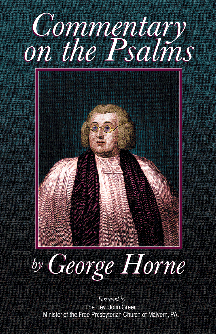
Commentary On The Psalms, George Horne, (reprinted by Old Paths Publications, $18.00, available from Reformation Heritage Books, Grand Rapids USA, www.heritagebooks.org)
Horne's Commentary on the Psalms is a devotional classic. Spurgeon wrote: "He is among the best of our English writers on this part of Scripture and certainly one of the most popular." It is a commentary intended to be of devotional value to every Christian not a learned and technical Horne believes that the Psalms are "an epitome of the Bible, adapted to the purposes of devotion". The Psalms contain that which is found elsewhere in Scripture in terms of doctrine, history, duty and prophecy but express them in the spirit of devotion. Horne's commentary explains the Psalms in "their literal or historical sense, as they relate to King David, and the people of Israel" but also spiritually in "their application to the Messiah, to the Church, and to individuals as members thereof." In his own refreshingly meditative approach, Horne finds Christ in most of the Psalms. Not limiting himself to those cited in the New Testament alone, he follows the principles underlying the apostolic interpretation of the Psalms. His approach follows from the best insights of Chrysostom and Augustine on this portion of Scripture.
Many in our own day do not recognise the sufficiency and entire relevance of the Psalms. Nothing could be better suited for the purposes of devotion. Horne notes that the "Psalms when thus applied, have advantages, which no fresh compositions, however finely executed, can possibly have...they point out the connexion between the old and new dispensations, thereby teaching us to admire and adore the wisdom of God displayed in both, and furnishing us while we read or sing them, an inexhaustible variety of the noblest matter that can engage the contemplations of man." This is a commentary designed to help the individual Christian to sing with the spirit and the understanding.
Horne (1730-1792), was a noted evangelical preacher who was Vice-Chancellor of Oxford University, Dean of Canterbury, and Bishop of Norwich. While his Anglican allegiance appears in various interpretations and expressions it is not over intrusive in the commentary which he published commentary in 1771. He comments on the pleasure that he had in meditating on the Book of Psalms in putting together the Commentary. "Happier hours than those which have been spent on these meditations on the Songs of Sion, he never expects to see in this world". It was written for those "who will exercise their faculties in discerning and contemplating the mysteries of the kingdom of heaven, and who are going on to perfection: to increase their faith, and inflame their charity: to delight them in prosperity, to comfort them in adversity, to edify them at all times". And truly if we use and apply the Psalms aright they will be blessed to us in this way.
Friday, January 26, 2007
how to approach the Lord's Supper
Meditations on the Lord's Supper
John Willison
Reformation Press, Stornoway, 1990, £1.80,
ISBN 1 872556 00 0 Publisher website
How do you prepare for the Lord's Supper? Hopefully you examine yourself in relation to appropriately challenging passages of Scripture and seek to acknowledge your condition in prayer. Sometimes, however, if we are honest, we find it difficult to maintain the right frame of spiritually-mindedness. These meditations stir the soul and provide an example of those spiritual breathings that we long for. There are nine meditations for before going to the table and eight for afterwards.
John Willison, best known as the author of the Mother's Catechism, ministered in Dundee almost 300 years ago. The language is not particularly dated, however, and the booklet is at a price that anyone could afford. Although they are short, only about a page and a half, they are especially full of the spiritual power of Scripture imagery as the following quotation shows.
O if our Lord Jesus Christ's love and glory would come flowing like a full sea, or the rushing of a mighty wind, and fill all the corners of His house and of His table, that great grace might be on all His people. O to hear a sound of going in the tops of the mulberry trees, a sign that God is gone forth before us to smite the hosts of our lusts, and triumph over our enemies. O that the kindly breathings and prosperous gales of God's Spirit would enliven all the drooping hearts, and fill all the empty sails of wind-bound communicants. O that the heavenly wind would blow from the right airth, that poor leaky vessels might come speed in their voyage, and sail straight forward to the shores of Emmanuel's land.
Click here for another excerpt.
Wednesday, January 24, 2007
worldliness
Worldliness, John P Thackway, Bible League Quarterly, Words of Truth booklets No. 4, 2004. ISBN 1741-5969. £1.25, 48pp. available from 46 Bulbridge Road, Wilton, Salisbury, Wiltshire, SP2 0LE Website of Bible League Trust
This is a vitally important and highly practical booklet. Mr Thackway laments that whereas historic evangelicalism asserted holy living together with doctrinal orthodoxy, modern evangelicals finds this concern embarassingly unfashionable. As Thackway expresses it: 'Fear of being judged “old fashioned” grips them much more than “the fear of the Lord” and how “to walk and to please God”. Engagement with the world in the name of relevance now means that any talk of separation from it is 'equated with seriously hindering meaningful witness'. The booklet begins by defining what the Bible means by the term 'the world' and proceeds to identify what it says about the Christian's pilgrim relationship to the world.
Application of these truths is followed through in terms of Scripture in the areas of speech, entertainments, the home and the church. Largely speaking principles are laid down as opposed to extensive practical application. While examples are used, perhaps it would not hurt to be even more specific. The benefit of the approach taken, however, is that it encourages the reader to think things through from a principled basis. We are too apt to see worldliness in things and practices rather than words and attitudes. The booklet concludes with sound principles for separation.
This is a vitally important and highly practical booklet. Mr Thackway laments that whereas historic evangelicalism asserted holy living together with doctrinal orthodoxy, modern evangelicals finds this concern embarassingly unfashionable. As Thackway expresses it: 'Fear of being judged “old fashioned” grips them much more than “the fear of the Lord” and how “to walk and to please God”. Engagement with the world in the name of relevance now means that any talk of separation from it is 'equated with seriously hindering meaningful witness'. The booklet begins by defining what the Bible means by the term 'the world' and proceeds to identify what it says about the Christian's pilgrim relationship to the world.
Application of these truths is followed through in terms of Scripture in the areas of speech, entertainments, the home and the church. Largely speaking principles are laid down as opposed to extensive practical application. While examples are used, perhaps it would not hurt to be even more specific. The benefit of the approach taken, however, is that it encourages the reader to think things through from a principled basis. We are too apt to see worldliness in things and practices rather than words and attitudes. The booklet concludes with sound principles for separation.
Tuesday, January 23, 2007
family worship
Returning to the Family Altar: A Commentary and Study Guide on the
Directory for Family Worship, Douglas W. Comin, £3.00 (including postage within UK),ISBN 0-9539241-2-2, 64 pp., booklet, James Begg Society, 2005(order from Donald Morgan, 7 Cearn Sheileidh, STORNOWAY, Isle of Lewis, HS1 2YW.
In a generation which as witness unprecedented attacks upon the family, so that Christian parents are struggling to raise a godly seed in the fear and admonition of the Lord, every help possible must surely be welcome. The wellbeing and future prospects of society and the Church have a connection with the vitality of family religion. It is no surprise therefore that the devil seeks to attack the very keystone of family religion, which is family worship. As the author of this booklet puts it: “ A big part of the solution to the erosion of Biblical family life lies in a return to the sincere and consistent practice of family worship.”
This booklet is a commentary and study guide on the somewhat neglected Directory for Family Worship which was approved by the Church of Scotland in 1647. It was not part of the documents produced by the Westminster Assembly which perhaps accounts for some of its neglect. It is no coincidence, however, that the Directory was approved by the Church of Scotland in the same year that they ratified the Westminster Confession of Faith. It expands in a practical way upon the Westminster Confession's requirement of the worship of God “in private families daily” and the relevant parts of the Larger Catechism Q129-130.
Describing family worship as “a necessary duty”, the Directory gives especially practical help and guidance as to why, when, how and by whom it is to be conducted. With fifteen sections in total, other matters are also addressed such as the elements of family worship, its benefits and how it is to be maintained on the Lord's Day. The language of duty is in no way extreme as the American Presbyterian John Girardeau indicates: “the awful imprecation, 'Pour out Thy fury upon the heathen that know Thee not, and upon the families that call not on Thy name' (Jer. 10:25), while it furnishes support to the view just expressed, also enforces, under sanctions of the most dreadful character, the duty of family worship...They who neglect this obligation are classed with heathen, and are threatened with the fury of the Almighty poured upon them like a storm.”
Comin makes brief comments on each section, highlighting the spiritual wisdom of the Directory and seeks to apply it. He makes the telling point that churches have devised all kinds of meetings for all kinds of age groups yet often never emphasise and enforce family worship. It might have been better to give a fuller defence of the biblical requirement of family worship and deal with potential objections in view of the sad fact that it is so widely neglected. Others have undertaken this before, however, for instance the Covenanter John Brown of Wamphray gave twenty four proofs that family worship is required by God together with answers to seven objections. . More could be said on the subject, and there are other longer treatments such as J W Alexander's Thoughts on Family Worship. This is, however, a very helpful and inexpensive booklet on the subject which will be of great benefit to those that have been engaged in family worship over many years as well as those that need encouragement to begin by God's grace.
Directory for Family Worship, Douglas W. Comin, £3.00 (including postage within UK),ISBN 0-9539241-2-2, 64 pp., booklet, James Begg Society, 2005(order from Donald Morgan, 7 Cearn Sheileidh, STORNOWAY, Isle of Lewis, HS1 2YW.
In a generation which as witness unprecedented attacks upon the family, so that Christian parents are struggling to raise a godly seed in the fear and admonition of the Lord, every help possible must surely be welcome. The wellbeing and future prospects of society and the Church have a connection with the vitality of family religion. It is no surprise therefore that the devil seeks to attack the very keystone of family religion, which is family worship. As the author of this booklet puts it: “ A big part of the solution to the erosion of Biblical family life lies in a return to the sincere and consistent practice of family worship.”
This booklet is a commentary and study guide on the somewhat neglected Directory for Family Worship which was approved by the Church of Scotland in 1647. It was not part of the documents produced by the Westminster Assembly which perhaps accounts for some of its neglect. It is no coincidence, however, that the Directory was approved by the Church of Scotland in the same year that they ratified the Westminster Confession of Faith. It expands in a practical way upon the Westminster Confession's requirement of the worship of God “in private families daily” and the relevant parts of the Larger Catechism Q129-130.
Describing family worship as “a necessary duty”, the Directory gives especially practical help and guidance as to why, when, how and by whom it is to be conducted. With fifteen sections in total, other matters are also addressed such as the elements of family worship, its benefits and how it is to be maintained on the Lord's Day. The language of duty is in no way extreme as the American Presbyterian John Girardeau indicates: “the awful imprecation, 'Pour out Thy fury upon the heathen that know Thee not, and upon the families that call not on Thy name' (Jer. 10:25), while it furnishes support to the view just expressed, also enforces, under sanctions of the most dreadful character, the duty of family worship...They who neglect this obligation are classed with heathen, and are threatened with the fury of the Almighty poured upon them like a storm.”
Comin makes brief comments on each section, highlighting the spiritual wisdom of the Directory and seeks to apply it. He makes the telling point that churches have devised all kinds of meetings for all kinds of age groups yet often never emphasise and enforce family worship. It might have been better to give a fuller defence of the biblical requirement of family worship and deal with potential objections in view of the sad fact that it is so widely neglected. Others have undertaken this before, however, for instance the Covenanter John Brown of Wamphray gave twenty four proofs that family worship is required by God together with answers to seven objections. . More could be said on the subject, and there are other longer treatments such as J W Alexander's Thoughts on Family Worship. This is, however, a very helpful and inexpensive booklet on the subject which will be of great benefit to those that have been engaged in family worship over many years as well as those that need encouragement to begin by God's grace.
Friday, January 12, 2007
The Lord's Day
O Day most calm, most bright,
The fruit of this, the next worlds bud,
Th’ indorsement of supreme delight,
Writ by a friend, and with his bloud;
The couch of time; cares balm and bay:
The week were dark, but for thy light:
Thy torch doth show the way.
The other dayes and thou
Make up one man; whose face thou art,
Knocking at heaven with thy brow:
The worky-daies are the back-part;
The burden of the week lies there,
Making the whole to stoup and bow,
Till thy release appeare.
Man had straight forward gone
To endlesse death: but thou dost pull
And turn us round to look on one,
Whom, if we were not very dull,
We could not choose but look on still;
Since there is no place so alone,
The which he doth not fill.
Sabbaths the pillars are,
On which heav’ns palace arched lies:
The other dayes fill up the spare
And hollow room with vanities.
They are the fruitfull beds and borders
In Gods rich garden: that is bare,
Which parts their ranks and orders.
The Sabbaths of mans life,
Thredded together on times string,
Make bracelets to adorn the wife
Of the eternall glorious King.
On Sabbath heavens gate stands ope:
Blessings are plentifull and rife,
More plentifull then hope.
This day my Saviour rose,
And did inclose this light for his:
That, as each beast his manger knows,
Man might not of his fodder misse.
Christ hath took in this piece of ground,
And made a garden there for those
Who want herbs for their wound.
The rest of our Creation
Our great Redeemer did remove
With the same shake, which at his passion
Did th’ earth and all things with it move.
As Sampson bore the doores away,
Christs hands, though nail’d, wrought our salvation,
And did unhinge that day.
The brightnesse of that day
We sullied by our foul offence:
Wherefore that robe we cast away,
Having a new at his expence,
Whose drops of bloud paid the full price,
That was requir’d to make us gay,
And fit for Paradise.
Thou art a day of mirth:
And where the Week-dayes trail on ground,
Thy flight is higher, as thy birth.
O let me take thee at the bound,
Leaping with thee from sev’n to sev’n,
Till that we both, being toss’d from earth,
Flie hand in hand to heav’n!
This is a poem written by the early 17th century Anglican minister and poet George Herbert(1593–1633). Herbert was a classical Calvinist episcopalian. Herbert is said to have described his book of poems as ‘a picture of the many spiritual Conflicts that have past betwixt God and my Soul, before I could subject mine to the will of Jesus my Master’.
The original title of the poem above is "Sunday" and I have taken the liberty of amending Sunday to Sabbath in the poem. I appreciate that this detracts from the way that Herbert plays on the word sun but I still think it best to avoid the connection with the pagan name and give the day a biblical name where possible . Sometimes Herbert is obscure in his poetry but this poem is very clear and bright with the spirit of rejoicing in the day of resurrection, which inaugurated in a special way the New Creation that Christ's redemption opened up for His people. Herbert shows here how the Christian sabbath replaces the Old Testament sabbath which was connected with the broken Covenant of Works. He makes Samson a type of Christ in his physical removing of the gates of Gaza (Judges 16:3).
The fruit of this, the next worlds bud,
Th’ indorsement of supreme delight,
Writ by a friend, and with his bloud;
The couch of time; cares balm and bay:
The week were dark, but for thy light:
Thy torch doth show the way.
The other dayes and thou
Make up one man; whose face thou art,
Knocking at heaven with thy brow:
The worky-daies are the back-part;
The burden of the week lies there,
Making the whole to stoup and bow,
Till thy release appeare.
Man had straight forward gone
To endlesse death: but thou dost pull
And turn us round to look on one,
Whom, if we were not very dull,
We could not choose but look on still;
Since there is no place so alone,
The which he doth not fill.
Sabbaths the pillars are,
On which heav’ns palace arched lies:
The other dayes fill up the spare
And hollow room with vanities.
They are the fruitfull beds and borders
In Gods rich garden: that is bare,
Which parts their ranks and orders.
The Sabbaths of mans life,
Thredded together on times string,
Make bracelets to adorn the wife
Of the eternall glorious King.
On Sabbath heavens gate stands ope:
Blessings are plentifull and rife,
More plentifull then hope.
This day my Saviour rose,
And did inclose this light for his:
That, as each beast his manger knows,
Man might not of his fodder misse.
Christ hath took in this piece of ground,
And made a garden there for those
Who want herbs for their wound.
The rest of our Creation
Our great Redeemer did remove
With the same shake, which at his passion
Did th’ earth and all things with it move.
As Sampson bore the doores away,
Christs hands, though nail’d, wrought our salvation,
And did unhinge that day.
The brightnesse of that day
We sullied by our foul offence:
Wherefore that robe we cast away,
Having a new at his expence,
Whose drops of bloud paid the full price,
That was requir’d to make us gay,
And fit for Paradise.
Thou art a day of mirth:
And where the Week-dayes trail on ground,
Thy flight is higher, as thy birth.
O let me take thee at the bound,
Leaping with thee from sev’n to sev’n,
Till that we both, being toss’d from earth,
Flie hand in hand to heav’n!
This is a poem written by the early 17th century Anglican minister and poet George Herbert(1593–1633). Herbert was a classical Calvinist episcopalian. Herbert is said to have described his book of poems as ‘a picture of the many spiritual Conflicts that have past betwixt God and my Soul, before I could subject mine to the will of Jesus my Master’.
The original title of the poem above is "Sunday" and I have taken the liberty of amending Sunday to Sabbath in the poem. I appreciate that this detracts from the way that Herbert plays on the word sun but I still think it best to avoid the connection with the pagan name and give the day a biblical name where possible . Sometimes Herbert is obscure in his poetry but this poem is very clear and bright with the spirit of rejoicing in the day of resurrection, which inaugurated in a special way the New Creation that Christ's redemption opened up for His people. Herbert shows here how the Christian sabbath replaces the Old Testament sabbath which was connected with the broken Covenant of Works. He makes Samson a type of Christ in his physical removing of the gates of Gaza (Judges 16:3).
Monday, December 18, 2006
The Bible's testimony against Christmass
At this time of year many churches are busy with carol services, nativity plays, Christmass day services and the like. Very few stop to ask why they do these things. Does God in His Word require these things? If he does not, how do we know whether or not they are acceptable?
The origins of the festival of Christmass in Babylonian paganism in terms of its date and its customs are quite obvious (see Alexander Hislop's study http://philologos.org/__eb-ttb/sect31.htm). The Encyclopedia Britannica makes this clear "In the south of Europe, in Egypt and Persia, the sun gods were worshipped with elaborate ceremonies at the season of the winter solstice, as a fitting time to pay tribute to the benign god of plenty, while in Rome the Saturnalia reigned for a week. In northern lands mid-December was a critical time, for the days became shorter and shorter and the sun was weak and far away. Thus these ancient peoples held feast at the same period that Christmas is now observed." (1961 ed.), 5:643.
Christmass was not celebrated by the apostles or the early church. It was not until the middle of the 4th century, that many churches in the Latin west celebrated Christmass and during the 5th century, Christmass became an official Roman Catholic holy day. The Roman Catholics of that time believed in bringing pagans into the Church by "Christianizing" their pagan religious customs and practices. They simply transferred the symbols of the worship of pagan gods and gave them a Christian significance. Although a successful "missionary strategy" outwardly it was in direct rebellion against God who commands: "Learn not the way of the heathen, and be not dismayed at the signs of heaven; for the heathen are dismayed at them. For the customs of the people are vain" (Jer. 10:2-3). "Thou shalt not do so unto the LORD thy God: for every abomination to the LORD, which he hateth, have they done unto their gods" (Deut. 12:31).
Even if Christmas had no pagan associations of the past or with Roman Catholicism we ought to reject it because the Bible does not teach the observance of Christmas. The Scriptures make it clear exactly how we are to worship God, including special days that we should observe, “what thing soever I command you, observe to do it; thou shalt not add thereto, nor diminish from it”. (Deut. 12:32 cf Lev. 10:1-3). For other Scriptures maintaining this principle see: Genesis 4:3-5; 2 Samuel 6:3-7 and 1 Chronicles 15:13-15, cp. Numbers 4:6 and 15. The second commandment teaches us that we are only to worship God in the way that He requires. Answer 109 of the Westminster Larger Catechism explains that the commandment forbids "any other wise approving, any religious worship not instituted by God himself." The teaching of the Lord Jesus Christ reinforces this: - “In vain do they worship me, teaching for doctrines the commandments of men. For laying aside the commandment of God, ye hold the tradition of men” (Mark 7:7-8). The Apostle Paul likewise warns against “will worship” (Col. 2:22-23), worship that originates in the wishes of man wants to do rather than the commandment of God.
The Lord Jesus Christ commands the Church to teach men to observe all things that He had commanded (Matt. 28:20). They had no authority to add or take from what He has commanded. This scriptural teaching that whatever Scripture does not command is to be excluded from worship is known as the "regulative principle”. We exclude uninspired hymns, musical instruments and also holy days appointed by man. It is of course appropriate to respond to the providence of God with days of thanksgiving or prayer and humiliation as the Westminster Directory For Public Worship explains: “Nevertheless, it is lawful and necessary, upon special emergent occasions, to separate a day or days for public fasting or thanksgiving, as the several eminent and extraordinary dispensations of God’s providence shall administer cause and opportunity to his people” (Westminster Directory For Public Worship), it goes on to say, however, that, “festival days, vulgarly called ‘Holy-days’, having no warrant in the Word of God, are not to be continued”.
While events and situations in providence vary across the years and century and across nations, the facts of the redemption that has been accomplished do not. The death and resurrection of Christ are commemorated through the Lord's Supper and the Lord's Day. No other days have been appointed and therefore they are not needed. To appoint other days is to reject the wisdom of God, believing that His appointment was insufficient.
King Jeroboam of Israel violated the regulative principle by ordaining a holy day “which he had devised of his own heart” (1 Kings 12:32-33). It was similar to the one that God had ordained and it was in worship of the same God but it was not on the day that God had commanded but on a day of Jeroboam’s devising.
v32 And Jeroboam ordained a feast in the eighth month, on the fifteenth day of
the month, like unto the feast that is in Judah, and he offered upon the altar. So did he in Bethel, sacrificing unto the calves that he had made: and he placed in Bethel the priests of the high places which he had made.
v33 So he offered upon the altar which he had made in Bethel the fifteenth day
of the eighth month, even in the month which he had devised of his own heart;
and ordained a feast unto the children of Israel: and he offered upon the altar,
and burnt incense.
Some may appeal to the feast of Purim in the book of Esther. The feast of Purim was not, however, worship as Esther 9:18, 26, and 28 makes clear. It was a day of gladness, but not an institution of worship like Jeroboam’s sacrifices. The Westminster Confession speaks of “solemn fastings, and thanksgivings upon special occasions, which are, in their several times and seasons, to be used in an holy and religious manner.” (WCF Chapter 21, Section 5). It uses Esther 9:20-22 as a proof text for “and thanksgivings upon special occasions”, not for the ordinances of worship which it deals with before this.
For an excellent study of this matter see The Regulative Principle of Worship and Christmas by Brian Schwertley
http://reformedonline.com/view/reformedonline/xmas.htm
The origins of the festival of Christmass in Babylonian paganism in terms of its date and its customs are quite obvious (see Alexander Hislop's study http://philologos.org/__eb-ttb/sect31.htm). The Encyclopedia Britannica makes this clear "In the south of Europe, in Egypt and Persia, the sun gods were worshipped with elaborate ceremonies at the season of the winter solstice, as a fitting time to pay tribute to the benign god of plenty, while in Rome the Saturnalia reigned for a week. In northern lands mid-December was a critical time, for the days became shorter and shorter and the sun was weak and far away. Thus these ancient peoples held feast at the same period that Christmas is now observed." (1961 ed.), 5:643.
Christmass was not celebrated by the apostles or the early church. It was not until the middle of the 4th century, that many churches in the Latin west celebrated Christmass and during the 5th century, Christmass became an official Roman Catholic holy day. The Roman Catholics of that time believed in bringing pagans into the Church by "Christianizing" their pagan religious customs and practices. They simply transferred the symbols of the worship of pagan gods and gave them a Christian significance. Although a successful "missionary strategy" outwardly it was in direct rebellion against God who commands: "Learn not the way of the heathen, and be not dismayed at the signs of heaven; for the heathen are dismayed at them. For the customs of the people are vain" (Jer. 10:2-3). "Thou shalt not do so unto the LORD thy God: for every abomination to the LORD, which he hateth, have they done unto their gods" (Deut. 12:31).
Even if Christmas had no pagan associations of the past or with Roman Catholicism we ought to reject it because the Bible does not teach the observance of Christmas. The Scriptures make it clear exactly how we are to worship God, including special days that we should observe, “what thing soever I command you, observe to do it; thou shalt not add thereto, nor diminish from it”. (Deut. 12:32 cf Lev. 10:1-3). For other Scriptures maintaining this principle see: Genesis 4:3-5; 2 Samuel 6:3-7 and 1 Chronicles 15:13-15, cp. Numbers 4:6 and 15. The second commandment teaches us that we are only to worship God in the way that He requires. Answer 109 of the Westminster Larger Catechism explains that the commandment forbids "any other wise approving, any religious worship not instituted by God himself." The teaching of the Lord Jesus Christ reinforces this: - “In vain do they worship me, teaching for doctrines the commandments of men. For laying aside the commandment of God, ye hold the tradition of men” (Mark 7:7-8). The Apostle Paul likewise warns against “will worship” (Col. 2:22-23), worship that originates in the wishes of man wants to do rather than the commandment of God.
The Lord Jesus Christ commands the Church to teach men to observe all things that He had commanded (Matt. 28:20). They had no authority to add or take from what He has commanded. This scriptural teaching that whatever Scripture does not command is to be excluded from worship is known as the "regulative principle”. We exclude uninspired hymns, musical instruments and also holy days appointed by man. It is of course appropriate to respond to the providence of God with days of thanksgiving or prayer and humiliation as the Westminster Directory For Public Worship explains: “Nevertheless, it is lawful and necessary, upon special emergent occasions, to separate a day or days for public fasting or thanksgiving, as the several eminent and extraordinary dispensations of God’s providence shall administer cause and opportunity to his people” (Westminster Directory For Public Worship), it goes on to say, however, that, “festival days, vulgarly called ‘Holy-days’, having no warrant in the Word of God, are not to be continued”.
While events and situations in providence vary across the years and century and across nations, the facts of the redemption that has been accomplished do not. The death and resurrection of Christ are commemorated through the Lord's Supper and the Lord's Day. No other days have been appointed and therefore they are not needed. To appoint other days is to reject the wisdom of God, believing that His appointment was insufficient.
King Jeroboam of Israel violated the regulative principle by ordaining a holy day “which he had devised of his own heart” (1 Kings 12:32-33). It was similar to the one that God had ordained and it was in worship of the same God but it was not on the day that God had commanded but on a day of Jeroboam’s devising.
v32 And Jeroboam ordained a feast in the eighth month, on the fifteenth day of
the month, like unto the feast that is in Judah, and he offered upon the altar. So did he in Bethel, sacrificing unto the calves that he had made: and he placed in Bethel the priests of the high places which he had made.
v33 So he offered upon the altar which he had made in Bethel the fifteenth day
of the eighth month, even in the month which he had devised of his own heart;
and ordained a feast unto the children of Israel: and he offered upon the altar,
and burnt incense.
Some may appeal to the feast of Purim in the book of Esther. The feast of Purim was not, however, worship as Esther 9:18, 26, and 28 makes clear. It was a day of gladness, but not an institution of worship like Jeroboam’s sacrifices. The Westminster Confession speaks of “solemn fastings, and thanksgivings upon special occasions, which are, in their several times and seasons, to be used in an holy and religious manner.” (WCF Chapter 21, Section 5). It uses Esther 9:20-22 as a proof text for “and thanksgivings upon special occasions”, not for the ordinances of worship which it deals with before this.
For an excellent study of this matter see The Regulative Principle of Worship and Christmas by Brian Schwertley
http://reformedonline.com/view/reformedonline/xmas.htm
Saturday, December 02, 2006
The Third Day
On which day did the Lord Jesus Christ rise again from the dead?
The Lord Jesus Christ rose again from the dead on the third day (1 Cor 15:4; Luke 24: 7, 21, 26; Acts 10:40).
Why does Scripture speak of resurrection after three days as well as on the third day?
Scripture speaks of the resurrection as upon the third day most frequently which assumes only 1 day and 2 nights intervening between the day of His death and His resurrection. Scripture uses the same expression in other instances e.g. Luke 2:46 “after three days” which means the third day. According to the divine commandment circumcision was to be on the eighth day after birth which would allow for only six whole days intervening, but Scripture says that Christ was circumcised after eight days – it is plain however that both expressions mean the same thing (Luke 2:21). Three days and the third day are therefore to be regarded as equivalent.
How do the Scriptures prophesy of Christ's rising from the dead on the third day?
By types, prophecies and the words of Christ Himself.
Who were the types of Christ's rising from the dead on the third day?
Jonah, who was in belly of the fish for 3 days and nights (Matt. 12:40). Even so Christ was taken out of the jaws of death and restored to the land of the living. Isaac was to Abraham dead for 3 days while he prepared to sacrifice him and he was restored to life in a figure (Gen. 22:4; Heb. 11:19).
What else was a type of Christ's resurrection on the third day?
1.Moses receiving the law (Ex. 19:11, 15-16, 20) when it was said that “the LORD will come down in the sight of all the people upon mount Sinai”and that the LORD called Moses up to the top of the mount.
2.Under the ceremonial law purification from the pollution of death was effected on the third day (Num. 19:12, 19; 31:19).
3.The peace-offerings had to be eaten before their corruption the third day (Lev. 7:15-18; 19:6-8). Thus Christ did not see corruption in the grave (Ps. 16:10).
4.The first-fruits were offered the day after the sabbath of the Passover (Lev. 23:10-12), which was the exact day on which Christ arose. One sheaf was selected as the best and waved before the LORD in the name of all the rest. Thus Christ is the firstfruits “For as in Adam all die, even so in Christ shall all be made alive. But every man in his own order: Christ the firstfruits; afterward they that are Christ’s at his coming.” (1 Cor. 15:20 & 23). It was on the third day of creation that the earth brought forth her fruit (Gen. 1:11-12), these were the very first firstfruits.
Where is Christ's resurrection on the third day prophesied?
Hosea prophesies of Christ's resurrection “After two days will he revive us: in the third day he will raise us up, and we shall live in his sight. Then shall we know, if we follow on to know the LORD: his going forth is prepared as the morning; and he shall come unto us as the rain, as the latter and former rain unto the earth.” (Hos. 6:2-3). David prophesies of it in Psalm 16:10 in making it clear that the Messiah would not see corruption in the grave (Acts 2:27). The Lord Jesus Christ refers to these in Luke 24:46.
Where does Christ predict His rising again from the dead on the third day?
He speaks most frequently of rising on the third day (Matt. 16:21; Matt. 17:23; Matt. 20:19; Mark 9:31; Mark 10:34; Luke 9:22; Luke 18:33; Luke 24:7) and on two occasions of rising after three days (Mark 8:31; John 2:19).
Who, besides the disciples, were witnesses that Christ rose on the third day?
The soldiers who guarded the tomb until the third day (Matt. 27:64).
Why did Christ rise on the third day?
If He arose suddenly and immediately it would be open to question by doubters that He may merely have swooned and revived without dying completely. It was necessary therefore to assure all that He did die and then arose from the dead. Lazarus arose from the dead after 4 days by which time his body had entered into corruption as expected (Jn. 11:39). Christ rose on the third day without His body entering into corruption because it was preserved by His divine nature to which it was still united though parted from His human soul.
How does Christ's resurrection on the third day relate to the sabbath?
Christ rested in the grave on the Old Testament sabbath but rose again on the first day of the week to sanctify the Christian sabbath, thus preserving the commandment but changing the day. Christ rested from His works of laying the foundation of the New Creation in and by His resurrection. The Christian sabbath remains then, as a pledge of our future full entering into His rest (Heb 4:9-10).
Why was the day changed?
For His own honour and service and to mark the completion of redemption, Christ, who is the Lord of the Sabbath, has appointed this day above that of the Creation sabbath - which was connected with the Covenant of Works. The rest of Creation was spoiled by the Fall, but the rest of Redemption can never be marred. Redemption is therefore a far greater and more excellent work than even that of Creation. The yearly calendar was changed after the Exodus (Ex. 12:2 and Deut 5:15), yet the redemption wrought by Christ was greater therefore a change in the day is equally appropriate.
How can the change of the Sabbath from the last to the first day of the week be proved from Scripture?
(See Fisher's Catechism).
1.the Lord Jesus Christ after His resurrection, met ordinarily with His disciples on the first day of the week;
2.after the ascension, He poured out His Spirit in an extraordinary manner on that day;
3.the apostles honoured this day above all others for the public worship in their example
4. by command of the apostles this day was to be kept for Sabbath service
5.this day is given the special title of the Lord's Day
The Lord Jesus Christ rose again from the dead on the third day (1 Cor 15:4; Luke 24: 7, 21, 26; Acts 10:40).
Why does Scripture speak of resurrection after three days as well as on the third day?
Scripture speaks of the resurrection as upon the third day most frequently which assumes only 1 day and 2 nights intervening between the day of His death and His resurrection. Scripture uses the same expression in other instances e.g. Luke 2:46 “after three days” which means the third day. According to the divine commandment circumcision was to be on the eighth day after birth which would allow for only six whole days intervening, but Scripture says that Christ was circumcised after eight days – it is plain however that both expressions mean the same thing (Luke 2:21). Three days and the third day are therefore to be regarded as equivalent.
How do the Scriptures prophesy of Christ's rising from the dead on the third day?
By types, prophecies and the words of Christ Himself.
Who were the types of Christ's rising from the dead on the third day?
Jonah, who was in belly of the fish for 3 days and nights (Matt. 12:40). Even so Christ was taken out of the jaws of death and restored to the land of the living. Isaac was to Abraham dead for 3 days while he prepared to sacrifice him and he was restored to life in a figure (Gen. 22:4; Heb. 11:19).
What else was a type of Christ's resurrection on the third day?
1.Moses receiving the law (Ex. 19:11, 15-16, 20) when it was said that “the LORD will come down in the sight of all the people upon mount Sinai”and that the LORD called Moses up to the top of the mount.
2.Under the ceremonial law purification from the pollution of death was effected on the third day (Num. 19:12, 19; 31:19).
3.The peace-offerings had to be eaten before their corruption the third day (Lev. 7:15-18; 19:6-8). Thus Christ did not see corruption in the grave (Ps. 16:10).
4.The first-fruits were offered the day after the sabbath of the Passover (Lev. 23:10-12), which was the exact day on which Christ arose. One sheaf was selected as the best and waved before the LORD in the name of all the rest. Thus Christ is the firstfruits “For as in Adam all die, even so in Christ shall all be made alive. But every man in his own order: Christ the firstfruits; afterward they that are Christ’s at his coming.” (1 Cor. 15:20 & 23). It was on the third day of creation that the earth brought forth her fruit (Gen. 1:11-12), these were the very first firstfruits.
Where is Christ's resurrection on the third day prophesied?
Hosea prophesies of Christ's resurrection “After two days will he revive us: in the third day he will raise us up, and we shall live in his sight. Then shall we know, if we follow on to know the LORD: his going forth is prepared as the morning; and he shall come unto us as the rain, as the latter and former rain unto the earth.” (Hos. 6:2-3). David prophesies of it in Psalm 16:10 in making it clear that the Messiah would not see corruption in the grave (Acts 2:27). The Lord Jesus Christ refers to these in Luke 24:46.
Where does Christ predict His rising again from the dead on the third day?
He speaks most frequently of rising on the third day (Matt. 16:21; Matt. 17:23; Matt. 20:19; Mark 9:31; Mark 10:34; Luke 9:22; Luke 18:33; Luke 24:7) and on two occasions of rising after three days (Mark 8:31; John 2:19).
Who, besides the disciples, were witnesses that Christ rose on the third day?
The soldiers who guarded the tomb until the third day (Matt. 27:64).
Why did Christ rise on the third day?
If He arose suddenly and immediately it would be open to question by doubters that He may merely have swooned and revived without dying completely. It was necessary therefore to assure all that He did die and then arose from the dead. Lazarus arose from the dead after 4 days by which time his body had entered into corruption as expected (Jn. 11:39). Christ rose on the third day without His body entering into corruption because it was preserved by His divine nature to which it was still united though parted from His human soul.
How does Christ's resurrection on the third day relate to the sabbath?
Christ rested in the grave on the Old Testament sabbath but rose again on the first day of the week to sanctify the Christian sabbath, thus preserving the commandment but changing the day. Christ rested from His works of laying the foundation of the New Creation in and by His resurrection. The Christian sabbath remains then, as a pledge of our future full entering into His rest (Heb 4:9-10).
Why was the day changed?
For His own honour and service and to mark the completion of redemption, Christ, who is the Lord of the Sabbath, has appointed this day above that of the Creation sabbath - which was connected with the Covenant of Works. The rest of Creation was spoiled by the Fall, but the rest of Redemption can never be marred. Redemption is therefore a far greater and more excellent work than even that of Creation. The yearly calendar was changed after the Exodus (Ex. 12:2 and Deut 5:15), yet the redemption wrought by Christ was greater therefore a change in the day is equally appropriate.
How can the change of the Sabbath from the last to the first day of the week be proved from Scripture?
(See Fisher's Catechism).
1.the Lord Jesus Christ after His resurrection, met ordinarily with His disciples on the first day of the week;
2.after the ascension, He poured out His Spirit in an extraordinary manner on that day;
3.the apostles honoured this day above all others for the public worship in their example
4. by command of the apostles this day was to be kept for Sabbath service
5.this day is given the special title of the Lord's Day
Friday, November 10, 2006
relationship not a religion?
Among many evangelicals the word "religion" is quite literally an anathema. The slogan that real Christianity is a "Relationship not a Religion" is everywhere. For many it is the key content of evangelism, "What God wants is for you to respond to His invitation to join Him in a relationship", they say. For others it is a crucial principle of church growth theory. Potential church members are supposed to be looking for fulfillment, meaning, balance, relationships, mentors, a sense of community, and, first and foremost, "Relationship, not Religion."
As with all slogans there is an element of truth distorted by generalisation. Slogans were never meant to be definitions but simply an advertising technique. Of course it's possible to make religion an end in itself and to be very religious but miss salvation altogether. Those that go about to establish their own righteousness through religion but have not submitted to the righteousness of God which is by faith. The problem is not so much with religion itself but with the way in which people use it. If we are to despise everything God-given that man in his depravity can abuse we will be left with nothing.
The definition that "Religion is the human effort to reach God through rules and rituals" is a bit off the mark. What they have defined is salvation by works, some religions are based upon that but not all have to be. Of course we need to be apprehended of Christ in salvation and to come into union and communion with Him by faith. But there is also the vital matter of obedience as an evidence of that union and communion. "If ye love me, keep my commandments" (Jn 14:15). There is relationship and religion but they are not being opposed. "And hereby we do know that we know him, if we keep his commandments. He that saith, I know him, and keepeth not his commandments, is a liar, and the truth is not in him. But whoso keepeth his word, in him verily is the love of God perfected: hereby know we that we are in him." (1 John 2:3-5). The claim to a relationship without any fruit of holiness and obedience is just as empty as religion that has no true bond with the Saviour.
The problem is that the Bible uses the word religion, and it uses it in a positive way. What about the pure and undefiled religion of James 1:27? Keeping oneself unspotted from the world - isn't there rules and regulations in that? Religion involves a distinctive set of beliefs as well as distinctive life and worship. It isn't just a claim to "know Jesus" without making it clear who the Lord Jesus Christ is, how He is to be worshipped and served. The word relationship can mean lots of things. There are many kinds of relationships. It seems to allow for the cherished idea of "unconditional love no matter what we do". Forgiveness is a precious doctrine and reality but so is sanctification.
The root problem is with popular evangelicalism rather than with religion itself. It has turned conversion into mental assent, worship into a carnal feel-good factor, and made obeying Christ as Lord into an optional extra. They have attracted people that come to church for the music and the friends, the relationships but yet they are not really converted. Is it any wonder that they are finding that there is very little reality in this at all?
The word religion comes from a Latin word which means "to be bound back". We ought to be bound back to God by covenant. We must have been drawn by His lovingkindness (Jer. 31:3), with the cords of a man (Hosea 11:4) and held by covenant grace. When we are baptised we are engaged to be His, there are covenant obligations sealed in that ordinance, that we should love and serve God all the days of our lives. The name of Christ is upon those that have been baptised, in the most solemn of vows. As the Puritan Christopher Nesse puts it: "The covenant of your God is upon you, the bond of the covenant should bind you fast (as the word 'religion' signifies) unto God and godliness. O break not those bands, nor cast away those cords from you, for then you are sure to be broken as a potter's vessel that cannot be patched up again...[as] he that breaks His covenant with the great God who will assuredly avenge the quarrel of His covenant. O keep yourselves in the love of God and continue in Christ's love, which constrains you to obedience and holiness." O to know that sweet constraint, the constraint of true religion 2 COR 5:14 "the love of Christ constraineth us". A constraint that enables us to put sin to death and to keep ourselves from the world. "I will run the way of thy commandments, when thou shalt enlarge my heart" (Psalm 119:32).
As with all slogans there is an element of truth distorted by generalisation. Slogans were never meant to be definitions but simply an advertising technique. Of course it's possible to make religion an end in itself and to be very religious but miss salvation altogether. Those that go about to establish their own righteousness through religion but have not submitted to the righteousness of God which is by faith. The problem is not so much with religion itself but with the way in which people use it. If we are to despise everything God-given that man in his depravity can abuse we will be left with nothing.
The definition that "Religion is the human effort to reach God through rules and rituals" is a bit off the mark. What they have defined is salvation by works, some religions are based upon that but not all have to be. Of course we need to be apprehended of Christ in salvation and to come into union and communion with Him by faith. But there is also the vital matter of obedience as an evidence of that union and communion. "If ye love me, keep my commandments" (Jn 14:15). There is relationship and religion but they are not being opposed. "And hereby we do know that we know him, if we keep his commandments. He that saith, I know him, and keepeth not his commandments, is a liar, and the truth is not in him. But whoso keepeth his word, in him verily is the love of God perfected: hereby know we that we are in him." (1 John 2:3-5). The claim to a relationship without any fruit of holiness and obedience is just as empty as religion that has no true bond with the Saviour.
The problem is that the Bible uses the word religion, and it uses it in a positive way. What about the pure and undefiled religion of James 1:27? Keeping oneself unspotted from the world - isn't there rules and regulations in that? Religion involves a distinctive set of beliefs as well as distinctive life and worship. It isn't just a claim to "know Jesus" without making it clear who the Lord Jesus Christ is, how He is to be worshipped and served. The word relationship can mean lots of things. There are many kinds of relationships. It seems to allow for the cherished idea of "unconditional love no matter what we do". Forgiveness is a precious doctrine and reality but so is sanctification.
The root problem is with popular evangelicalism rather than with religion itself. It has turned conversion into mental assent, worship into a carnal feel-good factor, and made obeying Christ as Lord into an optional extra. They have attracted people that come to church for the music and the friends, the relationships but yet they are not really converted. Is it any wonder that they are finding that there is very little reality in this at all?
The word religion comes from a Latin word which means "to be bound back". We ought to be bound back to God by covenant. We must have been drawn by His lovingkindness (Jer. 31:3), with the cords of a man (Hosea 11:4) and held by covenant grace. When we are baptised we are engaged to be His, there are covenant obligations sealed in that ordinance, that we should love and serve God all the days of our lives. The name of Christ is upon those that have been baptised, in the most solemn of vows. As the Puritan Christopher Nesse puts it: "The covenant of your God is upon you, the bond of the covenant should bind you fast (as the word 'religion' signifies) unto God and godliness. O break not those bands, nor cast away those cords from you, for then you are sure to be broken as a potter's vessel that cannot be patched up again...[as] he that breaks His covenant with the great God who will assuredly avenge the quarrel of His covenant. O keep yourselves in the love of God and continue in Christ's love, which constrains you to obedience and holiness." O to know that sweet constraint, the constraint of true religion 2 COR 5:14 "the love of Christ constraineth us". A constraint that enables us to put sin to death and to keep ourselves from the world. "I will run the way of thy commandments, when thou shalt enlarge my heart" (Psalm 119:32).
Monday, November 06, 2006
what 5 November means for Scotland
Scots have a reason to remember the 5 November 1688, the beginning of the glorious revolution, when William III landed at Torbay at the head of 15,000 men in order to save Protestantism. Eventually he displaced the Romanist Stuart king James II from the throne. James was determined upon restoring Roman Catholicism in Britain. In the spring of 1688 he ordered his Declaration of Indulgence, suspending the penal laws against Catholics, to be read from every Anglican pulpit in the land. The Church of England and its staunchest supporters, the peers and gentry, were outraged. The birth of an heir, James Francis Stuart (later known as the Old Pretender) increased public concern about a Roman Catholic dynasty; fears confirmed when the baby was baptised into the Romanist faith. Open favour to the Roman Catholic cause was in fact manifest when the official commemoration of the Gunpowder Plot in Edinburgh (Fountainhalls Notices, 5 November 1685) was discontinued; no sermon was preached and no salute of cannon from the castle ramparts took place. The object apparently was not to upset any papists.
In Scotland James had waged war upon the Covenanters and they were hunted across the mountains and moors. According to Daniel Defoe's report to the English Parliament during the Killing Times over 18,000 men, women and children were killed or suffered severe hardship in the furnace of persecution, he reckoned that “above 18,000 people have suffered the utmost extremities their enemies could inflict”. It was a war still continuing in 1688. As Alexander Shields, the author of A Hind Let Loose, a defence of the Covenanters first printed in Holland in 1687, says: 'The more they (i.e. the authorities) insisted in this inquisition, the more did the number of witnesses multiply, with a growing increase of undauntedness, so that the then shed blood of the martyrs became the seed of the Church; and as, by hearing and seeing them so signally countenanced of the Lord, many were reclaimed from their courses of compliance, so others were daily more and more confirmed in the ways of the Lord, and so strengthened by His grace that they chose rather to endure all torture and embrace death in its most terrible aspect, than to give the tyrant and his accomplices any acknowledgement, yea not so much as to say, God save the King, which was offered as the price of their life'.
James Renwick, Scottish Covenanter, was born on February 15, 1662 and was executed on February 17, 1688. He was the last Covenanter minister to be martyred for the faith during the "Killing Times." In June 1688, in Sorn, Scotland, the Royalists interrogated a sixteen-year-old boy called George Wood. hoping for leads. When he proved unable or unwilling to tell them anything they shot him. Wood was officially the last and youngest victim of the Killing Times. The most notorious and vicious of the persecutors was John Graham, Earl of Claverhouse, Viscount of Dundee known as "Bloody Clavers" because of his brutality. In 1688 when William of Orange invaded, James II made Graham second-in-command of the Scottish army and named him Viscount Dundee. Less than a year later he was mortally wounded at the Battle of Killikrankie.
On 5 November 1688 the Lord turned again the captivity of Zion and they were as men that dreamed. It was a revolution which ended the Stuart tyranny and extinguished the fires of persecution. As John Willison of Dundee, the evangelical minister of the 18th Century put it:
"BUT behold how the mercy of God appeared for us, after innumerable provocations, and when all ranks had made fearful defections from God and their engagements to him. And after this church had lien under oppression for near twenty eight years, and Popery was far advanced, and the civil power in the hands of Papists, and there was but little wanting to accomplish the ruin both of our civil and religious liberties; the mighty Lord stept in, and in made a wonderful appearance for us, by sending over the Prince of Orange (afterwards proclaimed king) in November 1688, to rescue us from Popery and tyranny, and that at a time after several attempts for our relief had misgiven, and the hearts of all true Protestants were beginning to faint within them, and the Popish faction had a numerous army to support them. Yet now, when God's time was come, our deliverance was brought about with great facility, through the wonderful working and concurrence of Divine Providence: So that it was not our own arm, but the Lord's right hand, that wrought this salvation for us; a salvation never to be forgotten by the friends of religion and liberty.—In particular, the church of Scotland ought always to commemorate the glorious deliverance and revolution in 1688, whereby she was raised out of the dust, and to be thankful to the great God the Author thereof, and to have a savoury remembrance of the name of king William the happy instrument of it under God."
In Scotland James had waged war upon the Covenanters and they were hunted across the mountains and moors. According to Daniel Defoe's report to the English Parliament during the Killing Times over 18,000 men, women and children were killed or suffered severe hardship in the furnace of persecution, he reckoned that “above 18,000 people have suffered the utmost extremities their enemies could inflict”. It was a war still continuing in 1688. As Alexander Shields, the author of A Hind Let Loose, a defence of the Covenanters first printed in Holland in 1687, says: 'The more they (i.e. the authorities) insisted in this inquisition, the more did the number of witnesses multiply, with a growing increase of undauntedness, so that the then shed blood of the martyrs became the seed of the Church; and as, by hearing and seeing them so signally countenanced of the Lord, many were reclaimed from their courses of compliance, so others were daily more and more confirmed in the ways of the Lord, and so strengthened by His grace that they chose rather to endure all torture and embrace death in its most terrible aspect, than to give the tyrant and his accomplices any acknowledgement, yea not so much as to say, God save the King, which was offered as the price of their life'.
James Renwick, Scottish Covenanter, was born on February 15, 1662 and was executed on February 17, 1688. He was the last Covenanter minister to be martyred for the faith during the "Killing Times." In June 1688, in Sorn, Scotland, the Royalists interrogated a sixteen-year-old boy called George Wood. hoping for leads. When he proved unable or unwilling to tell them anything they shot him. Wood was officially the last and youngest victim of the Killing Times. The most notorious and vicious of the persecutors was John Graham, Earl of Claverhouse, Viscount of Dundee known as "Bloody Clavers" because of his brutality. In 1688 when William of Orange invaded, James II made Graham second-in-command of the Scottish army and named him Viscount Dundee. Less than a year later he was mortally wounded at the Battle of Killikrankie.
On 5 November 1688 the Lord turned again the captivity of Zion and they were as men that dreamed. It was a revolution which ended the Stuart tyranny and extinguished the fires of persecution. As John Willison of Dundee, the evangelical minister of the 18th Century put it:
"BUT behold how the mercy of God appeared for us, after innumerable provocations, and when all ranks had made fearful defections from God and their engagements to him. And after this church had lien under oppression for near twenty eight years, and Popery was far advanced, and the civil power in the hands of Papists, and there was but little wanting to accomplish the ruin both of our civil and religious liberties; the mighty Lord stept in, and in made a wonderful appearance for us, by sending over the Prince of Orange (afterwards proclaimed king) in November 1688, to rescue us from Popery and tyranny, and that at a time after several attempts for our relief had misgiven, and the hearts of all true Protestants were beginning to faint within them, and the Popish faction had a numerous army to support them. Yet now, when God's time was come, our deliverance was brought about with great facility, through the wonderful working and concurrence of Divine Providence: So that it was not our own arm, but the Lord's right hand, that wrought this salvation for us; a salvation never to be forgotten by the friends of religion and liberty.—In particular, the church of Scotland ought always to commemorate the glorious deliverance and revolution in 1688, whereby she was raised out of the dust, and to be thankful to the great God the Author thereof, and to have a savoury remembrance of the name of king William the happy instrument of it under God."
Saturday, November 04, 2006
sins of omission and the 10 commandments
Does God require a perfect conformity to His law?
Yes; there is a curse pronounced against every one that continues not in all
things written in the book of the law to do them, Gal. 3:10. Every deviation
from God's holy law, in terms of omitting what it commands is sin, Isaiah
43:22.
What are the sins of omission relating to the first commandment?
They are the omission or neglect of anything due to God, required in this
commandment;[Isa. 43:22-24]:
not knowing and acknowledging of God to be the only true God, and our God
and also not having and avouching him for God, and our God;[1]
not worshipping and glorifying Him accordingly,[2]
not thinking on Him [3]
not meditating on Him,[4]
not remembering Him,[5]
not highly esteeming Him,[6]
not honouring Him,[7]
not adoring Him,[8]
not choosing Him,[9]
not loving Him,[10]
not desiring Him,[11]
not fearing Him;[12]
not believing Him[13] trusting,[14] hoping,[15] delighting,[16] rejoicing in
Him;[17]
not being zealous for Him;[18]
not calling upon Him, giving all praise and thanks,[19] or yielding all
obedience and submission to Him with the whole man;[20]
not being careful in all things to please him,[21] or sorrowful when in
anything he is offended;[22]
and not walking humbly with him.[23]
1. I Chr. 28:9; Deut 26:17; Isa. 43:10; Jer. 14:22; Psa. 81:11
2. Psa. 29:2; 95:6-7; Matt. 4:10
3. Mal. 3:16
4. Psa. 63:6
5. Eccl. 12:1
6. Psa. 71:19
7. Mal. 1:6
8. Isa. 45:28
9. Josh. 24:15, 22
10. Deut. 6:5
11. Psa. 73:25
12. Isa. 8:13
13. Exod. 14:31
14. Isa. 26:4
15. Psa. 130:7
16. Psa. 37:4
17. Psa. 32:11
18. Rom. 12:11; Num. 25:11
19. Phil. 4:6
20. Jer. 7:28; James 4:7
21. I John 3:22
22. Jer. 31:18; Psa. 119:136
23. Micah 6:8
What are the sins of omission relating to the second commandment?
They are:
not receiving, observing, and keeping pure and entire, all such religious
worship and ordinances as God hath instituted in his word;[1] particularly
prayer and thanksgiving in the name of Christ;[2] the reading, preaching,
and hearing of the word;[3] the administration and receiving of the
sacraments;[4] church government and discipline;[5] the ministry and
maintenance thereof;[6] religious fasting;[7] swearing by the name of
God,[8] and vowing unto him:[9]
not disapproving, detesting, opposing, all false worship;[10] or, not
according to our place and calling, removing it, and all monuments of
idolatry.[11]
1. Deut. 32:46-47; Matt. 28:30; Acts 2:42; I Tim. 6:13-14
2. Phil. 4:6; Eph. 5:20
3. Deut. 17:18-19; Acts 10:88; 15:21; II Tim. 4:2; James 1:21-22
4. Matt. 28:19; I Cor. 11:23-30
5. Matt. 16:19; 18:15-17; I Cor. ch. 5; 12:28
6. Eph. 4:11-12; I Tim. 5:17-18; I Cor. 9:1-15
7. Joel 2:12-13; I Cor. 7:5
8. Deut. 6:13
9. Isa. 19:21; Psa. 76:11
10. Acts 17:16-17; Psa. 16:4
11. Deut. 7:5; Isa. 30:22
What are the sins of omission relating to the third commandment?
They are not using of God's name as is required;[Mal. 2:2] especially:
not using holily and reverently the name of God or any means whereby he
makes himself known, in terms of His titles, attributes,[1] ordinances,[2]
the word,[3] sacraments,[4] prayer,[5] oaths,[6] vows,[7] lots,[8] His
works,[9].
not using these holily and reverently in thought,[10] meditation,[11]
word,[12] and writing;[13] by an holy profession,[14] and answerable
conversation,[15] to the glory of God,[16] and the good of ourselves,[17]
and others.[18]
1. Matt. 6:9; Deut. 28:58; Psa. 29:2; 68:4; Rev. 15:3-4
2. Mal. 1:14; Eccl. 5:1
3. Psa. 138:2
4. I Cor. 11:24-25, 28-29
5. I Tim. 2:8
6. Jer. 4:2
7. Eccl. 5:2, 4-6
8. Acts 1:24, 26
9. Job 36:24
10. Mal. 3:16
11. Psa. 8:1, 3-4, 9
12. Col. 3:17; Psa. 105:2, 5
13. Psa. 102:18
14. I Peter 3:15; Micah 4:5
15. Phil. 1:27
16. I Cor. 10:31
17. Jer. 32:39
18. I Peter 2:12
What are the sins of omission relating to the fourth commandment?
They are not sanctifying or keeping holy to God the Christian sabbath, or
The Lord's day.
not holy resting all the day,[1] from such works as are at all times sinful,
or from worldly employments and recreations as are on other days lawful;[2]
not making it our delight to spend the whole time (except so much of it as
is to betaken up in works of necessity and mercy)[3] in the public and
private exercises of God's worship:[4]
not preparing our hearts, and with such foresight, diligence, and
moderation, to dispose and seasonably dispatch our worldly business, that we
may be the more free and fit for the duties of that day.[5]
omitting any duty required on the sabbath,[6]
omitting from the quality of those duties through a careless, negligent, and
unprofitable performing of them, and being weary of them;[7].
1. Exod. 20:8, 10
2. Exod. 16:25-28; Neh. 13:15-22; Jer. 17:21-22
3. Matt. 12:1-13
4. Isa. 58:18; 66:23; Luke 4:16; Acts 20:7; I Cor. 16:1-2; Psa. ch. 92; Lev.
23:3
5. Exod. 16:22, 25-26, 29; 20:8; Luke 23:54, 56; Neh. 13:19
6. Ezek. 22:26
7. Acts 15:7, 9; Ezek. 33:30-32; Amos 8:5; Mal. 1:13
In the case of heads of families, employers and rulers, sins of omission are
not ensuring that the sabbath is observed by all those that are under their
charge; and not ensuring that they require nothing which would prevent the
proper observance of the day[1]
1. Exod. 20:10; 23:12; Josh. 24:15; Neh. 13:15, 17; Jer. 17:20-22
What are the sins of omission relating to the fifth commandment?
In considering the fifth commandment we should remember that its general
scope covers the duties which we mutually owe in our several relations, as
inferiors, superiors, or equals.[1]
1. Eph. 5:21; I Peter 2:17; Rom. 12:10
Inferiors are prone to omitting duties required to superiors [Matt. 15:4-6],
especially:
due reverence in heart,[1] word,[2] and behaviour towards their
superiors;[3]
prayer and thanksgiving for them;[4]
imitation of their virtues and graces;[5]
willing obedience to their lawful commands and counsels;[6]
due submission to their corrections;[7]
fidelity to,[8] defense [9] and maintenance of their persons and authority,
according to their several ranks, and the nature of their places;[10]
bearing with their infirmities, and covering them in love, that so they may
be an honour to them and to their government.[11]
1. Mal. 1:6; Lev. 19:3
2. Prov. 31:28; I Peter 3:6
3. Lev. 19:32; I Kings 2:19
4. I Tim. 2:1-2
5. Heb. 13:7; Phil. 3:17
6. Eph. 6:1-2, 5-7; I Peter 2:13-14; Rom. 13:1-5; Heb. 13:17; Prov. 4:3-4;
23:22; Exod. 18:19, 24
7. Heb. 12:9; I Peter 2:18-20
8. Titus 2:9-10
9. I Sam. 26:15-16; II Sam. 18:3; Est.. 6:2
10. Matt. 22:21; Rom. 13:6-7; I Tim. 5:17-18; Gal. 6:6; Gen. 45:11; 47:12
11. Psa. 127:3-5; Prov. 31:23
Superiors are prone to neglect of the duties required of them towards
inferiors,[Ezek. 34:2-4] especially according to that power they receive
from God, and that relation wherein they stand:
to love,[1] pray for,[2] and bless their inferiors;[3]
to instruct,[4] counsel, and admonish them;[5]
countenancing,[6] commending,[7] and rewarding such as do well;[8]
discountenancing,[9] reproving, and chastising such as do ill;[10]
protecting,[11] and providing for them all things necessary for soul [12]
and body:[13]
grave, wise, holy, and exemplary carriage, to procure glory to God,[14]
honour to themselves,[15] and so to preserve that authority which God hath
put upon them.[16]
1. Col. 3:19; Titus 2:4
2. I Sam. 12:28; Job 1:5
3. I Kings 8:55-56; Heb. 7:7; Gen. 49:28
4. Deut. 6:6-7
5. Eph. 6:4
6. I Peter 3:7
7. I Peter 2:14; Rom. 13:3
8. Esth. 6:3
9. Rom. 13:3-4
10. Prov. 29:15; I Peter 2:14
11. Job 29:12-17; Isa. 1:10, 17
12. Eph. 6:4
13. I Tim. 5:8
14. I Tim. 4:12; Titus 2:3-5
15. I Kings 3:28
16. Titus 2:15
Equals are prone to omitting the duties required by this commandment [Rom.
13:8] in:
not regarding the dignity and worth of each other,[1]
not giving honour to go one before another;[2]
not rejoicing in each other's gifts and advancement, as their own.[3]
1. I Peter 2:17
2. Rom. 12:10
3. Rom. 12:15-16; Phil. 2:3-4
What are the sins of omission relating to the sixth commandment?
We omit from the requirements of the sixth commandment by:
not carefully and lawfully endeavouring, to preserve the life of ourselves
[1] and others [2] by resisting all thoughts and purposes,[3] subduing all
passions,[4]
not avoiding all occasions,[5] temptations,[6] and practices, which tend to
the unjust taking away the life of any;[7]
not justly defending the lives of any against violence,[8]
not patient bearing of the hand of God,[9] quietness of mind,[10]
cheerfulness of spirit;[11]
not making sober use of meat,[12] drink,[13] medicine,[14] sleep,[15]
labour,[16] and recreations;[17]
not displaying charitable thoughts,[18] love,[19] compassion,[20] meekness,
gentleness, kindness;[21] peaceable,[22] mild and courteous speeches and
behavior;[23] forbearance, readiness to be reconciled, patient bearing and
forgiving of injuries, and requiting good for evil;[24]
not comforting and succouring the distressed, and protecting and defending
the innocent.[25]
1. Eph. 5:28-29
2. I Kings 18:4
3. Jer. 26:15-16; Acts 23:12, 16-17, 21, 27
4. Eph. 4:26-27
5. II Sam. 2:22; Deut. 22:8
6. Matt. 4:6-7; Prov. 1:10-11, 15-16
7. I Sam. 24:2; 26:9-11; Gen. 37:21-22
8. Psa. 82:4; Prov. 24:11-12; I Sam. 14:45
9. James 5:7-11; Heb. 12:9
10. I Thess. 4:11; I Peter 3:3-4; Psa. 37:8-11
11. Prov. 17:22
12. Prov. 25:16, 27
13. I Tim. 5:23
14. Isa. 38:21
15. Psa. 127:2
16. Eccl. 5:12; II Thess. 3:10, 12; Prov. 16:26
17. Eccl. 3:4, 11
18. I Sam. 19:4-5; 22:13-14
19. Rom. 13:10
20. Luke 10:33-34
21. Col. 3:12-13
22. James 3:17
23. I Peter 3:8-11; Prov. 15:1; Judg. 8:1-3
24. Matt. 5:24; Eph. 4:2, 32; Rom. 12:17, 20-21
25. I Thess. 5:14; Job 31:19-20; Matt. 25:35-36; Prov. 31:8-9
What duties are we prone to omit from the seventh commandment?
Sins of omission in connection with the seventh commandment are,
not maintaining chastity in body, mind, affections,[1] words,[2] and
behaviour;[3]
not seeking to preserve chastity in ourselves and others;[4]
not having a watchfulness over the eyes and all the senses;[5]
not having temperance,[6]
not keeping chaste company,[7]
not being modest in apparel;[8]
not marrying when we do not have the gift of continency,[9]
not showing conjugal love,[10] and cohabitation;[11]
not labouring diligently in our callings;[12]
not shunning all occasions of uncleanness, and resisting temptations
thereunto.[13]
1. I Thess. 4:4; Job 31:1; I Cor. 7:34; Prov. 5:7
2. Col. 4:6
3. I Peter 2:3
4. I Cor. 7:2, 35-36
5. Job 31:1
6. Acts 24:24
7. Prov. 2:16-20
8. I Tim. 2:9
9. I Cor. 7:2, 9
10. Prov. 5:19-20
11. I Peter 3:7
12. Prov. 31:11, 27-28
13. Prov. 5:8; Gen. 39:8-10
What duties are we prone to omit from the eighth commandment?
The sins of omission in connection with the eighth commandment are:
not maintaining truth, faithfulness, and justice in contracts and commerce
between man and man;[1]
not rendering to everyone his due;[2]
not making restitution of goods unlawfully detained from the right owners
thereof;[3]
not giving and lending freely, according to our abilities, and the
necessities of others;[4]
not maintaining moderation of our judgments, wills, and affections
concerning worldly goods;[5]
not ensuring a provident care and study to get,[6] keep, use, and dispose
these things which are necessary and convenient for the sustentation of our
nature, and suitable to our condition;[7]
not pursuing a lawful calling,[8] and diligence in it;[9]
not maintaining frugality;[10]
not avoiding unnecessary lawsuits [11] and suretyship, or other like
engagements;[12]
not endeavouring, by all just and lawful means, to procure, preserve, and
further the wealth and outward estate of others, as well as our own.[13]
1. Psa. 15:2, 4; Zech. 7:4, 10; 8:16-17; James 2:15-16; I John 3:17
2. Rom. 13:7
3. Lev. 6:2-5; Luke 19:8
4. Luke 6:30, 38; I John 3:17; Eph. 4:28; Gal. 6:10
5. I Tim. 6:6-9; Gal. 6:14
6. I Tim. 5:8
7. Prov. 27:23-27; Eccl. 2:24; 3:12-13; I Tim. 6:17-18; Isa. 38:1; Matt.
11:8
8. I Cor. 7:20; Gen. 2:15, 3:19
9. Eph. 4:28; Prov. 10:4
10. John 6:12; Prov. 21:20
11. I Cor. 6:1-9
12. Prov. 6:1-6; 11:15
13. Lev. 25:35; Deut. 22:1-4; Exod. 23:4-5; Gen. 47:14, 20; Phil. 2:4, Matt.
22:39
What are the sins of omission relating to the ninth commandment?
The particular sins of omission relating to this commandment are:
not preserving and promoting of truth between man and man,[1] and the good
name of our neighbour, as well as our own;[12]
not appearing and standing for the truth;[3] and not from the heart,[4]
sincerely,[5] freely,[6] clearly,[7] and fully,[8] speaking the truth, and
only the truth, in matters of judgment and justice,[9] and in all other
things whatsoever;[10]
not having a charitable esteem of our neighbors;[11]
not loving, desiring, and rejoicing in their good name;[12] sorrowing
for,[13] and covering of their infirmities;[14]
not freely acknowledging of their gifts and graces,[15] defending their
innocency;[16]
not readily receiving of a good report,[17] and being unwilling to admit of
an evil report,[18] concerning them;
not discouraging talebearers,[19] flatterers,[20] and slanderers;[21]
not showing love and care of our own good name, and defending it when need
requireth;[22]
not keeping of lawful promises;[23]
not studying and practicing of whatsoever things are true, honest, lovely,
and of good report.[24]
1. Zech. 8:16
2. III John 1:12
3. Prov. 31:8-9
4. Psa. 15:2
5. II Chr. 19:9
6. I Sam. 19:4-5
7. Josh. 7:19
8. II Sam. 14:18-20
9. Lev. 19:15; Prov. 14:5, 25
10. II Cor. 1:17-18; Eph. 4:25
11. Heb. 6:9; I Cor. 13:7
12. Rom. 1:8; II John 1:4; III John 1:3-4
13. II Cor. 2:4; 12:21
14. Prov. 17:9; I Peter 4:8
15. I Cor. 1:4-5, 7; II Tim. 1:4-5
16. I Sam. 22:14
17. I Cor. 13:6-7
18. Psa. 15:3
19. Prov. 25:23
20. Prov. 26:24-25
21. Psa. 101:5
22. Prov. 22:1; John 8:49
23. Psa. 15:4
24. Phil. 4:8
What are the sins of omission relating to the tenth commandment?
We are guilty of sins of omission relating to the tenth commandment when we
do not have a full contentment with our own condition,[1] and such a
charitable frame of the whole soul toward our neighbor, as that all our
inward motions and affections respecting him, tend unto, and further all
that good which is his.[2]
1. Heb. 13:5; I Tim. 6:6
2. Job 31:29; Psa. 122:79; I Tim. 1:5; Est. 10:3; I Cor. 13:4-7
Subscribe to:
Posts (Atom)

 Posts
Posts

