Showing posts with label samuel rutherford. Show all posts
Thursday, August 16, 2012
Samuel Rutherford: an introduction to his theology #2
A word cloud of the text of Samuel Rutherford: An Introduction to His Theology (see table of contents below). This book can now be purchased from Reformation Heritage Books for $22.
Strangely, for someone who had a significant role in shaping one of the most important theological documents of modern times, Rutherford’s theology has fallen under comparative neglect. It offers, however, a valuable key to understanding the original intentions and context behind the Westminster standards.
Too many of Rutherford’s works are long out of print and were never reprinted after his lifetime; similarly his Latin works have never been translated into English. It would be immensely satisfying to think that this volume might encourage scholars, readers and publishers to invest in realising the goal of reviving these long obscured writings. It is hoped that the varied approaches contained within this collection may help to point to the richness and the rigour of this underestimated theologian and to stimulate further research and interest in Rutherford and his theology.
The General Table of Contents is as follows.
Chronology of Samuel Rutherford’s Life and Times
Revaluing Rutherford’s Theological Contribution
Chapter 1 Introduction: Samuel Rutherford Redivivus
Matthew Vogan
Chapter 2 Samuel Rutherford’s Theology in its Historical Context
San-Deog Kim
Rutherford and Practical Theology
Chapter 3 Samuel Rutherford and the Theology and Practice of Preaching
Matthew Vogan
Chapter 4 The Two shall become One Flesh: Samuel Rutherford’s ‘Affectionate’ Theology of Union with
Christ in the Song of Songs
Guy Richard
Chapter 5 Samuel Rutherford’s Polemic against Antinomianism in Christ Dying, and Drawing Sinners to Himself
Matthew Vogan
First Extract from Rutherford: The Influences of the Life of Grace
Rutherford and Covenant Theology
Chapter 6 Samuel Rutherford’s Contribution to Covenant Theology in Scotland
D. Patrick Ramsey
Chapter 7 Samuel Rutherford and the Preached Covenant
Sherman Isbell
Second Extract from Rutherford:
The Covenant of Life Opened
Rutherford and Ecclesiastical Theology
Chapter 8 Introduction to Samuel Rutherford’s The Due Right of Presbyteries
Sherman Isbell
Chapter 9 Samuel Rutherford on The Eldership of Matthew 18:17 and 1 Corinthians 5:4: The Ministerial Assembly of Elders Holds the Power to Bind and Loose
Richard Bacon
Third Extract from Rutherford: A Peaceable and Temperate Plea for Paul’s Presbyterie in Scotland
Rutherford and Political Theology
Chapter10 Samuel Rutherford on Civil Government
David McKay
Chapter 11 Samuel Rutherford and Liberty of Conscience
Crawford Gribben
Fourth Extract from Rutherford: A Brotherly and Free Epistle to the Patrons and Friends of Pretended Liberty of Conscience
Rutherford and the Covenanted Reformation
Chapter 12 A Half Reformation: English Puritanism according to Samuel Rutherford
Michael Brown
Fifth Extract from Rutherford: Testimony to the Covenanted Work of Reformation, in Britain and Ireland
Labels:
samuel rutherford
Thursday, July 26, 2012
The Lord hath removed Scotland’s crown, for we owned not His crown
The Lord hath removed Scotland’s crown, for we owned not His crown...Our gold is become dim, the visage of our Nazarites is become black, the sun is gone down on our seers; the crown is fallen from our heads; we roar like bears. Lord save us from that, “He that made them will not have mercy on them” (Isa. xxvii. 11). The heart of the scribe meditateth terror.
Samuel Rutherford
Wednesday, July 11, 2012
Westminster Assembly
I hesitate to correct a correction to a factual error in the review recently posted since we appreciate the suggestion that the extracts in The King in His Beauty could be of daily devotional use.My understanding, drawn from a number of reliable sources, is that the Westminster Assembly first of all met in the Lady Chapel (built by Henry VII) in Westminster Abbey.
During the winter of 1643 they moved to the warmer surroundings of the Jerusalem Chamber, where they remained. Robert Baillie gives a first hand report: "The like of that Assemblie I did never see, and, as we hear say, the like was never in England, nor any where is shortlie lyke to be. They did sit in Henry the 7th's Chappell, in the place of the Convocation; but since the weather grew cold, they did go to Jerusalem chamber, a fair roome in the Abbey of Westminster, about the bounds of the College fore-hall, but wyder"
St. Margaret's was the location for the services held in connection with the Fast Days of the Westminster Assembly and the Fast Days appointed by the Long Parliament. It was here, rather than in the Houses of Parliament, that the Divines preached before the Parliamentarians. The King in His Beauty states that Rutherford preached before the Long Parliament and that the Westminster Assembly met in Westminster Abbey.
Labels:
samuel rutherford
Friday, June 29, 2012
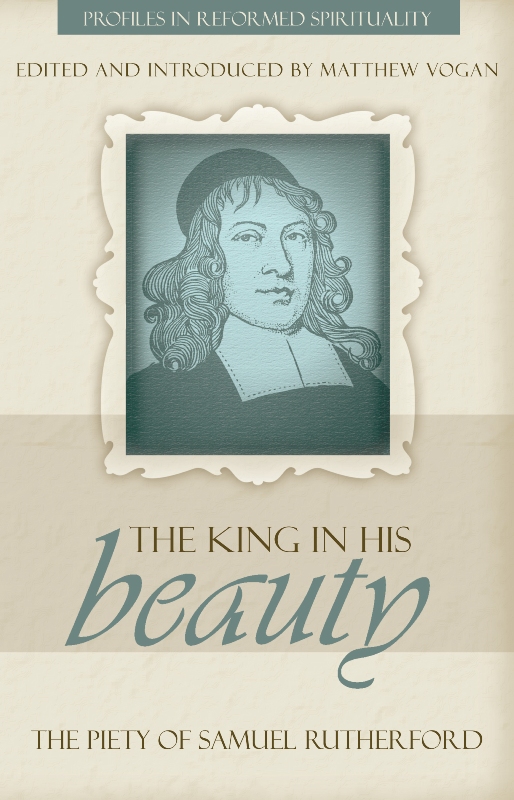
Review of The King in His Beauty
The King in His Beauty: the Piety of Samuel Rutherford. Ed. Matthew Vogan. 184pp. N.P. Pbk. ISBN 978-1-60178-125-3.
This selection from Rutherford’s writings conveys to the believing reader a sweet savour of the loveliness of Christ. Whether counselling suffering saints or exposing this world’s vain glory, he always leads us to Christ as the only resting place for our souls. We could do far worse at the close of each day than read, meditate
on, and pray over one of these extracts. One factual error needs a mention: the Westminster Assembly did
not meet in Westminster Abbey but in St. Margaret’s, next to it.
J.M.B.
SGU Magazine Peace & Truth 2011:4
Labels:
samuel rutherford
Wednesday, June 20, 2012
Samuel Rutherford: an introduction to his theology
Samuel Rutherford was perhaps the most influential religious writer in post-Reformation Scotland. He is famous for his Letters but his theological writings have been strangely neglected. This diverse collection of essays examines the breadth of his theological contribution. Several extracts from his writings are also included.
A preview is available here where it can also be purchased.
Labels:
samuel rutherford
Friday, September 30, 2011
The King in His Beauty #3
There is a review of this book in Reformatorisch Dagblad by Ds. R.W. de Koeijer, Putten under the title 'Gevoelige vroomheid van Samuel Rutherford' (roughly 'The Sensitive Piety of Samuel Rutherford').
Some people have asked how it can be obtained in the UK. Evangelical Press released this for distribution in the UK in July this year. They have sold out and have a quantity of back orders. They are in the process of organising an order from the USA shortly and will take orders direct, although it doesn't appear to be on their website. It is generally retailing for £7.50.
Labels:
samuel rutherford
Friday, April 08, 2011
The King in His Beauty #2
The King in his Beauty now has the release date of 13 April 2011. This is a "wordle" of the total content of the book. Wordles are “word clouds” generated from blocks of text. The clouds give greater prominence to words that appear more frequently in the source text. What it shows is something that would have been very important to Rutherford, that Christ is most frequently mentioned in the book much more than Rutherford himself.
"I wish it were in my power...to cry down all love but the love of Christ, and to cry down all gods but Christ, all saviours but Christ, all well-beloveds but Christ, and all soul-suitors and love-beggars but Christ."
"Oh, but Christ is heaven's wonder, and earth's wonder. What marvel that His bride saith, "He is altogether lovely," Oh, pity for evermore, that there should be such a one as Christ Jesus, so boundless, so bottomless, and so incomparable."
Labels:
samuel rutherford
Tuesday, March 29, 2011
the dawn of heaven breaks
As well remembered here, today marks the 350th anniversary of Samuel Rutherford's death 29 March 1661.
Rutherford wrote in his book Christ Dying:
When the sun riseth first, the beams over-gild the tops of green mountains that look toward the east, and the world cannot hinder the sun to rise: some are so near heaven, that the everlasting Sun hath begun to make an everlasting day of glory on them; the rays that come from his face that sits on the throne, so over-goldeth the soul, that there is no possibility of clouding peace, or of hindering daylight in the souls of such.
We believe that he had such himself upon the date mentioned above. Howie gives an account of it as follows.
Mr Blair, whose praise is in the Churches, being present, when he took a little wine in a spoon to refresh himself, being then very weak, said to him, "Ye feed on dainties in heaven, and think nothing of our cordials on earth." He answered, "They are all but dung; but they are Christ's creatures, and, out of obedience to His command, I take them. Mine eyes shall see my Redeemer; I know He shall stand the last day upon the earth, and I shall be caught up in the clouds to meet Him in the air, and I shall ever be with Him; and what would you have more? there is an end." And stretching out his hands, he said again, "there is an end." And a little after, he said, "I have been a single man, but I stand at the best pass that ever a man did; Christ is mine, and I am His;" and spoke much of the white stone and new name. Mr Blair, who loved with all his heart to hear Christ commended, said to him again—" What think ye now of Christ?" To which he answered, "I shall live and adore Him. Glory! glory to my Creator and my Redeemer for ever! Glory shines in Immanuel's land." In the afternoon of that day, he said, "Oh! that all my brethren in the land may know what a Master I have served, and what peace I have this day. I shall sleep in Christ, and when I awake I shall be satisfied with His likeness. This night shall close the door, and put my anchor within the vail; and I shall go away in a sleep by five of the clock in the morning;" which exactly fell out. Though he was very weak, he had often this expression, "Oh! for arms to embrace Him! Oh! for a well-tuned harp!"
When some spoke to him of his former painfulness and faithfulness in the ministry, he said, "I disclaim all that; the port that I would be at is redemption and forgiveness through His blood; 'Thou shalt show me the path of life, in Thy sight is fulness of joy:' there is nothing now betwixt me and the resurrection, but "to-day thou shalt be with Me in paradise."' Mr Blair saying, "Shall I praise the Lord for all the mercies He has done and is to do for you?" He answered, "Oh ! for a well-tuned harp." To his child he said, "I have again left you upon the Lord; it may be you will tell this to others, that 'the lines are fallen to me in pleasant places; I have got a goodly heritage.' I bless the Lord that He gave me counsel."
Thus, by five o'clock in the morning, as he himself foretold, it was said unto him, "Come up hither;" and he gave up the ghost, and the renowned eagle took its flight unto the mountains of spices.
Thus died the famous Samuel Rutherford, who may justly be accounted among the sufferers of that time; for surely he was a martyr, both in his own design and resolution, and by the design and determination of men. Few men ever ran so long a race without cessation; so constantly, so unweariedly, and so unblameably. Two things rarely to be found in one man, were eminent in him, viz., a quick invention and sound judgment; and these accompanied with a homely but clear expression, and graceful elocution; so that such as knew him best, were in a strait whether to admire him most for his penetrating wit, and sublime genius in the schools, and peculiar exactness in disputes and matters of controversy, or for his familiar condescension in the pulpit, where he was one of the most moving and affectionate preachers in his time, or perhaps in any age of the Church. To sum up all in a word, he seems to have been one of the most resplendent lights that ever arose in this horizon.
Rutherford's epitaph, composed by William Wilson, (see Thomson, Martyr Graves p.208) may not be the highest poetry but expresses things very well.
Most constantly he did contend,
Until his time was at an end.
At last he won to full fruition
Of that which he had seen in vision.
Rutherford wrote in his book Christ Dying:
When the sun riseth first, the beams over-gild the tops of green mountains that look toward the east, and the world cannot hinder the sun to rise: some are so near heaven, that the everlasting Sun hath begun to make an everlasting day of glory on them; the rays that come from his face that sits on the throne, so over-goldeth the soul, that there is no possibility of clouding peace, or of hindering daylight in the souls of such.
We believe that he had such himself upon the date mentioned above. Howie gives an account of it as follows.
Mr Blair, whose praise is in the Churches, being present, when he took a little wine in a spoon to refresh himself, being then very weak, said to him, "Ye feed on dainties in heaven, and think nothing of our cordials on earth." He answered, "They are all but dung; but they are Christ's creatures, and, out of obedience to His command, I take them. Mine eyes shall see my Redeemer; I know He shall stand the last day upon the earth, and I shall be caught up in the clouds to meet Him in the air, and I shall ever be with Him; and what would you have more? there is an end." And stretching out his hands, he said again, "there is an end." And a little after, he said, "I have been a single man, but I stand at the best pass that ever a man did; Christ is mine, and I am His;" and spoke much of the white stone and new name. Mr Blair, who loved with all his heart to hear Christ commended, said to him again—" What think ye now of Christ?" To which he answered, "I shall live and adore Him. Glory! glory to my Creator and my Redeemer for ever! Glory shines in Immanuel's land." In the afternoon of that day, he said, "Oh! that all my brethren in the land may know what a Master I have served, and what peace I have this day. I shall sleep in Christ, and when I awake I shall be satisfied with His likeness. This night shall close the door, and put my anchor within the vail; and I shall go away in a sleep by five of the clock in the morning;" which exactly fell out. Though he was very weak, he had often this expression, "Oh! for arms to embrace Him! Oh! for a well-tuned harp!"
When some spoke to him of his former painfulness and faithfulness in the ministry, he said, "I disclaim all that; the port that I would be at is redemption and forgiveness through His blood; 'Thou shalt show me the path of life, in Thy sight is fulness of joy:' there is nothing now betwixt me and the resurrection, but "to-day thou shalt be with Me in paradise."' Mr Blair saying, "Shall I praise the Lord for all the mercies He has done and is to do for you?" He answered, "Oh ! for a well-tuned harp." To his child he said, "I have again left you upon the Lord; it may be you will tell this to others, that 'the lines are fallen to me in pleasant places; I have got a goodly heritage.' I bless the Lord that He gave me counsel."
Thus, by five o'clock in the morning, as he himself foretold, it was said unto him, "Come up hither;" and he gave up the ghost, and the renowned eagle took its flight unto the mountains of spices.
Thus died the famous Samuel Rutherford, who may justly be accounted among the sufferers of that time; for surely he was a martyr, both in his own design and resolution, and by the design and determination of men. Few men ever ran so long a race without cessation; so constantly, so unweariedly, and so unblameably. Two things rarely to be found in one man, were eminent in him, viz., a quick invention and sound judgment; and these accompanied with a homely but clear expression, and graceful elocution; so that such as knew him best, were in a strait whether to admire him most for his penetrating wit, and sublime genius in the schools, and peculiar exactness in disputes and matters of controversy, or for his familiar condescension in the pulpit, where he was one of the most moving and affectionate preachers in his time, or perhaps in any age of the Church. To sum up all in a word, he seems to have been one of the most resplendent lights that ever arose in this horizon.
Rutherford's epitaph, composed by William Wilson, (see Thomson, Martyr Graves p.208) may not be the highest poetry but expresses things very well.
Most constantly he did contend,
Until his time was at an end.
At last he won to full fruition
Of that which he had seen in vision.
Labels:
samuel rutherford
Wednesday, February 23, 2011
The King in His Beauty #1
Matthew Vogan, “The King in His Beauty”: The Piety of Samuel Rutherford
“The King in His Beauty” introduces readers to the life and writings of Samuel Rutherford (1600–1661). Matthew Vogan’s biographical introduction traces the significant events of this Scottish theologian’s life and guides readers through his writings, focusing on his distinctive insight into Christian experience. In forty-three excerpts drawn from Rutherford’s letters, major treatises, catechism, and sermons, readers will discover the depth of Rutherford’s compassion, piety, and theological wisdom, all rooted in his unwavering love for Christ.
Description by the publishers. Coming soon (DV) from Reformation Heritage Books
“The King in His Beauty” introduces readers to the life and writings of Samuel Rutherford (1600–1661). Matthew Vogan’s biographical introduction traces the significant events of this Scottish theologian’s life and guides readers through his writings, focusing on his distinctive insight into Christian experience. In forty-three excerpts drawn from Rutherford’s letters, major treatises, catechism, and sermons, readers will discover the depth of Rutherford’s compassion, piety, and theological wisdom, all rooted in his unwavering love for Christ.
Description by the publishers. Coming soon (DV) from Reformation Heritage Books
Labels:
samuel rutherford
Thursday, February 10, 2011
falling into Christ's lap
O how sweet to be in Christ, and to grow as a tree planted on the banks of the river of life! when such die, they fall in Christ's lap and in his bosom, be the death violent or natural; 'tis all one whether a strong gale and a rough storm shore the child of God on the new Jerusalem's dry
land, or if a small calm blast even with rowing of oars bring the passenger to heaven, if once he be in that goodly land.
from Christ Dying and Drawing Sinners to Himself
See here for related quotations
land, or if a small calm blast even with rowing of oars bring the passenger to heaven, if once he be in that goodly land.
from Christ Dying and Drawing Sinners to Himself
See here for related quotations
Labels:
samuel rutherford
Thursday, October 07, 2010
Why read Samuel Rutherford?
Rutherford was one of the greatest Scottish theologians, a moving preacher and experimental writer. He is both exuberant and sublime in his commendation of communion with the Lord Jesus Christ but also uniquely homely in the powerful imagery flowing from his pen. Only the Bible exceeds his letters in spirituality.
[This is an opportune time to introduce www.samuelrutherford.org.uk - this site seeks to promote his works and various recent studies of this important figure. The site introduction doesn't quite manage 50 words but is very close.]
[This is an opportune time to introduce www.samuelrutherford.org.uk - this site seeks to promote his works and various recent studies of this important figure. The site introduction doesn't quite manage 50 words but is very close.]
Labels:
samuel rutherford
Saturday, May 30, 2009
sad divisions that make us lose the fair scent of the Rose of Sharon
"One day when he [Samuel Rutherford] was preaching in Edinburgh," says Robert Woodrow, "after dwelling for some time on the differences of the day, he broke out with: 'Woe is unto us for these sad divisions that make us lose the fair scent of the Rose of Sharon', and then he went on commending Christ, going over all his precious styles and titles about a quarter of an hour; upon which the laird of Glanderston said, 'Ay, now you are right; hold you there'."
Rutherford mentions the same concern - that sad times and energy in combating divisions and defections may cloud the loveliness of Christ if we are not careful - in the Trial and Triumph of Faith. He says,'the truth is, while we endeavour to gain a grain-weight of truth, it is much if we lose not a talent-weight of goodness and Christian love'. Rutherford was such a resolute defender of the truth, however, out of devotion to Christ as King and Head of the Church. We ought not to run to the other danger of abandoning any contention for the faith and the truth because there is a temptation that we may not keep it in balance with everything else.
Rutherford is very wise in his counsel. He says that we need to keep the glory of Christ in view together with the condition of the times so that we know what we are contending for. It is lack of love for Christ that hinders faithful contending. 'Christ hath too many occasional friends; but the ground of all is this, "I love Jesus Christ, but I have not the gift of burning quick for Christ." Oh, how securely should faith land us out of the gun-shot of the prevailing power of a black hour of darkness! Faith can make us able to be willing, for Christ, to go through a quarter of hell's pain'. We also need to view free grace lest we think of ourselves more highly than we ought and think that we earn something by faithful contending.
Listen to Rutherford's commendation of the Rose of Sharon.
Rutherford mentions the same concern - that sad times and energy in combating divisions and defections may cloud the loveliness of Christ if we are not careful - in the Trial and Triumph of Faith. He says,'the truth is, while we endeavour to gain a grain-weight of truth, it is much if we lose not a talent-weight of goodness and Christian love'. Rutherford was such a resolute defender of the truth, however, out of devotion to Christ as King and Head of the Church. We ought not to run to the other danger of abandoning any contention for the faith and the truth because there is a temptation that we may not keep it in balance with everything else.
Rutherford is very wise in his counsel. He says that we need to keep the glory of Christ in view together with the condition of the times so that we know what we are contending for. It is lack of love for Christ that hinders faithful contending. 'Christ hath too many occasional friends; but the ground of all is this, "I love Jesus Christ, but I have not the gift of burning quick for Christ." Oh, how securely should faith land us out of the gun-shot of the prevailing power of a black hour of darkness! Faith can make us able to be willing, for Christ, to go through a quarter of hell's pain'. We also need to view free grace lest we think of ourselves more highly than we ought and think that we earn something by faithful contending.
Listen to Rutherford's commendation of the Rose of Sharon.
Should Christ, the condition of affairs we are now in, the excellency of free grace, be seen in all their own lustre and dye, we should learn much wisdom from these three. Christ speedeth little in conquering of lovers: because we have not "seen his shape at any time," we look not upon Christ, but upon the accidents that are beside Christ; and therefore, few esteem Christ a rich pennyworth. But there is not a rose out of heaven, but there is a blot and thorn growing out of it, except that one only rose of Sharon, which blossometh out glory. Every leaf of the rose is a heaven, and serveth "for the healing of the nations;" every white and red in it, is incomparable glory; every act of breathing out its smell, from everlasting to everlasting, is spotless and unmixed happiness. Christ is the outset, the master-flower, the uncreated garland of heaven, the love and joy of men and angels. But the fountain-love, the fountain-delight, the fountain-joy of men and angels is more; for out of it floweth all the seas, springs, rivers, and floods of love, delight, and joy. Imagine all the rain and dew, seas, fountains, and floods, since the creation, were in one cloud, and these multiplied in measures, for number to many millions of millions, and then divided in drops of showers to an answerable number of men and angels;—this should be a created shower, and end in a certain period of time; and this huge cloud of so many rivers and drops, should dry up, and rain no more. But we cannot conceive so of Christ: for if we should imagine millions of men and angels to have a coeternal dependent existence with Christ, and they eternally in the act of "receiving grace for grace out of his fullness," the flux and issue of grace should be eternal, as Christ is. For Christ cannot tire or weary from eternity to be Christ; and so, he must not, he cannot but be an infinite and eternal flowing sea, to diffuse and let out streams and floods of boundless grace. Say that the rose were eternal; the sweet smell, the loveliness of greenness and colour must be eternal.
Oh, what a happiness, for a soul to lose its excellency in His transcendent glory! What a blessedness for the creature, to cast in his little all, in Christ's matchless all-sufficiency! Could all the streams retire into the fountain and first spring, they should be kept in a more sweet and firm possession of their being, in the bosom of their first cause, than in their borrowed channels that they now move in. Our neighbourhood, and retiring in, to dwell forever and ever in the fountain-blessedness, Jesus Christ, with our borrowed goodness, is the firm and solid fruition of our eternal happy being. Christ is the sphere, the connatural first spring and element of borrowed drops, and small pieces of created grace. The rose is surest in being, in beauty, on its own stalk and root: let life and sap be eternally in the stalk and root, and the rose keep its first union with the root, and it shall never wither, never cast its blossom nor greenness of beauty. It is violence for a gracious soul to be out of his stalk and root; union here is life and happiness; therefore the Church's last prayer in canonic Scripture is for union, (Rev. 22:20.) "Amen: Even so, come, Lord Jesus." It shall not be well till the Father, and Christ the prime heir, and all the weeping children, be under one roof in the palace royal. It is a sort of mystical lameness, that the head wanteth an arm or a finger; and it is a violent and forced condition, for arm and finger to be separated from the head. The saints are little pieces of mystical Christ, sick of love for union. The wife of youth, that wants her husband some years, and expects he shall return to her from oversea lands, is often on the shore; every ship coming near shore is her new joy; her heart loves the wind that shall bring him home. She asks at every passenger news: "Oh! saw ye my husband? What is he doing? When shall he come? Is he shipped for a return?" Every ship that carrieth not her husband, is the breaking of her heart. What desires hath the Spirit and Bride to hear, when the husband Christ shall say to the mighty angels, "Make you ready for the journey; let us go down and divide the skies, and bow the heaven: I will gather my prisoners of hope unto me; I can want my Rachel and her weeping children no longer. Behold, I come quickly to judge the nations." The bride, the Lamb's wife, blesseth the feet of the messengers that preach such tidings, "Rejoice, O Zion, put on thy beautiful garments; thy King is coming." Yea, she loveth that quarter of the sky, that being rent asunder and cloven, shall yield to her Husband, when he shall put through his glorious hand, and shall come riding on the rainbow and clouds to receive her to himself.
Labels:
samuel rutherford
Friday, February 27, 2009
7 reasons why God permits sin
Samuel Rutherford gives these reasons in his A Sermon Preached before the Honourable House of Commons.
if permitting sin had not been,
1) The beauty of free grace and 'pardoning grace' had never been made obvious.
2) There had been no employment for 'the mercy of a soul-redeeming Jesus'.
3) We had not have had occasion to exalt 'the new Psalme of the Praise of a Redeemer'.
4) By this permission, the human creature of self-dependence is cried down, whereas God is exalted.
5) By this, the broken and humble heart is necessitated to kiss Christ, who binds up the broken hearted. 6) Then, we as poor pupils improve our dependence upon so kingly a Tutor.
7) Therefore, when clay triumphs over Angels and hell through the strength of Jesus Christ, 'Satan hath faire justice in open patent court'.
In his Catechism Rutherford writes just as concisely.
This is a complex area and the Reformer Ursinus is very helpful and careful in it:
He further defines a little what this withdrawal of divine grace is by which God,
The Westminster Confession (6:1 also Larger Catechism Q19) declare that God 'permits' sin, but that it is not a 'bare permission'.(5:4) A 'bare permission' (such as Arminians believe) would make it an involuntary decision whereas it was possible not to permit it.
Turretin is characteristically concise: 'Two extremes are to he avoided. First, that of defect, when an otiose permission of sin is ascribed to God. Second, that of excess, when the causality of sin is ascribed to him. Between these extremes, the orthodox hold the mean, who contend that the providence of God extends to sin in such way that he does not involuntarily permit it, as the Pelagians say, nor actively cause it as the Libertines assert, but voluntarily ordains and controls it'.
Boston is characteristically rich: "God's providence is most holy. "The Lord is righteous in all his ways and holy in all his works" (Psalm 145:17) Even though providence reach to and be conversant in sinful actions, yet it is pure; as the sun contracts no defilement, though it shine on a dunghill. For God is neither the physical nor moral cause of the evil of any action, more than he who rides on a lame horse is the cause of its halting. All the evil that is in sinful actions proceeds and flows from the wicked agent, as the stench of the dunghill does not proceed from the heat of the sun, but the corrupt matter contained in the dunghill."
Jonathan Edwards writes: "To permit the event of sin, or not to hinder it, implies, that the cause of defection is not in the permitter, but in the permitted; not m the governor, but the governed." What is very interesting about Edwards' views is that he believed that "the glory of the divine rectitude, towards the intelligent and moral part of the universe, considered as accountable, and to the full extent of its moral capabilities, could not be manifested without the permission of sin. The full exercise of equity must necessarily leave the moral system to its own tendencies and operations." Note the following: "Without the permission of sin, restoring benevolence, or the exercise of mercy, would have been impossible; and consequently the glory of that perfection, which can be fully displayed only by its exercise towards the miserable, would have been eternally concealed".
Finally, Witsius expresses it attractively in saying "it is peculiar to divine wisdom
and power not only to do good but much more, to make the evil devised by others, to answer a good and valuable end, and manage those things which appear to be evil to the greatest advantage".
But lest these thoughts should lead us to any smaller or weaker views of the exceeding sinfulness of sin itself as the greatest evil and our own responsibility for it, read The Absence of Sin in Present Day Religion.
if permitting sin had not been,
1) The beauty of free grace and 'pardoning grace' had never been made obvious.
2) There had been no employment for 'the mercy of a soul-redeeming Jesus'.
3) We had not have had occasion to exalt 'the new Psalme of the Praise of a Redeemer'.
4) By this permission, the human creature of self-dependence is cried down, whereas God is exalted.
5) By this, the broken and humble heart is necessitated to kiss Christ, who binds up the broken hearted. 6) Then, we as poor pupils improve our dependence upon so kingly a Tutor.
7) Therefore, when clay triumphs over Angels and hell through the strength of Jesus Christ, 'Satan hath faire justice in open patent court'.
In his Catechism Rutherford writes just as concisely.
has God any hand in sin? A. He suffers men to sin, and punishes sin and
directs it to his own glory; but he neither allow, loves, nor commands sin'. Q.
But is not God the author of sin when he hardens men's hearts? Q. Not at all,
for God, as the ruler of the world and judge, leaves men to harden their own
heart, and so punishes sin by sin (Psa. 81:11,12; Rom. 1:24; 2Thess. 2:11,12)
as that no guilt cleaves to him'. ...Q. How can God then be free of sin if he
works in sin? A. The Lord can touch a serpent and not be stanged, (i.e.
stung), and as a good painter drawers black lines in the image to make the
white appear more beautiful, and the physician extracts good oil out of
poisonous herbs, and the musician makes the mistuned harp to send out a
pleasant sound, even so God in the hardening of men's heart does the part of
a judge justly and holily.
This is a complex area and the Reformer Ursinus is very helpful and careful in it:
The evils of guilt as far as they are such, that is, sins, have not the nature of that which is good. Hence God does not will them, neither does he tempt men to perform them, nor does he effect them or contribute thereto ; but he permits devils and men to do them, or does not prohibit them from committing them when he has the power to do so. Therefore these things do indeed also fall under the providence of God, but not as if they were done by him, but only permitted. The word permit is therefore not to be rejected, seeing that it is sometimes used in the scriptures.
...But we must have a correct understanding of the word lest we detract from God a considerable portion of the government of the world, and of human affairs. For this permission is not an indifferent contemplation or suspension of the providence and working of God as it respects the actions of the wicked, by which it comes to pass
that these actions do not depend so much upon some first cause, as upon the will of the creatures acting; but it is a withdrawal of divine grace by which God (whilst he accomplishes the decrees of his will through rational creatures) either does not make known to the creature acting what he himself wishes to be done, or he does not incline the will of the creature to render obedience, and to perform what is agreeable to his will. Yet he, nevertheless, in the meanwhile, controls and influences the creature so deserted and sinning as to accomplish what he has purposed.
He further defines a little what this withdrawal of divine grace is by which God,
1. Does not make known to man his will, that he might act according thereto.
2. He does not incline the will of man to obey and honor him, and to act in accordance with his will as revealed. "If a dreamer of dreams shall arise among you, thou shalt not hearken unto him, for the Lord your God proveth you." "The Lord moved David against Israel to say, Go and number Israel and Judah. (Deut. 13:1,3; 2 Sam. 24:1.) Why did he afterwards punish David? That he might be led to repentence.
3. He nevertheless influences and controls those who are thus deserted, so as to accomplish through them his just judgments; for God accomplishes good things through evil instruments, no less than through those which are good. For as the work of God is not made better by the excellency of the instrument, so neither is it made worse by the evil character of the instrument. God wills [by permission] actions that are evil, but only in as far as they are punishments of the wicked. All good things are from God, All punishments are just and good. Therefore they are from God...
The Westminster Confession (6:1 also Larger Catechism Q19) declare that God 'permits' sin, but that it is not a 'bare permission'.(5:4) A 'bare permission' (such as Arminians believe) would make it an involuntary decision whereas it was possible not to permit it.
Turretin is characteristically concise: 'Two extremes are to he avoided. First, that of defect, when an otiose permission of sin is ascribed to God. Second, that of excess, when the causality of sin is ascribed to him. Between these extremes, the orthodox hold the mean, who contend that the providence of God extends to sin in such way that he does not involuntarily permit it, as the Pelagians say, nor actively cause it as the Libertines assert, but voluntarily ordains and controls it'.
Boston is characteristically rich: "God's providence is most holy. "The Lord is righteous in all his ways and holy in all his works" (Psalm 145:17) Even though providence reach to and be conversant in sinful actions, yet it is pure; as the sun contracts no defilement, though it shine on a dunghill. For God is neither the physical nor moral cause of the evil of any action, more than he who rides on a lame horse is the cause of its halting. All the evil that is in sinful actions proceeds and flows from the wicked agent, as the stench of the dunghill does not proceed from the heat of the sun, but the corrupt matter contained in the dunghill."
Jonathan Edwards writes: "To permit the event of sin, or not to hinder it, implies, that the cause of defection is not in the permitter, but in the permitted; not m the governor, but the governed." What is very interesting about Edwards' views is that he believed that "the glory of the divine rectitude, towards the intelligent and moral part of the universe, considered as accountable, and to the full extent of its moral capabilities, could not be manifested without the permission of sin. The full exercise of equity must necessarily leave the moral system to its own tendencies and operations." Note the following: "Without the permission of sin, restoring benevolence, or the exercise of mercy, would have been impossible; and consequently the glory of that perfection, which can be fully displayed only by its exercise towards the miserable, would have been eternally concealed".
Finally, Witsius expresses it attractively in saying "it is peculiar to divine wisdom
and power not only to do good but much more, to make the evil devised by others, to answer a good and valuable end, and manage those things which appear to be evil to the greatest advantage".
But lest these thoughts should lead us to any smaller or weaker views of the exceeding sinfulness of sin itself as the greatest evil and our own responsibility for it, read The Absence of Sin in Present Day Religion.
Labels:
samuel rutherford
Friday, March 17, 2006
Rutherford and the Gospel Offer
Excerpts from Trial and Triumph of Faith
- Now, the special intent of the gospel is to bring men to put a high and rich price upon Christ, and this is one gospel-offer: What thinkest thou of so excellent a one as Christ? What wouldst thou part with? What wouldst thou do or suffer for Christ?
- Faith can stand upon one foot, even on a general word; hence, this is a gospel word in the Prophets, which requireth faith, Turn to the Lord for he is merciful, (Jer. 3:12; Joel 2:13; John 4:2). And because a general promise received with heart-adherence and confidence giveth glory to God; and if it be holden forth to a humbled soul, who is now within the lists and bounds of grace, and, for any thing that the person thus laden with sin knoweth on the contrary, (for the secrets of election and reprobation belong to the Lord) Christ mindeth and intendeth to him salvation, therefore he is to believe.
- This would be considered, that unbelief breaketh with Christ first, before Christ break with the unbeliever; and the elect of God findeth no more, nor any higher favour in the kind of external means to open the Lamb's book of life, which is sealed and closed with God's own hand, than the commandment of believing. Now, when our Lord maketh offer of the kingdom of sons, to slaves, and casteth his jewel of Christ offered in the gospel, in the lap and bosom of a bastard, whatever be the Lord's secret decree and purpose in so doing, the bastard is to take God at his word, and to catch the opportunity of God's love in so far; and if he do it not, the gospel offer to the reprobate being a treaty of peace, then the treaty breaketh off first upon his side; for Christ cometh within a mile of mercy, to meet the sinner, and the sinner cometh not the fourth part of a mile, yea, not half a step of love and thankful obedience, to meet Christ; and so, Christ killeth the unbeliever with the sweetness of the preventing courtesy of offered mercy.
- But if the sinner be wearied and laden, and seeth, though through a cloud only, Christ only must help and save, if not, he is utterly and eternally lost, What is there upon Christ's part to hinder thee to believe, O guilty wretch? Oh, (saith he,) I fear Christ only offereth himself to me, but he mindeth no salvation to me.
—Answer. Is not this to raise an evil report and slander on the holy One of Israel? For Christ's offer is really an offer, and in so far, it is real love, though it cannot infer the love of election to glory, yet the total denial of this offer openeth up the black seal of reprobation to heathens without the church. And therefore it is love to thee, if thou be humbled for sin; (2.) And have half an eye to the unsearchable riches of gospel mercy; (3.) And be self-condemned; (4.) And have half a desire of Christ: thou mayest expound love by love, and lay hold on the promise, and be saved. An error of humble love to Christ, is no error.
Though it were true, that you were upon the borders of hell, yet the gospel, though it except you from actual mercy, yet excepts you not from the duty of believing and coming to Christ; and though such think and imagine, that they believe Christ is able to save and redeem them, only they doubt of his will, yet the truth is, the doubt of unbelief is more of the power of mercy and infinite grace in Christ than of his will; and my reason is, "that whosoever believeth, hath set to his seal that God is true;" (John 3:33;) and "He that believeth not God, hath made him a liar, because he believeth not the record that God gave of his Son." (1 John 5:10.) - It is true, the gospel excepteth no man from pardon, and all that hear the gospel are to be wearied and laden, and to receive Christ by faith, as if God intended to save them. But the promises of the gospel are not simply universal, as if God intended and purposed, that all and every one should be actually redeemed and saved in Christ, as Arminians teach; and so God excepteth in his own hidden decree, not a few, though he reveal not in the gospel who they are, yet he revealeth in the gospel the general, that "many are called, but few are chosen:"
And I grant, there is no ground for any one man not to believe upon this ground, because some are reprobated from eternity, and it may be I am one of those, for the contrary is a sure logic; many are chosen to life eternal, and it may be that I am one of those. (2.) It is most untrue, that Christ belongeth to sinners as sinners, for then, Christ should belong to all unbelievers, how obstinate soever, even to those that sin against the Holy Ghost. Nay, Christ belongeth only to sinners elected to glory, as elected to glory in regard of God's gracious purpose, and He belongeth only to believing sinners, as believing, in regard of actual union with Christ, (Eph. 3:17, Gal. 2:20). (3.) It is false that sinners, as sinners, do receive Christ, for so, Judas and all sinners should receive Christ: now the Scripture showeth, that believers only receive him, (John 1:12, Gal. 2:20, Eph. 3:17). (4.) It is false, that sinners, as sinners, believe in Christ. This way of libertines is a broad way for sorcerers, thieves, murderers, parricides, idolaters, remaining in that damnable state, to believe; whereas sinners, as such, sinners thus and thus qualified, are to believe; that is, humbled, wearied, and self-condemned sinners only, are to believe, and come to Christ. It is true, all sinners are obliged to believe, but to believe after the order of free grace; that is, that they be first self-lost and sick, and then be saved by the physician. - If Christ be sent for lost Israel, and say in the gospel, 'Who will go with me?' and say to thee, 'My Father the King sent me, his own Son, to bring thee up to his house,' why, but thou shouldst go? When old Jacob saw the chariots and messengers that Prince Joseph, his own son, yet living, had sent to fetch him, "His heart failed for joy." Seest thou the chariot of Pharaoh paved with love? make, then, for the journey. The home we have here is a taking lover; why, but thou mayest say, I cannot stay here, the king hath sent for me.
Christ's act of dying was a special law: "This commandment received I of my Father, that I should lay down my life." (John 10:18.) (3.) By his death and resurrection he is made a Prince by law, and hath law and authority to forgive sins, (Acts 5:31; Matt. 9:6); and power to give life eternal, (John 17:2,)—and rule all by a new law in his new kingdom. (Matt. 28:8.) Our heaven now, is by law and a special commission; but the gospel is a general: he brought all God's secrets from heaven; and in his special commission, Christ hath, as it were, private instructions: Save such and such persons, not any other, not all Israel, but the lost sheep; not the goats. There is a great mystery, how there be no double-dealing in the gospel, and two contrary wills in God. - He offereth, in the gospel, life to all, so they believe; and God mindeth to work faith, and intendeth to bestow life on a few only; like a king's son coming to a prison of condemned men, with offered pardons to all, upon condition they accept of them; but yet he singleth out some, and persuadeth them to lay hold on the Father's grace; and by the head taketh them out, and leaveth all the rest to justice. Yet is it no greater mystery than this, "Many are called, but few are chosen." So Christ's sending with his commission, cometh under a two-fold notion: one is, in the intention of the Evangel; the other is, in the intention of him who proposeth the Evangel to men,—I mean, God's intention to give faith and effectual grace. The former is nothing but God's moral complacency of grace, revealing an obligation that all are to believe if they would be saved; and upon their own peril be it, if they refuse Christ. This is the heart and mind of Christ to persons, revealing two things: (1.) Men's duty; (2.) God's grace to give life eternal to believers. But the latter is not a moral will in God only, but a real physical will, (to speak so,) according to the which, Christ effectually, strongly layeth bands of love, cords of sweet enforcing grace, to persuade the soul to take Jesus Christ. Christ cometh to the mind under a higher apprehension, with his rainy and wet hair, knocking, and again knocking, to show his face in such soul-redeeming beauty and excellency, as the soul must be taken captive, subdued, and overcome with the love of Christ; as the spouse is so wrought on with the beauty, grace, riches, endowments of excellency, words of love of such an husband, that she is forced to say, 'I have no power, neither heart nor hand to refuse you.' Now, the former notion of the gospel is enough to lay the obligation of believing on all; so as though the gospel reveal not God's purpose of election, (that is only and formally revealed in, and by God's efficacious working of faith, called the inward calling,) yet it saith this to all, 'You are all to believe no less, than if there were not any reprobated persons amongst you.' If, therefore, any despairing ones, as Cain, yea, and many weak ones, refuse to believe, on this ground, Why should I believe? the gospel hath excepted me, it belongeth not to me, I am a reprobate,—they are deluded, for the gospel formally revealeth neither the Lord's decree of election nor reprobation. The embracing of the gospel, and the final rejection thereof, can speak to both these; but that is neither the gospel voice, nor the gospel spirit, that revealeth any such bad tidings.
Labels:
Preaching,
samuel rutherford
Subscribe to:
Posts (Atom)