Does Scripture speak on the issue of hair length? That is the question. If the Bible is silent or non-committal on the subject, then we may be so too. But if God’s Word has spoken on the matter, then we must contend earnestly for this part of the Christian faith, along with every other part of revealed religion.
Wednesday, June 10, 2015
a longer look at 1 Corinthians 11
Friday, December 13, 2013
No fool
Jim Elliot had a great quote:
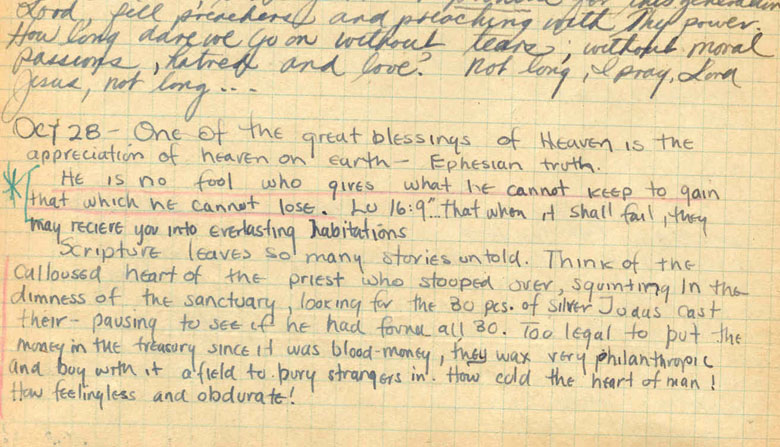
He is no fool, who gives what he cannot keep, to gain what he cannot lose.
Allan Harman's biography of Matthew Henry quotes his father Philip Henry with much the same words:
He is no fool who parts with that which he cannot keep, when he is sure to be recompensed with that which he cannot lose.
–from Matthew Henry: His Life and Influence, by Allan Harman, (Chritian Focus, 2012), Kindle location 345-47.
It would be remarkable if Elliott were not echoing Henry. Neither men were fools. They lived by these words. What about you?
Wednesday, August 15, 2012
Whose Faith Follow
The motto of the blog is 'whose faith follow…' John Owen comments on this part of Hebrews 13:7 that follow means “to imitate” "This remembrance of our guides is prescribed with reference unto the duty of following their faith: “Whose faith follow;” — ‘So mind them and their work, in preaching the word of God, as to follow or imitate them in their faith'". "It is such a following as wherein we are fully conformed unto, and do lively express, that which we are said to follow. So a scholar may be said to follow his master, when, having attained all his arts and sciences, he acts them in the same manner as his master did. So are we to follow the faith of these guides". He qualifies this: "No mere man, not the best of men, is to be our pattern or example absolutely, or in all things. This honor is due unto Christ alone". This is wrapped up in what Paul goes on to say "Considering the end of their conversation Jesus Christ the same yesterday, and today, and forever." Is the whole goal and tendency of our life here to point to the unchangeable, never enough admired Altogether Lovely One?
This endeavour will have done valuable work for God in this generation if it encourages this spirit in a rising generation.
Saturday, May 21, 2011
sin: the enemy of usefulness#2
That is true; they are still, they abide in a heart where there is some neglect of mortification; but they are ready to die, Rev. 3:2, they are withering and decaying. The heart is like the sluggard's field, -- so overgrown with weeds that you can scarce see the good corn. Such a man may search for faith, love, and zeal, and scarce be able to find any; and if he do discover that these graces are there yet alive and sincere, yet they are so weak, so clogged with lusts, that they are of very little use; they remain, indeed, but are ready to die. But now let the heart be cleansed by mortification, the weeds of lust constantly and daily rooted up (as they spring daily, nature being their proper soil), let room be made for grace to thrive and flourish, -- how will every grace act its part, and be ready for every use and purpose!
John Owen - Chapter 4 Mortification of Sin
Thursday, May 05, 2011
sin: the enemy of usefulness
John Owen, Chapter 10, Mortification of Sin
Thursday, November 18, 2010
Godliness in everything
James Durham
Thursday, March 11, 2010
Clothing ourselves to the glory of God
the absolute necessity of the righteousness of God, the imputed righteousness, with its fitness eyery way to clothe the sinful soul".
The law of the first mention relates to the interpretation of Scripture by placing importance on the first mention of something in Scripture. Boston writes that it was "a humbling memorial to them of the spring of their ruin". we ought to remember that The least rag for our clothing, crumb for our food, breathing in God's air, etc. is what we deserve not at the hand of God, (Luke 17:10)". Here we see the principle that clothing is necessary due to the fall and that is God's right to order in general the nature of that clothing. The sinful natural tendency of man is to seek a covering that is insufficient in design, both in terms of distinction of the sexes and in terms of its function of preserving modesty. God's provision was designed to deal with both. Whatsoever we do we must do all to the glory of God (1 Cor. 10:31). Note number 3.
In his commentary on Ezekiel 16, the puritan William Greenhill considers “for what ends the Lord hath given apparel and ornaments”:
(1.) To cover man’s nakedness. God set man and woman naked in the world at first, that they might see they had nothing of their own, that all was the Lord’s who created them; but when they sinned in eating the forbidden fruit, they were ashamed of their nakedness, and sought to cover it, Gen. 3:7, 21; yea, God made them ‘coats of skins, and clothed them,’ ver. 21, that so their nakedness and shame might not be seen, that so modesty and chastity might be preserved: Hos. 2:9, ‘I will recover my wool and my flax given to cover her nakedness.’
(2.) To arm and defend them against the injury of the air, the violence of wind and weather, heat and cold [Prov. 31:21; 25:20; Job 24:7] . . .
(3.) To distinguish one sex from another. God would not have men and women dressed and adorned alike; Deut. 22:5, ‘The woman shall not wear that which pertaineth unto a man, neither shall a man put on a woman’s garment:’ God would not have men to be effeminate, nor women to be mannish . . .
(4.) To preserve the healthiness of our bodies. ‘Man is born to labour, as the sparks fly upward,’ Job 5:7; and man labouring, his body sweats . . . which our vestures receiving are to be changed, and so health preserved: so in time of sickness, Job 30:18 . . .
(5.) To notify the conditions, ranks, and places of men [Gen. 41:42; Esth. 6:8; Acts 12:21 ; Psalm 45:13, 14; II Sam. 13:18 ; Lam. 4:5; Matt. 11:8; 27:28] . . .
(6.) To adorn the body [Gen. 27:15; Isa. 52:1; Hos. 2:13 ] . . . Jer. 2:32 , ‘Can a maid forget her ornaments?’ Exod. 28:40, Aaron’s sons must have coats, girdles, bonnets, ‘for glory and beauty’ . . .
(7.) To testify grief or joy. Mordecai put on sackcloth in a time of mourning [Joel 1:13 ; Luke 15:22 ; Isa. 61:10; Eccl. 9:8] . . . (I have taken this from the booklet Christian Clothing which contains a lot of helpful information although there are various points that are a matter of debate amongst those that hold to gender-distinctive dress and roles)
There is a sensitive and adept treatment of the subject of gender-distinctive dress by a young woman here. The article is called "Decent and Distinct".
The verse Deuteronomy 22:5 is important here. "The woman shall not wear that which pertaineth unto a man, neither shall a man put on a woman's garment: for all that do so are abomination unto the LORD thy God". Another blog demonstrates the historical interpretation and application of thishere and
here and here is another interesting contribution. (The writer seems to regard headcovering in I Cor. 11 as a cultural matter which is incorrect, it is an aspect of the public worship of God in all cultures for the New Testament Church). The author is American, so for pants read trousers.
The writer elsewhere notes the following in relation to Deuteronomy 22:5. "It doesn't say that the garment is an abomination or that the activity is an abomination. The person is an abomination. This is the only time in Scripture that a person is an abomination unto the LORD for doing something. Why? Because it attacks or rebels against God's design. At a root level, God is our Creator (Rom 1:25). He wants recognition of that by the acknowledgment of His design. It is also another way that those roles are preserved. Appearance is the primary way that roles are taught. This is why we have a gigantic passage in the New Testament that also deals with this issue (1 Cor 11:3-16)".
He continues:
It doesn't say "men should look like men and women should look like women." It says nothing about transvestism or Canaanite worship, some of the new inventions to avoid practicing the text. It says nothing about women putting on military gear. It doesn't say, "they both wore robes," because it isn't about removing distinctions. What it does say is that a man should not ever have on the woman's article and that the woman should not wear the male garment. It assumes that there is a male item of clothing designated to differentiate him from the woman, as well as a female item designated to differentiate her from the man.
He shows that this issue impacts upon men as much as women:
our culture has eliminated the male garment. There is none. The woman still has the skirt or the dress. The man has nothing...When the world did away with the male garment, Christians protested. When women started wearing pants, Christians opposed it. When Christian women started wearing pants, it wasn't because a group of godly women got together and prayed about it and sought God's will. No. It was a matter of rebellion and then the church went along with the world on this one. It's been so long since most churches practiced this, that it doesn't even seem like a biblical teaching any more.
Friday, February 19, 2010
Both Callings
"A Christian, at his Two Callings, is a man in a Boat, Rowing for Heaven, the House which our Heavenly Father hath intended for us. If he mind but one of his Callings, be it which it will, he pulls the Oar but on one side of the Boat, and will make but a poor dispatch to the Shoar of Eternal Blessedness...."
--Cotton Mather, from "A Christian at His Calling" (1701)
This is an excellent quote posted on the Puritan Writing blog. Of course using one oar more than the other takes you off course. Rowing only with one oar takes you round in circles. No wonder we feel stressed if we give to much to our earthly calling.
Thursday, November 26, 2009
Directions to those who wish to do more than others
2. Would they deny themselves more than others? then they should pray more than others
3. Would they pray more than others? then they should resolve more than others
4. Would they resolve more than others? then they should love more than others
5. Would they love more than others? then they should believe more than others
6. Would they believe more than others? then they should know more than others
7. Would they know more than others? then God must reveal himself more to them than he does to others
Matt. 5:47 'What do ye more than others?'
William Secker(d. 1681?), The nonsuch professor in his meridian splendour, or, The singular actions of sanctified Christians (also titled 'The Consistent Christian')
The book is based on seven sermons given at All Hallows, London Wall in 1660.
'Those people...who are sincerely desirous of knowing and becoming such Christians, will derive advantage from a perusal of Secker's "Consistent Christian." It is written for men of plain sense, and is adapted to the taste of no 'scholarly' reader. It is a book of practical godliness...Mr. Secker points to Jesus as the rock upon which the soul rests, and insists upon godly works as the only conclusive evidence, that the professor of religion can give of his having the faith of God's elect'. Alexander McLeod
As Secker himself puts it in the Introduction ‘the design of this piece is not the ostentation of the author, but the edification of the reader’.
It can be purchased here
Wednesday, November 25, 2009
The believer's daily principles
2. That after all his present receivings he will be brought to his future reckonings
3. That God bears a greater respect to his heart than to his works
4. That there is more final bitterness in reflecting on sin, than there can be present sweetness in the commission of sin
5. That there is the greatest vanity in all created excellency
6. That duties can never have too much attention paid to them, nor too little confidence placed in them
7. That those precious promises, which are given to insure his happiness, do not supersede those directions which are laid down for him to seek alter happiness
8. That it is dangerous to dress himself for another world at the looking-glass of this world
9. That where sin proves hateful, it shall not prove hurtful
10. That inward purity is the ready road to outward plenty
11. That all the time which God allows him, is but enough for the work which he allots him
12. That there can never he too great an estrangement from defilement
13. That whatsoever is temporarily enjoyed should be spiritually improved
14. That he should speak well of God whatsoever evil he receives from God
15. That the longer God forbears with the unrelenting sinner in life, the sorer he strikes him in the judgment-day
16. That there is no judging of the inward conditions of men by the outward dispensations of God
17. That it is safest to cleave to that good which is the choicest
18. That no present worldly business should interrupt his pursuit of future blessedness
19. That gospel integrity towards God is the best security against wicked men
20. That the richness of the crown that shall be received shall more than compensate for the bitterness of the cross which may here be endured
William Secker, The Nonsuch Professor
Tuesday, November 24, 2009
What the Christian does more than others
2. He brings up the bottom of his life to the top of his light
3. He prefers the duty he owes to God to the danger he fears from man
4. He seeks the public good of others above the private good of himself
5. He has the most beautiful conversation among the blackest persons
6. He chooses the worst of sorrows rather than commit the least sin
7. He becomes a father to all in charity, and a servant to all in humility
8. He mourns most before God for those lusts which appear least before men
9. He keeps his heart lowest when God raises his estate highest
10. He seeks to be better inwardly in his substance than outwardly in appearance
11. He is grieved more at the distresses of the church than affected at his own happiness
12. He renders the greatest good for the greatest evil
13. He takes those reproofs best which he needs most
14. He takes up duty in point of performance, and lays it down in point of dependence
15. He takes up his contentment in God's appointment
16. He is more in love with the employment of holiness than with the enjoyment of happiness
17. He is more employed in searching his own heart than in censuring other men's states
18. He sets out for God at his beginning, and holds out with him to the end
19. He takes all the shame of his sins to himself, and gives all the glory of his services to Christ
20. He values an heavenly reversion above an earthly possession
Matt. 5:47 'What do ye more than others?'
William Secker, 'The Nonsuch Professor'
Monday, November 23, 2009
Why a Christian should do more than others
2. Because he is more nearly related to God than others
3. Because he professes more than others
4. Because he is inwardly conformed to the Redeemer more than others
5. Because he is looked upon more than others
6. Because if he does no more than others, it will appear that he is no more than others
7. Because he is appointed to be a judge of others
8. Because he expects more than others
Matt. 5:47 'What do ye more than others?'
William Secker, 'The Nonsuch Professor'
Tuesday, May 19, 2009
The Art of Living Well to God
This was very much the concern of the puritans. Hence their commitment to spiritual diaries which allowed them to examine their lives. To the Puritan the art of living was the highest art form, as Owen Watkins indicates, this was the principle that lay behind Puritan autobiographies, ‘that the only masterpiece worthy of the name was to be achieved in the most complex and difficult of all forms of creative endeavour: a human life’ (Watkins, p.1). This is also why the puritans laid such stress upon sermons full of practical and experimental divinity. It was through authentic experience of the Word of God that the saint would live the life exemplified in Scripture. John Owen shows the progression of the experience of the Word. It begins with divinely assisted understanding, then follows ‘a spiritual sense of the goodness, power, and efficacy of the word and the things contained in it, in the conveyance of the grace of God unto our souls...By the one...our minds are refreshed; and by the other, our souls are nourished’. ‘To complete the experience intended, there follows hereon a conformity in the whole soul and conversation unto the truth of the word, or the mind of God in it, wrought in us by its power and efficacy’. Puritan sermons were therefore weighted towards application or the 'uses'of the doctrine of Scripture.
The puritan George Swinnock has a book which is rather like Thomas Watson's 'The Godly Man drawn with a scripture pencil'. The book is called 'The Christian Man's Calling' and in it he writes: 'I have drawn the saint's picture, by which thou mayest perceive somewhat of the beauty of his person, and the excellency and loveliness of his life. This indeed is the true life, all other but the shadow of living'. Godliness is a Godlikeness, bearing the image of the One who is entitled 'The Beauty of Holiness' and who clothes his own people in holy beauties from the womb of the morning. It is a likeness to Christ and a conformity to His image. To me to live is Christ. Living must be done in dependence upon the Son of God who loved His people and gave Himself for them. John Willison writes: O that we could learn the heavenly art of living by faith on the Son of God, by continued dependence on him, and making application to him for righteousness and strength; righteousness for removing our guilt, and justifying our persons before God ; and strength for performing duties, conquering lusts, and bearing crosses!'
Where is this found in the New Testament? The people of God are his 'workmanship' (poiema) which means a created thing. They are 'created in Christ Jesus unto good works which God hath before ordained that we should walk in them' (Eph 2:10). In Titus 2:10 the saints are to 'adorn the doctrine of God our Saviour in all things' - they are to have an order and arrangement in their lives that corresponds to the truth of Scripture. There is an order in beauty - the best things in the best order, the most attractive things in the most attractive order. They live 'as it becometh the gospel'. The beauty of the gospel in its perfect wisdom and grace, the manifold wisdom and grace of God, is reflected in their lives. Swinnock says that man is made to be the mirror of God's glory: 'Man is made as a glass, to represent the perfections that are in God. A glass can receive the beams of the sun into it, and reflect them back again to the sun. The excellencies of God appear abundantly in His works; man is made to be the glass where these beams of divine glory should be united and received, and also from him reflected back to God again.'Who would not desire this?
The life of faith is available to all. The poorest among us, and the least educated can travel this road to Heaven. The poor may have little opportunity to become wealthy or honourable, but they can live a truly happy life through faith! They can live such a life just as much as the greatest princes and learned educators. Whoever you are, if you desire to lift up your condition and change the few days of your pilgrimage into happier and longer days, faith is the art of living well, and living long! (Samuel Ward)
Monday, June 16, 2008
The Fashion of Feminism
The Guardian claimed that he "reworked the rules of fashion defining how modern women dressed". He has been described as "the French fashion designer who created a bold new dress code for women during the feminist revolution of the 1970s". The news agency Agence France-Presse elaborated on how he "changed the silhouette of 20th century woman with a daring new dress code". This refers to the fact that he invented and popularised the trouser-suit for women. The silhouette refers to the fact that gender distinction could be clearly indicated as it is in symbol form by the silhouette of a woman in a skirt and a man in trousers. His business partner comments. "He was the first to put women in pants, the first to put them in tuxedos, the first to put them in masculine clothes". “He transformed society and he transformed women.” The trouser suit has been hailed as the real birth of the feminist revolution of the 1970s and "what fashion gave to feminism." “Feminism was built on the trouser suit”. As commentators have pointed out he introduced this revolution when the French academic feminists were airing their views. Although there had been a similar expression of feminism by some women in the 1920s it was in the 1970s that feminism became truly popular. There were certain reasons for this. A Russian news agency points to the context of "massive popular cultural shifts of the 1960s, with sexual liberation, women's unprecedented economic freedom, and the rise of feminism".
In 1970 the Free Presbyterian Church of Scotland took account of these sea changes in society in its rebellion against God's Word. Its resolution (reaffirmed in 2003) noted that there "is evidence that the "permissiveness" of the age has influenced the Church. In particular this is the case in the dress of the women, and in the hair styles of both men and women.
The Word of God demands of women that they be dressed in modest apparel, and the Synod urge the women of the Church to give heed to this counsel. Not only does it require modesty of dress but also distinction in dress between the sexes. The practice of men and women wearing clothes which obliterates this distinction is quite contrary to God's Word and expressly declared to be an abomination to Him. "The woman shall not wear that which pertaineth unto a man neither shall a man put on a woman's garment: for all that do so are abomination unto the Lord thy God" (Deut 22:5).
The Church must therefore condemn these practices as contrary to God's Word and direct her people to seek the grace of the Lord Jesus Christ to enable them to live unspotted in the world."
Several articles in the Young People's Magazine give further guidance.
"Such also is the spirit of feminism, which tries to destroy all God’s distinctions between man and woman (Ephesians 5:21-32, 1 Timothy 2:9-15, 1 Peter 3:1-7). Holy Scripture also makes a clear distinction between male and female in dress: “The woman shall not wear that which pertaineth unto a man, neither shall a man put on a woman’s garment: for all that do so are abomination unto the Lord thy God” (Deuteronomy 22:5). As John Calvin points out, this text is one of around 24 in Exodus to Deuteronomy which enlarge on God’s teaching of the Seventh Commandment. It is exceedingly solemn to despise any of God’s precepts. The Lord Jesus endured such suffering as no tongue can tell (Hebrews 2:10) when the wrath of God fell upon Him because of a broken law, to which He gave perfect obedience (Romans 5:19). That is our only hope of eternal life. Feminism is all about removing God-given distinctions between men and women. The items of clothing that, throughout Western society, have distinguished between men and women for hundreds of years are trousers and skirts. This is a clear distinction, still universally used today on buildings. God has made a clear distinction between men and women, but feminism rejects God and His Word. Those who fear God wish to cleave to His precepts. Thus, in their walk, and especially in His house, they honour Him by acknowledging this God-given distinction. “Why call ye Me Lord, Lord, and do not the things that I say?” We grieve the Holy Spirit when we show some outward attachment to His people while following the fashions of this world. “Know ye not that the friendship of the world is enmity with God? Whosoever therefore will be a friend of the world is the enemy of God” (James 4:4). How solemn to hear one and another say, “Well, X does it”...We are safe only when we follow Christ and His Word. Let God be true and every man a liar."
Another article by Rev Neil Ross addresses the issue.
"It is true that God looks on the heart, while man looks upon the outward appearance. But the outward appearance does matter; it is part of a Christian lifestyle. Take clothing, for example: certain ways of dressing can lead to sin, and so we should remember some Scripture principles.
First, Deuteronomy 22:5 teaches us that there ought to be a distinction between male and female in their clothing: “The woman shall not wear that which pertaineth unto a man, neither shall a man put on a woman’s garment: for all that do so are abomination unto the Lord thy God”. Changes in fashion do not cancel out this principle. It was in the 1960s, says a writer on the history of fashion, “that the distinctions between clothing made for men and that made for women became less and less obvious”. The principle remains however: God has ordained that there be a clear distinction between the sexes. In our culture, the dress or skirt is still viewed as the distinctly female garment."
Tuesday, March 18, 2008
Books we never have read: Books we never should
'And further, by these, my son, be admonished: of making many books there is no end; and much study is a weariness of the flesh.' (Ecclesiastes 12:12). Life is short, there are too many books to read and the pursuit of them can lead us away from the one book needful if we do not approach them in the right way: prayerfully, humbly, and scripturally. Martin Luther has an appropriate comment on this in 'An Open Letter to The Christian Nobility':
'The number of theological books must also be lessened, and a selection made of the best of them. For it is not many books or much reading that makes men learned; but it is good things, however little of them, often read, that make men learned in the Scriptures, and make them godly, too. Indeed the writings of all the holy fathers should be read only for a time, in order that through them we may be led to the Holy Scriptures. As it is, however, we read them only to be absorbed in them and never come to the Scriptures. We are like men who study the sign-posts and never travel the road. The dear fathers wished, by their writings, to lead us to the Scriptures, but we so use them as to be led away from the Scriptures, though the Scriptures alone are our vineyard in which we ought to work and toil.'
But it is true that one can discuss books one hasn't read. The false idea that one must have viewed, heard or read something that is obviously blasphemous or immoral before one can protest about its content is frequently made but absurd. It is the idea and the content not the 'artistic merit' one is discussing. 'whatsoever things are true, whatsoever things are honest, whatsoever things are just, whatsoever things are pure, whatsoever things are lovely, whatsoever things are of good report; if there be any virtue, and if there be any praise, think on these things' (Phil 4:5).
This brings us on to books one should never read. These are what R.L. Dabney called 'dangerous books' by which he referred to 'particularly the usual kinds of fictitious narratives, novels, impure sentimental poetry, and biographies, whether accurate or not, of criminal and degraded characters. profess only to amuse while they destroy; which say, "Am I not in sport," [Prov. 26.19,] while they "scatter firebrands, arrows, and death." [Verse 18.]'
Dabney's objections to these can be summarised as follows, but the whole article is not long and repays careful reading. One point is interesting which is the one that anticipates the observation that television and film portrayal of violence, distress etc desensitises us to real, factual portrayal of these things. Another point is that fiction creates an alterior world which when indulged gives an altered sense of reality akin to what we complain of nowadays in relation to computer games, mind-altering drugs etc.
1. To do what they profess to do, to give a correct picture of human life and character in a fictitious narrative, is extremely difficult.I fearlessly assert that, even though their intentions and principles were pure, and their scenes undefiled by pictures of vice, the views of human life and of the human heart which they give would not be true to nature, but unnatural, exaggerated and absurd. They do not truly paint the springs of human conduct and feeling. The true history of the past, on the contrary, gives true, and useful views of life, because they are painted from nature. There men are drawn as they really lived and acted.
2. The habitual contemplation of fictitious scenes, however pure, produces a morbid cultivation of the feelings and sensibilities, to the neglect and injury of the active virtues.
3. Now, all works of fiction are full of scenes of imaginary distress, which are constructed to impress the sensibilities. The fatal objection to the habitual contemplation of these scenes is this, that while they deaden the sensibilities, they afford no occasion or call for the exercise of active sympathies. But the beholder of these fictitious sorrows has his sympathies impressed, and therefore deadened, while those sympathies must necessarily remain inert and passive, because the whole scene is imaginary. And thus, by equal steps, he becomes at once sentimental and inhuman.
4. All men who read novels will confess that usually they read them as an indulgence, and not as a means of improvement. Now, it is an indulgence which is not recreation, for it excites, wearies and emasculates the mind even more than excessive mental labor. But every man is responsible to God for the improvement of every hour which is not devoted to wholesome recreation. Novel-reading is the murder of time, and on this simple ground every mind which professes to be guided by religious principles is sternly challenged by God's authority to forego it. "Redeem the time." "The night cometh." [Eph. 5.16; John 9.4.]
5. The vast majority, besides being liable to the objections formerly stated, in their full force, lie under the still more damning charge of moral impurity. Many of them are, in truth, systems of error, covertly embodying and teaching ruinous falsehoods. Some are written for the secret purpose of teaching infidelity, and some to teach the epicurean philosophy. Many of them are the aimless effusions of a general hatred against every thing correct and pious. There may be no professed attack on right principles, probably no didactic discussion at all, in the whole book, and yet the whole may be false philosophy or heresy, teaching by fascinating incident and example.
Monday, February 25, 2008
Removing the horse leach of covetousness
"The horseleach hath two daughters, crying, Give, give." Proverbs 30:15. None of us think that we are covetous or the victims of consumerism but if we searched our life, hearts and habits honestly - our time and our thoughts we would know otherwise.
The puritan Richard Capel makes this point. 'We must be convinced that covetousness, I mean that our covetousness, is a vice; for it holds something of a virtue, of frugality, which is not to waste that which one hath; and this makes us entertain thoughts that it is no vice; and we often say that it is good to be a little worldly; a little covetousness we like well; which shows that we do not indeed and in heart, hold it to be a sin. For if sin be naught, a little of sin cannot be good. As good say, a little poison were good, so it be not too much.' This is how destructive covetousness and consumerism is.
We must describe it as it is, and as Scripture describes it, idolatry. ‘Little do they think that worldliness is a most guiltful sin in respect of God, and most hurtful in respect of men. Hark what the Word of God saith of it, Eph 5:5, - it is idolatry, and idolatry is the first sin of the first table.’ (Richard Capel)
'Covetousness is called idolatry, which is worse than infidelity, Colossians 3:5; for it is less rebellion not to honour the king than to set up another king against him.' (Henry Smith).
The only way to deal with the destructive influence of covetousness is not to contain it but to remove it altogether. It must be destroyed itself. We are to mortify covetousness. The horse-leach must be removed or it will drain our spiritual life and endanger our eternal life.
Capel points to Psalm 119:36 "Incline my heart unto thy testimonies, and not to covetousness": he saith not, this or that testimony, but (as including all the laws of God) he saith "testimonies"; to show us covetousness draws us away, not from some only, but from all God's commandments. So St. Paul: where covetousness is, there are "many lusts," 1 Timothy 6:9, and "many sorrows," 1 Timothy 6:10. "It drowns men in perdition and destruction," 1 Timothy 6:9. And the Greek word signifies such a drowning as is almost past all hope and recovery. It is the bane all society: men cry out of it, because they would have none covetous, rich but themselves...Such believe not the word, they trust neither nor man. For he that trusts not God, cannot trust man. It robs God that confidence we should have in him, and dependence we owe unto him it turns a man from all the commandments. Hence the prophet prays God to turn his heart to his commandments, "and not to covetousness." For not only we ought not, but as the phrase is, "we cannot serve God mammon," Luke 16:13.'
One of the puritans that wrote most extensively concerning covetousness was William Gouge http://www.puritansermons.com/gouge/covindx.htm. He has five remedies for preventing or redressing covetousness.
1. The judgment must rightly be informed in these two points-
(1.) In the nature of true happiness.
(2.) In the vanity and deceitfulness of riches.
Many learned men lack this point of understanding.
It is the blindness of a man's mind that maketh him place a kind of happiness in the things of this world, whereby he is brought even to coat upon them. If therefore we shall be rightly instructed that happiness consisteth in matters of another kind than this world affords, and that the things of this world are so vain as they can afford no solid comfort to a man, especially in spiritual distress, and so uncertain as they may suddenly be taken away from men, or men from them, surely their immoderate desire of riches could not be but much allayed. He that said, 'There be many that say, Who will shew us any good O Lord, lift thou up the light of thy countenance upon us,' Ps. 4:6, well discerned the difference betwixt earthly and heavenly blessings. So did he who said, 'Riches profit not in the day of wrath; but righteousness delivereth from death,' Prov. 11:4.
2. The will and heart of man must follow the judgment well informed, and raise themselves up to that sphere where true happiness resteth. 'Set 'our affection on things above, not on things on the earth,' Col. 3:2. This will keep the heart from coating on things below; for 'where your treasure is, there will your heart be also,' Mat. 6:21. A beast which is feeding in fair and fresh pasture will not stray into a bare and barren heath; much less will an understanding man, that finds the sweetness of spiritual and heavenly blessings, feed upon earthly trash. This made Paul account all outward things but dung, because his heart had tasted of the sweetness of Christ, Phil. 3:8ff.
3. A man's confidence must be placed on God and his providence. God's providence is an overflowing and ever-flowing fountain. The richest treasures of men may be exhausted; God's cannot be. Be therefore fully resolved of this, that 'God will provide,' Gen. 22:8. This casting of our care on God's providence is much pressed in Scripture, as Ps. 55:22, 1 Pet. 5:7, Mat. 6:25, 26, &c. By experience we see how children depend on their parents' providence. Should not we much more on our heavenly Father? This resting upon God's providence is the more to be pressed in this case, because nothing makes men more to misplace their confidence than riches. 'The rich man's wealth is his strong city,' Prov. 10:15.
4. Our appetite or desire of riches must be moderate. Herein be of his mind who thus prayed, 'Give me neither poverty nor riches; feed me with food convenient for me,' Prov. 30:8. This is the main scope of the fourth petition, Matt. 6:11. Be content, therefore, with that portion which God gives thee, and be persuaded it is best for thee. This lesson had Paul well learned, Phil. iv. 11. Contentedness and covetousness are directly opposite, as light and darkness. The apostle here in this text opposeth them.
5. We must pray against covetousness, as he who said, 'Incline my heart unto thy testimonies, and not to covetousness,' Ps. 119:36. We ought the rather to pray to God against it, because it is a hereditary disease, and in that respect the more hardly cured. It was one of Christ's greatest miracles to cure one that was born blind, John 9:32.
Tuesday, February 19, 2008
The disease of consumerism
"The citizens of selfish capitalist countries are twice as likely to suffer from a mental illness as the citizens of countries in mainland western Europe, which practise 'unselfish capitalism'," argues Clinical psychologist Oliver James in his book The Selfish Capitalist: Origins of Affluenza.
He says that while the average English-speaking person's real wage has broadly remained the same since the 1970s, he or she is now constantly bombarded with messages to buy, buy, buy.
"The media, advertising, reality TV shows and so on, they give people unrealistic aspirations that they simply cannot meet with their wages and living standards. As a result, people get sucked into competitiveness and workaholism.
"We end up tirelessly striving for material wealth and valuing it over family and friendships. This really heaps pressure on people, damaging their health."
According to a BBC article, "Simon Wessely, professor of epidemiological and liaison psychiatry at King's College, London, believes that cultural factors, not capitalism itself, have created a situation where more people define themselves as mentally ill."
"It is true that rates of self-reported symptoms are on the rise," says Wessely, but that has to be seen in a context where "more human experiences" are seen as illnesses nowadays.
"In my trade, for example, states of sadness are now seen as 'depression', shyness has become 'social phobia', and all sorts of variations in childhood temperament, personality, emotions and behaviour have become characterised as diseases that need treatment, be it Asperger's autism or ADHD."
Daniel Ben-Ami, author of Cowardly Capitalism: The Myth of the Global Financial Casino says that "Today it's widely assumed that the solution to inequality is restraining growth and consumption, in order to protect people from ill-health. In the past, tackling inequality would have meant calling for more growth and increased consumption for the mass of society."
The BBC article says that "some experts believe 10% of Britons, and possibly 20% of British women, are manic, compulsive shoppers whose condition can lead to family break-ups, depression and in some instances suicide." When you think that the average British person is £8,000 in debt, discounting mortgages we ought to be concerned.
Another book, Affluenza: The all-consuming epidemic by John De Graaf, David Wann and Thomas H Naylor takes a similar view. It defines Affluenza as "a painful, contagious, socially-transmitted condition of overload, debt, anxiety and waste resulting from the dogged pursuit of more." It is destroying individuals, families and communities with waste, massive debt, constant dissatisfaction and work obsession. The buy, buy, buy messages stir up the want, want, want desires in all of our hearts.
We get nowhere until we realise that Affluenza is a sin, the sin of covetousness, and it shows what all sin is, a destructive disease that aims at maximum destruction.
"The horseleach hath two daughters, crying, Give, give." Proverbs 30:15. None of us think that we are covetous or the victims of consumerism but if we searched our life, hearts and habits honestly - our time and our thoughts we would know otherwise.
We need to be seeking our treasure in heaven and to be rich towards God in faith.
Friday, February 01, 2008
Moderating temporal joys
Consider that religion does not extirpate or annihilate worldly rejoicing, but only regulates it. It is not like a weeding hook to pluck up your joy by the roots, but like a pruning hook to lop off the luxuriancy of it, and to keep your joy in its due decorum.
Beloved, religion does not annihilate, but regulates your joys; nay, being religious rather increases than in any way diminishes your joys.
Take this conclusion: the worldly joy of a godly man is oftentimes mingled with more inward gripes and grief of spirit than the worldly joy of a wicked man is. As in, "Even in laughter the heart is sorrowful" (Proverbs 14:13). In 2 Corinthians, the apostle there speaks of some who gloried in appearance, but not in heart (2 Corinthians 5:12). The joy of the wicked is but in appearance, not in reality. When they are in their greatest jollity and mirth, even then they have some inward gripes and anguish of conscience that galls and troubles them. A wicked man's joy is like a godly man's sorrow. The former's joy is but in appearance, not in truth. A godly man has something like sorrow, but it is not so indeed; they are but "as sorrowful, yet always rejoicing" (2 Corinthians 6:10). "The blessing of the Lord maketh rich, and He addeth no sorrow with it" (Proverbs 10:22).
A smaller matter will interrupt the worldly joy of a wicked man than will interrupt the joy of a godly man, I mean, that outward worldly joy that he has here in this world, Ahab, though he had a whole kingdom, yet could take no contentment in it for want of Naboth's vineyard. A little thing diverts the joy of a wicked man, and therefore their joy is compared to the crackling of thorns under the pot (Ecclesiastes 7:6). They make a noise and blaze for a little while, but are soon put out. Belshazzar, when he was quaffing in his golden bowls, and in the midst of all his jollity, yet a hand writing upon the wall quickly dashed all his joys and made him hang down his head (Daniel 5).
Monday, August 06, 2007
Why are you so strict?
The puritan Richard Rogers suffered greatly through his refusal to conform to any requirements of the Church of England that were not required by the Scriptures, he refused to comply for instance with using the sign of the cross in baptism. Bishop Kennet remarks, "that England hardly ever brought forth a man who walked more closely with God." Rogers was once with a gentleman of respectability who said to him, "I like you and your company very well, only you are too precise." "Oh sir," he replied, " I serve a precise God." When we regard the requirements of Scripture as too strict or to be dispensed with we are displaying our true attitude to God. As the Lord Jesus Christ taught, if we love Him we will keep His commandments. The godly man's delight in God's law is unreserved, he believes in obeying all God's precepts concerning all things no matter how hard or how contrary to carnal taste and wisdom. Psalm 119:128 "Therefore I esteem all thy precepts concerning all things to be right". He gives all of God's commandments equal respect not discarding some and emphasising others. "The many "alls" in this verse used (not unlike that in Ezekiel 44:30) showeth the integrity and universality of his obedience. "All" is but a little word, but of large extent." (John Trapp)
"Whosoever therefore shall break one of these least commandments, and shall teach men so, he shall be called the least in the kingdom of heaven: but whosoever shall do and teach them, the same shall be called great in the kingdom of heaven" (Matthew 5:19).
Monday, March 26, 2007
The best and surest way to please God
The Christian's Daily Walk, Rev. Henry Scudder, (Member of Westminster Assembly)