Showing posts with label praise. Show all posts

Monday, July 21, 2014

Reflections in the Psalms

C.S. Lewis once wrote a book Reflections on the Psalms but it is not very recommended reading because of his treatment of the doctrine of inspiration and the imprecatory psalms (or psalms of cursing). To reflect ‘on’ the Psalms seems to be the wrong approach – since it establishes a position of personal opinion above Scripture. This cannot be right: we come to the Scriptures with humility and trust in order to be changed by them, not to have our own assumptions reflected back at us unaltered.   We should not walk away from the mirror of Scripture without ‘looking’ intently into the ‘perfect law of liberty’ in order to continue in its precepts, remembering the way in which it has exposed our character (James 1:22-25). We should behold in that mirror ‘the glory of the Lord’ in order to be ‘changed into the same image from glory to glory, even as by the Spirit of the Lord’ (II Corinthians 3:18).

The Early Church Fathers (especially Athanasius (c. 296-373), Bishop of Alexandria) viewed the Psalms in this way. Athanasius is famous for his mighty defence of the deity of Christ. In his Letter on the Psalms, he praises the Psalter very highly:
[Within it] are represented and portrayed in all their great variety the movements of the human soul. It is like a picture, in which you see yourself portrayed and, seeing, may understand and consequently form yourself upon the pattern given…you learn aboutyourself. You find depicted in it all the movements of your soul, all its changes, its ups and downs, its failures and recoveries. Moreover, whatever your particular need or trouble, from this same book you can select a form of words to fit it, so that you do not merely hear and then pass on, but learn the way to remedy your ill (p.19).
Athanasius stresses the singing of the Psalms – for him this is their primary use and purpose, and he finds a special benefit in this:
It seems to me, moreover, that because the Psalms thus serve him who sings them as a mirror, wherein he sees himself and his own soul, he cannot help but render them in such a manner that their words go home with equal force to those who hear him sing, and stir them also to a like reaction…just as in a mirror the movements of our own souls are reflected in them an the words are indeed our very own, given us to serve both as a reminder of our changes of condition and as a pattern and model for the amendment of our lives (p.22-23).
Athanasius, together with all the Church Fathers as well as the apostles, also sees the Psalms as the Book about Christ, words that are His very own spoken about Himself: reflections of the perfect life of the perfect man. ‘And therefore, before He came among us, He sketched the likeness if this perfect life for us in words, in this same book of Psalms; in order that, just as He revealed Himself in flesh to be the perfect, heavenly Man, so in the Psalms also men of good-will might see the pattern life portrayed, and find therein the healing and correction of their own’ (p.24).

John Calvin continued the idea in calling the Psalter ‘an anatomy of all parts of the soul, since no one can experience emotions whose portrait he could not behold reflected in its mirror. Yes, the Holy Spirit has there depicted in the most vivid manner every species of pain, affliction, fear doubt, hope, care, anxiety, and turbulent emotion, through which the hearts of men are chased’.

As a book for corporate at least as much as individual praise the book of Psalms is also able to reflect and to change the Church as its songs are sung together (for the Church in the interpretation of the Psalms see Bishop Horne’s classic exposition).

Tuesday, October 30, 2012

lift up your voices


“Serve the LORD with gladness: come before His presence with singing” (Ps. 100:2).

First, you must know that singing is not a neutral matter in which you may or may not engage. Rather, it is God’s command. As we have shown you before, God requires this from you and desires to be served by you in this manner. Consider these and similar quotes and impress them upon your heart as being mandatory. Begin to engage in this duty with an obedient heart; break open your mouth and your closed heart will open as well.

Secondly, God has created this ability in the very nature of man. This is to be observed in children of three or four years old. Take note of how they walk around the house while singing at the same time. Observe how even in nature the birds in their own way already praise their Creator early in the morning by way of singing. If you go outside in the morning, or if you have birds in your home, you will hear it. Will the birds and small children rebuke you, and would you, who have the greatest reason in the world to sing joyously, be dumb and silent?

Thirdly, it is the work of angels, for they glorify the Lord in song (cf. Job 38:7; Luke 2:13-14; Rev. 5:11-12), and it is the work of the church upon earth and in heaven: “And they sung a new song, saying, Thou art worthy to take the book, and to open the seals thereof: for Thou wast slain, and hast redeemed us to God by Thy blood out of every kindred, and tongue, and people, and nation” (Rev. 5:9); “And they sung as it were a new song before the throne…and no man could learn that song but the hundred and forty and four thousand, which were redeemed from the earth” (Rev. 14:3); “And they sing the song of Moses the servant of God, and the song of the Lamb, saying, Great and marvellous are Thy works, Lord God Almighty” (Rev. 15:3). If you have no desire to sing, then what will you do in church and in heaven? Furthermore, if you are desirous to magnify the Lord with an eternal hallelujah, you should presently begin upon earth.

Fourthly, God is particularly pleased when His children praise Him in song. There where the Lord is sweetly praised in song, there He will come with His blessings. “But Thou art holy, O Thou that inhabitest the praises of Israel” (Ps. 22:3). It is noteworthy to consider what transpired at the dedication of the temple. “It came even to pass, as the trumpeters and singers were as one…that then the house was filled with a cloud…so that the priests could not stand to minister by reason of the cloud: for the glory of the LORD had filled the house of God” (2 Chr. 5:13-14). When Jehoshaphat, together with his army, lifted up their voices in joyous exclamation and song (2 Chr. 20:22), the Lord defeated their enemies. When Paul and Silas sang praises unto God in the middle of the night, the doors of the prison were opened and the bands of all the prisoners were loosened (Acts 16:25-26). Therefore, if you are desirous to please the Lord, and delight in having the Lord visit your soul and desire to experience His help, then accustom yourself to singing.

Fifthly, singing will move a heart which frequently remains unmoved during prayer. It can be that while singing the tears will drip upon the book. Have you not frequently experienced this? Have not you been stirred up by hearing the singing of others? Others will therefore also be stirred up by your singing. The Papists in France knew this, and therefore they strictly forbade the singing of psalms and meted out cruel punishment for this—even prior to massacring the church. Therefore, no longer be silent, but lift up your voices—in spite of the devil and all the enemies of God—to the honor and glory of your God, as this has done you too much good already (and still does) than that you would refrain from thanking the Lord with songs of praise. You must furthermore do so in order that you might stir up others to serve the Lord with gladness. It will then become manifest to all natural men that godliness is a joyous rather than a grievous life, and they will become desirous for this as well. And if you sing, sing with understanding, with a fervent desire, conscious of the presence of the Lord (and thus reverently), with a modest demeanor, and with both inner and external attentiveness, so that it may all be becoming before the Lord and to the edification of others who surround us.”

- Wilhelmus A’Brakel, The Christian's Reasonable Service HT: Building Old School Churches Blog

Saturday, April 14, 2012

Praise is Comely - wordle

See previous post
'A line of praise is worth a leaf of prayer, an hour of praise is worth a day of fasting and mourning' 
- John Livingstone

Thursday, April 05, 2012

The autobiography of Jesus Christ

The gospels give us biographies of the Lord Jesus Christ but with the exception of the Servant Songs of Isaiah it is only really the Book of Psalms that gives us his autobiography. E.S. McKitrick states "the person of Christ is fully presented in the Psalter, as well as His work. Indeed, it has been asserted, and not without reason, that out of the Psalms one could compile a biography of Jesus". The proper term here would be autobiography, but he goes on helpfully:

His eternal Sonship is declared in Ps 2: "Jehovah said unto Me, Thou art My Son; This day have I begotten Thee." [Ps 2:7] His incarnation is foretold in Ps 40 as applied in Heb 10: "Sacrifice and offering Thou wouldest not, but a body didst Thou prepare for Me," [Heb 10:5] and in Ps 22: "Thou art My God since My mother bore Me." [Ps 22:10] It is at least suggestive of the supernatural birth of Jesus that, while He speaks repeatedly and tenderly in Ps 22 of a human mother, there is not a word concerning a human father. His favorite name, "Son of Man," is taken from Ps 8, as well as from the Book of Daniel. As we have seen, He is presented in Ps 2 as the "Son of God," and in the same Psalm He is called the "Anointed," that is, "the Christ," while Ps 23 is evidently the origin of "the Good Shepherd." All the usual names applied to Him in the New Testament are given in the Psalms, except the name Jesus, and it is given frequently in substance, if not in form. His trust in God and obedience to Him are beautifully set forth in the whole of Ps 18; His moral beauty in Ps 45—"Thou art fairer than the children of men" [Ps 45:2]; likewise His anointing of the Holy Spirit—"Grace is poured into Thy lips." [Ps 45:2] His life of self-sacrifice is shown from Ps 69 by the Apostle Paul, "For Christ also pleased not Himself; but, as it is written, The reproaches of them that reproached Thee fell on Me." [Rom 15:3] In this Psalm we have His passionate devotion to God's service—"The zeal of Thine house hath eaten Me up." [Ps 69:9] His taking sinners into union with Himself—a truth which underlies the whole Psalter—is stated in Ps 22, as interpreted in the Epistle to the Hebrews—"I will declare Thy name unto My brethren." [Ps 22:22] His rejection is mentioned in Ps 69—"I am become a stranger unto My brethren, and an alien unto My mother's children"; "They that hate Me without cause are more than the hairs of My head." [Ps 69:8,4] His triumphal entry into Jerusalem was foreshadowed in Ps 8—"Out of the mouths of babes and sucklings hast Thou established strength," [Ps 8:2] and in Ps 118—"Blessed be He that cometh in the name of Jehovah." [Ps 118:26] The conspiracy of His foes against Him is in Ps 31—"They took counsel together against Me, they devised to take away My life." [Ps 31:13] His betrayal by one of the Twelve is foretold in Ps 41, as He Himself pointed out—"He that eateth My bread lifted up his heel against Me." [Ps 41:9] The manner of His death is foretold in Ps 22—"They pierced My hands and My feet." Even the disposition of His clothes is mentioned—"They part My garments among them, and upon My vesture do they cast lots." [Ps 22:16,18] His cry of desertion was in the opening words of this Psalm, in which they are followed by a most accurate and pathetic description of the whole crucifixion scene. Ps 69 adds another line to the dark picture—"They gave Me also gall for My food; and in My thirst they gave Me vinegar to drink." [Ps 69:21] That His bones should not be broken, as were those hanging on either side of Him, is predicted in Ps 34, as applied in John's Gospel—"A bone of Him shall not be broken." [John 19:36] His dying words were from Ps 31—"Into Thy hands I commend My spirit." [Ps 31:5] His resurrection is foretold in Ps 16, as cited in Peter's sermon at Pentecost—"Thou wilt not leave My soul unto Hades, neither wilt Thou give Thy Holy One to see corruption." [Ps 16:10] His ascension, also, is mentioned—"Thou hast ascended on high" [Ps 68:18]; "God is gone up with a shout, Jehovah with the sound of a trumpet." [Ps 47:5] His kingdom and its ultimate triumph are described in the familiar Ps 72, and His coming in judgment in Ps 50 and Ps 98—"Our God cometh, and doth not keep silence"; "He calleth to the heavens above, and to the earth, that He may judge His people"; "For He cometh to judge the earth; He will judge the world with righteousness, and the peoples with equity." [Ps 50:3-4; Ps 98:9]


In these revelations of Jesus in the Psalter there is this advantage over all others—He speaks mainly in the first person, and tells us His own feelings while working and suffering and dying for our redemption. And these revelations are chiefly in the past tense, as if to indicate that they were intended more for the gospel age than for that in which they were written.


'Christ in the Psalms' E. S. McKitrick From The Psalms in Worship, edited by John McNaugher, Pittsburgh 1907.


Wednesday, March 21, 2012

Praise is Comely


This booklet is intended for all who are concerned
for the glory and honour of God. The praise of God
is a vitally important means of glorifying His Name
and all are therefore encouraged to enter into it as
fully as possible – whatever may be their ability.

The booklet outlines the biblical basis for taking
seriously congregational psalm-singing since due
consideration, reverent care and skill in this area
are a spiritual priority rather than a matter of mere
musical taste. Further aspects could well be developed
but the basic principles of public praise are to
be found here in order to bring the subject within
the reach of everyone.

That I may show forth all thy praise in the gates
of the daughter of Zion …
Psalm 9:14

Published by Kirk Session of the Inverness Congregation of the Free Presbyterian Church of Scotland.
£2 (not including p&p) from FP Bookroom.

CONTENTS
Preface
1
We are all commanded to praise God
2
We are all commanded to praise
God in singing
3
We are all commanded to praise God
in singing together
4
We are all commanded to praise God in 
singing together to edification
5
We are all commanded to praise God in 
singing together to edification and comeliness

Thursday, March 01, 2012

The manner in which psalms are to be sung

Something re: singing of praise before too long but for now...

From the Body of Practical Divinity by theologian John Gill (1697-1771):

The manner in which psalms are to be sung may be next considered. . . .

With grace in the heart,” (Col. 3:16) with the several graces; not one note, but a mixture of notes, makes melody; many voices, yet one sound, make a chorus: so singing must be with various graces; with faith in God, without which it is impossible to please him; and with strong love and affection for him; and also “with reverence and godly fear;” for God is “fearful in praises” reverend in them, to be praised with great fear and reverence of his Majesty. . . .

We should have in view the glory of God; for we are to “sing unto the Lord;” not to ourselves, merely to raise our natural affections, to gain applause from others, by the fineness of our voice, and by observing an exact conformity to the tune; but to the glory of Father, Son, and Spirit, the one God, who condescends to inhabit the praises of Israel.

Saturday, March 26, 2011

What must be the subject matter of the Church's praise?

Of course "glory to God in the highest" must ever form its all-pervading and most distinguishing element. Praise is the celebration of God's majesty and supremacy—of the glory of his works, and the sublimity of his purposes—the absolute perfection of his dominion over the universe, and the concentrated splendour of his moral attributes, softened into grace, as it shines upon our sinful world in the Person and work of his eternal son. Any serious error or defect here must be fatal to the Psalmody of the Church.

The grace and truth which emanate from God, and are wrought up into the subjective and devotional life of the Church, form an essential part of the matter of her praise. In all their original parity and completeness, these should be reflected in our songs of worship. Besides, the matter of the Church's praise must include and duly celebrate the great deliverances, spiritual and providential, which are all summarily represented in those wonders of old which God wrought for his chosen people, as recorded in his Word, but which he is perpetually renewing to the end of time. The answer of every believing prayer, the issue of every spiritual conflict, the agonising consciousness of impending danger, the piercing cry for immediate help, the joyous confidence of approaching victory, and the irrepressible shout of a realised deliverance—all must find full, poetic expression in the songs of the Church.

These songs, moreover by their prophetic expansiveness, must embrace the gradual enlargement and final triumphs of God's cause on earth—until "men shall be blessed in him, and all nations shall call him blessed." Praise exults in anticipation of the future, as well as in remembrance of the past. Thus exuberant gratitude and rejoicing hope mingle together their joyous strains as the Church advances in her career of conquest, or as individuals gradually advance towards, and are at length permitted to take part in, the ecstatic praises of eternity.

HOW CAN SUCH PRAISE BE PROVIDED?
Assuredly not by the Church. She is incompetent to the task. And even if competent, she is not warranted to undertake it. When did God devolve on any man, or body of men, the right to determine what should be offered to him in praise? We naturally look to One higher than a worshipper for songs of worship. We instinctively ask for One far removed above the level of sinful, erring, wayward humanity, to teach us to praise, and supply us with its matter. Our songs must be known to have come from the very midst of the throne and of the excellent glory, that we may be confident of their acceptance there, when they return glowing with the enkindled emotions, and fragrant with the bursting gratitude, of the church. Divine matter alone can be employed, or accepted, in the exercise of praise. And even were that matter furnished to their
hand, men would prove utterly incompetent to prepare it aright for the ordinance of worship.
The matter of praise must be distributed in brief, poetic, and exulting odes of universal adaptation. The highest and most elevating style of thought and of utterance alone is befitting such a service. Each song must be framed so as to express the emotions, not of one, or of a few, but of all. The completed collection must embrace in its various songs—each differing from the rest in length, or style, or substance—the entire matter of the Church's praise for all time. Yet this collection, as a whole, must be so brief, simple, and easy of entire appropriation, that when associated with suitable music, it may be readily grafted upon the memory of childhood, and so familiarised as to become the living embodiment and efflorescence of the devotion and piety of the people from generation to generation. An immature, ever-changing, multitudinous, uncertain psalmody mocks, but cannot satisfy, the deep and abiding necessities of the Church of God. This is no proper field for the display of conceited gifts, or the trial of empirical effusions. When the rage of hymn-making seizes upon men, countless rhapsodies will be amassed together and offered as suitable vehicles of the Church's praise. Must they all be accepted and sung, that a full tribute of worship may be presented to Jehovah? If not, who is authorised to make the final selection? And when it is made, who can give confidence to the anxious worshipper, that all the matter of praise is embraced in it, clothed in language
fitted to the ear of God, untainted with error, and purged from such spurious and self-pleasing emotions as are so apt to beguile us even in the divine presence? The Church never has undertaken a work so superhuman and responsible as this. Nor has God given the slightest hint that such a work was ever expected at her hands. We are shut up to the conclusion, that God himself must be the author and finisher of the praises of the Church.

In singing the book of Psalms, we may pass at once, and with boldness, into the holiest of all, confident that we are offering praise, that we are giving to the great God the glory due unto his name, that we are stirring up within ourselves and presenting unto him only such emotions as are well-pleasing in his sight, and such as will be beneficial to ourselves and others—in short, that we are doing true homage before the Jealous One, by worshipping him only in the way which he has appointed, and which he has pledged himself to accept at our hands.

On the other hand, if we take up one of the almost countless collections of hymns recently offered to the Church, what a Herculean and superhuman task is required of us before we dare venture to use any part of it in the solemn exercise of worship! Does it contain the true matter of the Church's praise without the fatal admixture of error or defect? Is each separate ode expressive of the sentiments of scriptural worship in language of celestial purity and poetic fire? Does the entire collection contain no misrepresentation of the divine character and purposes—no biased statement of Christian truth or experience—nothing that fosters sinful prejudice, ministers to self-deception, or panders to a domineering sensationalism—thus tending to make self, and not God, the centre and the end of all our worship? These questions require to be settled by each worshipper before he opens his lips in the use of such hymns. He cannot depute the task to another.

Nor is any council or synod competent to decide for him what he should offer in praise to God. He must decide for himself. To his own Master he standeth or falleth. And, when he has done so, may he not still be arrested and silenced by the challenge, "Who hath required this at your hands?" Is it not a daring impertinence, a solemn affront offered in the very exercise of worship, to come before God with the singing of human hymns, when he himself has furnished us with psalms which he has commanded us to sing?

Men must know beforehand what they are to sing, and be well assured that it is in accordance with God's will, before they can praise with the spirit and with the understanding also. How can they know this of hymns that bear no stamp whatever of divine approval? And even if an infallible test could be devised, how is it to be applied to the hundreds of hymns in different collections, that are so hastily adopted, and then so speedily subjected to change, revision, and alteration.

Josias A. Chancellor ("One of the ablest scholars and preachers that the Reformed Presbyterian Church of Ireland has produced")

Tuesday, November 23, 2010

the Free Church and the 2nd Commandment

After one post already on this, some might question my right to comment on this. Besides having belonged to the Free Church in the past, currently I belong to a church that inherits from the Free Church of 1843 and retains its constitution. The right to comment, however, is in Leviticus 19:17 "Thou shalt not hate thy brother in thine heart: thou shalt in any wise rebuke thy neighbour, and not suffer sin upon him". I trust that this will be understood in the light of that and neither will it be thought that I am breaching the first part of that verse in order to keep the second.

The Second Commandment "Thou shalt not make unto thee any graven image etc." tells us how God is to be worshipped i.e. the means of worship which are to be only according to his appointment and not by our invention. There is emphasis here upon the reflexive "making unto thee" devising and inventing after our own carnal preference and wisdom. Graven images are invented as an aid to worship and so this commandment is linked to the regulative principle of worship which is so abundant in scripture and forbids any aids to worship not appointed by God (Deut. 4:15-20; 12:32; Matt. 4:9-10; 15:8-9; Acts 17:23-25; Exod. 20:4-6, John 4:23-24; Col. 2:18-23; Lev. 10:1-3). A useful article on this is found here, see also here and here.

The Larger Catechism asks: Q. 109. What are the sins forbidden in the second commandment?

A. The sins forbidden in the second commandment are, all devising, counselling, commanding,using, and anywise approving, any religious worship not instituted by God himself...

Only only has to look at the arguments to see that what is now being taught and commanded by the Free Church is merely the doctrines and commandments of men. The crux of the matter is that noone has been able to find that God has instituted in Scripture extra-biblical hymns not immediately inspired by Himself. Neither has anyone been able to find that God has instituted in the New Testament the retention of parts of the ceremonial temple worship which typified Christ's perfect work of redemption and were therefore swept away. Musical instruments are included in this.

We can consider the steps to the position taken by the Free Church in the words of the Larger Catechism.

Using religious worship not instituted by God Himself
The Board in their Report pointed out that inconsistent practice has been maintained in the Free Church for a long time. "The Assembly had the matter drawn to their attention in 1953 when
they were asked to judge an appeal against a decision by the Synod of Ross. The Synod had sought to prohibit Free Church ministers from participating in worship involving hymns and instrumental music in other churches. The Assembly debated the matter, and upheld the right of Free Church ministers to participate in worship of this kind in other churches - thus moving against the spirit of the 1910 Act." This was what Kenneth Macrae protested against in his booklet "Resurgence of Arminianism" in the 1950s. The growing question becomes, "if the vows can be relaxed outwith the Free Church, why not within?" Neil Macmillan put this at the plenary General Assembly: "There are few of us who think that singing hymns and using musical instruments is sinful – hence the repeal of the Act. It if it sinful we should not do it anywhere. How can worship be acceptable to God in another church but not in the Free Church?" Others referred to the inconsistency of allowing church gatherings to use hymns but not allowing them in public worship. The Board tried to maintain this inconsistency but could not in the face of those taking matters to their logical conclusion.

Approving religious worship not instituted by God Himself
The Free Church have now gone the length of approving religious worship not instituted by God Himself. They have done this in a way that is exceedingly difficult to reverse, only an attempt through the barrier Act over several years would change this. Note that the Free Church would have found it a little more difficult and time-consuming to arrive at its current position following this method which was instituted for the prevention of such innovations. The Free Church as a whole with the consent of the majority of the members of her presbyteries approves of religious worship not instituted by God Himself.

Counselling religious worship not instituted by God Himself
The arguments that allow defection from purity of worship that one does not believe in themselves and believe that it will be more attractive to those who would otherwise leave are only counselling that which is sinful that good may come from it.

Commanding religious worship not instituted by God Himself
The result of this position is that the ordination vows and constitution have been changed. The ordination vows under which men took office cannot be maintained any longer. Despite the false assurances there is an imposition upon consciences made by this legislation. It is no longer possible to assert, maintain and defend purity of worship in congregations that will reject purity of worship. While liberty will be granted to use purity of worship when conducting worship there is there liberty to preach against the defection from purity of worship? Will this not be seen as schismatic and proceeded against? Will elders be able to protest against defections within their congregation? The truth is that men are being commanded to accept this. John Kennedy said that if the legislation permitting hymns had gone under the Barrier Act he would have separated from the Free Church due to the constitutional change. This position enters into the difference of views on duty as to the 1892 Declaratory Act. When I referred to this back in 2009 I commented that "I don't think that there are any of John Kennedy's spirit in the present day Free Church". It appears that I may have been wrong and I am very glad to say so because it seems Kenneth Stewart, Dowanvale has principle in view (his statement is here). There were 30 dissents apparently but protest rather than dissent is what is required in order to keep one's conscience and vows entact.

Devising religious worship not instituted by God Himself
The Free Church are now devising worship for themselves like Jeroboam "devised of his own heart" his worship (1 Kings 12:33). The Assembly approved as follows: "The General Assembly appoint a Special Committee (using consultants as required) to investigate the feasibility and desirability of producing a recommended list of paraphrases of Scripture and hymns and spiritual songs consistent with the Word of God and the whole doctrine of the Confession of Faith [there are none such consistent with WCF 21:1 and 5 - this is a Declaratory Act in relation to confessional subscription], and whether the Free Church ought to produce a praise resource supplementary to the Psalter, and to report to the 2011 General Assembly [with all due haste].” We also note that the anti-verbal inspiration principle of dynamic equivalence has been elevated to constitutional significance in the following instruction to the committee: "to investigate, collect and, if necessary prepare from within the resources of the Church appropriate portions of Scripture, other than the 150 Psalms, in a form which accurately renders the thought of the original [note that] and is suitable for singing in public worship".

This is the seriousness of the step that has been taken: using, approving, commanding, counselling and devising what is sinful in God's eyes. Jeroboam was described as one "who made Israel to sin" by his false aids to the worship of Jehovah not instituted by God Himself. We tremble to say it but this is what must be applied to the Free Church since Friday 19 November 2010.

Friday, November 19, 2010

Free Church votes to allow instruments and man-made hymns

Which makes it an extremely sad day for anyone who prizes the principles of the Scottish Reformation including the sufficiency and authority of Scripture. The vote was carried 98 to 14, defeating a report that proposed a compromise that was unconvincing and clearly not acceptable. As with many of these events in church history it is not the vociferous and determined minority that vote it through but those who do not want the change for themselves but want to keep the minority happy and think that they can and always will be able to harness the forces of change and conservatism. Those who approve of others who express views they personally never could are those who are responsible for the consequences of the change for they have given their support to it.

Take the example of Iain D Campbell who less than 18 months ago was clearly opposed to the change observing at the 2009 General Assembly that the regulative principle was being skewed in the report by a reference to the primacy of Scripture. He pointed out: 'This report affirms the primacy of Scripture. Primacy is something you start from. Scripture is a finality not a primacy'. He then said something important: 'We have taken serious vows regarding a particular position on worship. We’re now being asked to approve a process in this report that begs serious questions. We seem to be asked to reinvent the wheel. It seems to be predetermining the outcome. He did not think he could approve a report that would allow songs of human compositions and instruments.'

His intervention in the debate today was no doubt significant. 'The view I hold is that I want to remain in the same church as the previous two speakers [David Robertson and Kenneth Stewart]. I agree with Mr Stewart’s arguments. I have argued this before - always taken the view that the sufficiency of scripture means the sufficiency of the psalms. Now I need to ask which position safeguuards my position on worship. Alex’s! it safeguards my position insisting on singing psalms. BUT I need to ask what to do with my brethren who have come to another conclusion. What am I going to say to our young people - we’re educating them in the theology of the reformed faith but they drift away to other churches. I want to keep them! Alexs amendment in opening up honestly is a means to that end. We need to fill our pulpits and take more people - but we need to keep our people!' Principled expediency?

The motion carried and the quality of the arguments within the debate (here and here)are most concerning because very little was said of a scriptural character let alone logical consistency. The essence of the motion was that every one had their own 'equally conscientious and Biblically grounded but differing views on the subject' i.e. mere opinion and should be free to do what was right in their own eyes. Scripture wasn't clear on the matter and so it was a matter of conscience and subjective judgement. They had landed themselves in the same morass as John Frame, without a tenth of his rationalising attempts to dilute the regulative principle. Frame says “Unfortunately, it is virtually impossible to prove that anything is divinely required specifically for official services” (Worship in Spirit and Truth, p.44).

The most telling contribution and stinging indictment of the whole debate was from Chris Redmond - Dowanvale.
'There is lack of scripture and confusion. I sing Jesus with my understanding when I sing the psalms Going to support the deliverance as lesser of two evils. We are accommodating two different views of scriptures but God is not divided. Are we Reformed? Not if we are subjective and interpret scripture subjectively. My vows speaks of current worship. The pragmatic arguments? We are too accommodating to people rather than the word'.

Previous posts that have discussed this controversy are here.

Monday, February 15, 2010

my songs in the house of my pilgrimage

Pilgrims need songs for their journey. The pilgrims that went up to Zion at the three appointed feasts in the year had an ample store of divinely inspired psalms in the Songs of Degrees (or Ascents) (Pss. 120–134). The songs that we need in this valley of Baca are those which are the word of God or the statutes of God. 'Thy statutes have been my songs in the house of my pilgrimage' (Ps 119:54).

The psalms are the Scriptures in miniature; everything that is necessary and appropriate for our use is found there in its sufficiency. There are psalms appropriate for each stage and experience of the journey. Songs for the valley and the heights; the rough path and the plain; the day and the night. The story is told of the Scotsman who was accustomed to travel 20 miles in order that, as he put it, "he might get a guid sing at the auld psalms". Evidently he had at least 20 miles worth in memory, it would be well for us to get our 20 miles worth in memory for even in that selection there will be a diversity to suit our needs. The time may come when the written page is not to hand or if it is, we cannot read it. 'I will
never forget thy precepts, for with them thou hast quickened me'.

The Church Father Jerome mentions how the psalms had their own influence on daily life where he lived in Palestine: "The Psalms were continually to be heard in the fields and vineyards of Palestine. The plowman, as he held the plow, chanted the Hallelujah, and the reaper, the vinedresser, and the shepherd sang something from the Psalms of David. Where the meadows were coloured with flowers, and the singing birds made their plants, the Psalms sounded even more sweetly. These psalms are our love songs, these instruments of our agriculture".

Two books have sought to gather up the fragments of the impact that the psalms have made within Church history and upon individuals. There is Roland Prothero's 'The Psalms in Human Life'. James Kerr in 'The Psalms in History and Biography' writes:

What a wonderful story they could tell if we could gather it all from lonely chambers, from suffering sick-beds, from the brink of the valley of the shadow of death, from scaffolds and fiery piles witnessing in sunlight, from moors and mountains beneath the stars, and in high places of the field turning to flight the
armies of the aliens!

The book of Psalms, beyond every book of man, and most parts of the book of God, can be brought into this connection with life. We can take passage after passage and write out for it some grief it has comforted, some doubt it has solved, some deliverance it has wrought or celebrated.

If we can read the hook, or a part of it, in the light of such experiences, we may be helped to make it more our own, to take it home to our heart and to keep it for a possession. There are promises in the Bible which seem beyond our reach; we have nothing to draw with, and the well is deep. But some one, like ourselves, has been there before us, and has left a cup to be let down with his name and story engraven on the rim: 'For this shall every one that is godly pray unto thee in a time when thou mayest be found'.

George Horne's valuable commentary on the psalms shows that they have three applications; David/psalmist's life and experience; the individual believer and the Church; and Christ. The psalms arose from the experience of David and as the divinely worded transcript of that experience they speak to our own experience also - "deep unto deep doth call". As James Kerr puts it, the altogether fitly spoken words of the psalms are the apples of gold set in the pictures of silver of our own experience.

This is true of none more than Christ Himself, Whose inner thoughts, emotions and experiences are recorded in the psalms. He could say that they were His songs in the house of his pilgrimage, as He tabernacled amongst us in a house of clay in the days of His flesh. O to have Christ yet with us on our Emmaus pilgrim road to draw along side us and open up to us all the things concerning Himself in the psalms. The journey will not be long as the well-known psalm will then become a new song put in our hearts to magnify our God.

Wednesday, February 10, 2010

"The Free Church in its current form is finished" part 2

I omitted to mention in the last post that it is an extremely sad step that is being contemplated in the Free Church and noone who considers these matters deeply can view the largest presbyterian denomination in Europe still committed to purity of worship change, without real grief. I still remember the sorrowful, prayerful spirit that I had when I first learned of the influence of these trends around 12 years ago. Yes, there was an alarm too as now but I trust that the same spirit is in evidence as well.

I view the words of the editor of the Monthly Record in the title of this post as deeply significant. For the Free Church to take the step that he advocates, will mean abandonment of biblical puritan principle, the regulative principle of worship, strict subscription to the Westminster Confession(which requires psalms to be sung)as well as the regulative principle.

There is also a constitutional issue. The Free Church in 1910 declared its existing position very strongly by making a constitutional Class I Act and inserting reference to it in the ordination vows. To remove this is similar to removing the Westminster Confession from the ordination vows or making a Declaratory Act. To reverse wholescale a part of the constitution (rather than reaffirm or clarify what the Church is already committed to) can only really be done if every office-bearer that has taken these vows agrees. To impose this upon a dissenting minority risks the dissenting minority having the moral case for being the continuing Church whereas the majority have departed from the constitution and have no further right to be regarded as the same continuing Church. Whether they do become a protesting minority or not it could still be said, "the Free Church in its current form is finished".

The Free Church are cutting off a part of the heritage of the reformation Church of Scotland. This was protected in the National Church by the State in the 1693 Act for settling the quiet and peace of the Church. It is also in the British Constitution itself in the 1707 Act of Security protecting 'the true Protestant religion, as presently professed within this kingdom, with the worship, discipline, and government of the Church, should be effectually and unalterably secured'.

What the Free Church Act of 1910 refers to in the 1707 church legislation is what the National Church ordination vows referred to in speaking of 'the purity of the worship as presently practised in this national church, and asserted in the Act 15, Assembly 1707, entitled, Act against Innovations in the Worship of God'. The Free Church Act of 1910 ought really to have explicitly referred to psalms only rather than use the ambiguous phrase 'inspired materials of praise' since paraphrases were not in view in the 1707 Act and had not gone under the Barrier Act for approval. They had other reasons, however, for making room for paraphrases.

Previous generations were evidently very careful in setting up bulwarks against unscriptural innovations in worship, our own generation has become comparatively careless. There is a great attack is on biblical uniformity and allowing everyone to do what is right in their own eyes is advocated. This is what James Begg referred to as "Anarchy in Worship". "The very meaning of our being Presbyterians, moreover, as distinguished from Congregationalists, is that the details of worship shall be uniform, and settled by a central authority, so that in going from church to church, as from room to room in one great house, we shall not be distracted in our devotions by diversity and individual crotchets, as when "there was no king in Israel, but every man did that which was right in his own eyes." cf. Jud. 17:6f. To this "uniformity," as well as purity of worship, all the office-bearers of the Presbyterian Church are solemnly pledged". He described five types of innovators 1.) the presumptuous and blasphemous innovator; 2.) the popularity-hunting innovator; 3.) the politic and scheming innovator; 4.) the aesthetic innovator. 5.) the well-meaning innovator.

We fervently hope that the innovators in the Free Church only fall into the latter category. As Begg says, however, "We are not sure that a numerous class are to be
ranked under this head, and especially we deny that ministers and others who have avowed the Presbyterian principles of worship, and undertaken solemn obligations
in connection therewith, are entitled when they break their vows to take shelter under the plea of good intentions. But what is greatly important, is that even
when we have reason to believe that men have a good motive, this will not excuse the slightest deviation from the will of God in the matter of worship". He gives the example of Uzzah, that ought to be well-weighed. Begg refers to Jeremiah 7:12 "Go ye now," says God, " unto my place which was in Shiloh, where I set my name at the first, and see what I did to it for the wickedness of my people Israel." The wickedness specially referred to was all connected with false worship, concerning the introduction of which, God says, "I commanded them not, neither came it into my heart." (Jer. 7:31)

Tuesday, February 09, 2010

the Free Church in its current form is finished

This year the Free Church is to meet to debate and decide upon its position on worship. This comes after a sustained attack by an influential number upon their ordination vows. The current editor of the Monthly Record told the Assembly in 2008 that he could no longer ‘assert, maintain and defend’ the current practice on worship. That is that he desires hymns, instrumental music and women deacons too. He has said 'the Free Church is going to change', 'the Free Church in its current form is finished'.

The interesting thing for those who have a knowledge of the history of the Free Church is that the proponents of change are appealing to the historical precedent of the late-victorian Free Church where hymns and organs were permitted in order to make way for union with the United Presbyterian Church. Union with Church of Scotland evangelicals unable to accept psalms without organs is the great rallying cry now behind the movement for change. History is evidently repeating itself, it has to because few are really listening. An astute article looks at the historical arguments used by contemporary proponents of change. It notes that the changes in Victorian times came hand in hand with theological declension. The attempts to form a superchurch in those times culminated in the United Free Church declining further until it merged into the Church of Scotland in 1929. Only a very basic theological standard is going to suit most evangelicals in the Church of Scotland.

But the question might be asked as to why the Free Church waited until 1910 to firm up its position on worship. Even the 1905 Act did not have a constitutional authority binding any to purity of worship. Was it because there had been an influx of ministers of all hues and shades from other denominations which by 1910 had departed almost as quickly as they came? Some answers are available in Maurice Grant's, "The Heirs of the Disruption in Crisis and Recovery", in Crown Him Lord of All. He notes that the use of organs were a live issue for at least one Free Church congregation before the Great War. Perhaps the 1910 Act would have been as quietly ignored in the Lowlands as the Postures in Public Worship Act of 1910 if the legislation had not been Class I and constitutional.

John Kennedy said that if the legislation permitting hymns had gone under the Barrier Act he would have separated from the Free Church due to the constitutional change. This position enters into the difference of views on duty as to the 1892 Declaratory Act. I don't think that there are any of John Kennedy's spirit in the present day Free Church.

Saturday, August 29, 2009

considering our praise

'The praises of the Lord, being well considered, will yield continually new matter, and fresh delight in the work'

'There is no exercise whereunto we have more need to be stirred up, than to praise; such is our dulness, and such is the excellency and necessity of the work' David Dickson.

Man's chief end is to glorify God. To praise God is to declare His glory; this is the highest activity on earth of which we are capable. The book of Psalms concludes with these words, 'Let everything that hath breath praise the Lord. Praise ye the Lord' (Ps. 150:6). The godly Scottish divine John Willison writes: 'God made man the tongue of the creation, to trumpet forth aloud what the rest of the creation do but silently whisper'.

Praise is also the continual exercise of those in heaven where they behold his glory immediately. John Willison writes that praise 'is the eternal work of heaven, the music of saints and angels there, (Rev. 5:9-11; 15:3). And what are church-assemblies here, but the place of our apprenticeship and preparation for heaven? I know nothing in the world that more resembles heaven, than a company of God's people harmoniously singing his praises "with grace in their hearts, making melody to the Lord" for then the soul rejoiceth in divine goodness, meditates on divine promise, extols divine excellencies, and mounts up to God in acts of faith and love. Let us then make conscience of this heavenly duty in the public assemblies, and perform it with heart and tongue; for were it not a proper exercise, God would not honour it to be the only work of heaven, to the exclusion of prayer, repentance, reading, hearing, communicating, etc.'

We can sum these things up in the words of the Puritan Thomas Ford (member of the Westminster Assembly). 'To praise God, and bless his name, is the highest and most excellent service we can do on earth; it comes nearest to the exercise of the saints in heaven, who are always praising God in the admiration of his infinite and incomprehensible glory'. Elsewhere he says, 'I believe that godly men (who are such indeed) have scarcely seen more of God in any exercise than in this. To my thinking, there is not a more lively resemblance of heaven upon earth than a
company of godly Christians singing a psalm together'.

Praise is one of the parts of religious worship, it consists of singing psalms to God with grace in the heart. God is the focus of all our praise: 'whoso offereth praise glorifieth me' (Ps. 50:23; Ps. 109:1). We must not only 'praise him for his mighty acts', done for us but 'praise him according to his excellent greatness', for what He is in Himself, His glory and perfections. God, to whom all praise alone is due commands that we praise Him, 'Praise ye the Lord' (Ps. 147:1). He commands this duty frequently and even four times within one verse. 'God is gone up with a shout; sing praises to God, sing praises; sing praises unto our King, sing praises' (Ps. 47:6).

God also prescribes the type of praise that is worthy of His name and how we must engage in it. We are limited to the commandments of the Word of God in the exercise of praise. The Lord Jesus Christ regards that as vain or empty worship which is instructed by the commandments of men, 'in vain do they worship me, teaching for doctrines the commandments of men' (Matt. 15:9). He has instructed His Church only to teach to observe all things that He has commanded (Matt. 28:20). The Apostle Paul defines 'will worship' as that which is 'after the commandments and doctrines of men' (Col 2:22-23). In the praise of God, we are confined to singing the psalms of the Old Testament which only are commanded in Scripture without the accompaniment of musical instruments (since these are not commanded in the New Testament).

Thursday, July 09, 2009

The Forgotten Calvin

In the midst of the Calvin commemorations one aspect of his teaching will be conveniently forgotten because it doesn't sit well with most of those who are claiming to be his successors. His teaching on purity of worship is very clear, reflecting the historic uniform presbyterian and reformed position and practice. He maintained the regulative principle of worship, that nothing could be brought into the worship of God without scriptural warrant.

Calvin opposed instrumental music in public worship as belonging to the ceremonial law. "To sing the praises of God upon the harp and psaltery," says Calvin, "unquestionably formed a part of the training of the law and of the service of God under that dispensation of shadows and figures, but they are not now to be used in public thanksgiving." On Ps. lxxi. 22. He says again: "With respect to the tabret, harp, and psaltery, we have formerly observed, and will find it necessary afterwards to repeat the same remark, that the Levites, under the law, were justified in making use of instrumental music in the worship of God; it having been his will to train his people, while they were yet tender and like children, by such rudiments until the coming of Christ. But now, when the clear light of the gospel has dissipated the shadows of the law and taught us that God is to be served in a simpler form, it would be to act a foolish and mistaken part to imitate that which the prophet enjoined only upon those of his own time."On Ps. lxxxi. 3. He further observes: "We are to remember that the worship of God was never understood to consist in such outward services, which were only necessary to help forward a people as yet weak and rude in knowledge in the spiritual worship of God. A difference is to be observed in this respect between his people under the Old and under the New Testament; for now that Christ has appeared, and the church has reached full age, it were only to bury the light of the gospel should we introduce the shadows of a departed dispensation. From this it appears that the Papists, as I shall have occasion to show elsewhere, in employing instrumental music cannot be said so much to imitate the practice of God's ancient people as to ape it in a senseless and absurd manner, exhibiting a silly delight in that worship of the Old Testament which was figurative and terminated with the gospel." On Ps. xcii. 1.

He also wrote:

Musical instruments in celebrating the praises of God would be no more suitable thatn the burning of incense, the lighting of lamps, and the restoration of other shadows of the law. The Papists, therefore, have foolishly borrowed this, as well as many other things from the Jews. Men who are fond of outward pomp may delight in that noise; but the simplicitly which God recommends to us by the apostle [Heb. 13:15] is far more pleasing to Him.


Does any one object, that music is very useful for awakening the minds of men and moving their hearts? I own it; but we should always take care that no corruption creep in, which might both defile the pure worship of God and involve men in superstition. Moreover, since the Holy Spirit expressly warns us of this danger by the mouth of Paul, to proceed beyond what we are there warranted by him is not only, I must say, unadvised zeal, but wicked and perverse obstinacy.


Again, Calvin notes that: "We know that our Lord Jesus Christ has appeared, and by His advent has abolished these legal shadows. Instrumental music, we therefore maintain, was only tolerated on account of the times and the people, because they were as boys, as the sacred Scripture speaketh, whose condition required these puerile rudiments. But in gospel times we must not have recourse to these unless we wish to destroy the evangelical perfection and to obscure the meridian light which we enjoy in Christ our Lord." (Calvin's Commentary on the Thirty-third Psalm, and on 1 Sam. 18:1-9).

The best article on this subject appears to be one written by J G Vos. In terms of the content of praise, Calvin believed that the Psalms of Scripture were the only songs worthy of God. In the Preface to the Genevan Psalter he writes:

What is there now to do? It is to have songs not only honest, but also holy, which will be like spurs to incite us to pray to and praise God, and to meditate upon his works in order to love, fear, honor and glorify him. Moreover, that which St. Augustine has said is true, that no one is able to sing things worthy of God except that which he has received from him. Therefore, when we have looked thoroughly, and searched here and there, we shall not find better songs nor more fitting for the purpose, than the Psalms of David, which the Holy Spirit spoke and made through him. And moreover, when we sing them, we are certain that God puts in our mouths these, as if he himself were singing in us to exalt his glory. Wherefore Chrysostom exhorts, as well as the men, the women and the little children to accustom themselves to singing them, in order that this may be a sort of meditation to associate themselves with the company of the angels.


Richard Arnold therefore notes, “However Calvin’s enthusiasm for singing was subject to a crucial qualification: he restricted what was to be sung exclusively to the Psalms – these were, he writes in 1543, the songs provided by God and dictated by His Holy Spirit, and it would be presumptuous and sacrilegious for humankind to sing any words or arrangements of his of her own devising.”

Calvin extolled the range of truth found in the Psalms as entirely suited and adequate for New Testament worship. "The Psalms are replete with all the precepts which serve to frame our life to every part of holiness, piety, and righteousness". He wrote that "this book makes known to us this privilege, which is desirable above all others-that not only is there opened up to us familiar access to God, but also that we have permission and freedom granted us to lay open before him our infirmities, which we would be ashamed to confess before men". The Psalms were unique in the whole of Scripture:

There is no other book in which there is to be found more express and magnificent commendations, both of the unparalleled liberality of God towards his Church, and of all his works; there is no other book in which there is recorded so many deliverances, nor one in which the evidences and experiences of the fatherly providence and solicitude which God exercises towards us, are celebrated with such splendour of diction, and yet with the strictest adherence to truth; in short, there is no other book in which we are more perfectly taught the right manner of praising God, or in which we are more powerfully stirred up to the performance of this religious exercise


I have been accustomed to call this book, I think not inappropriately, The Anatomy of all the Parts of the Soul… there is not an emotion of which any one can be conscious that is not here represented as in a mirror. Or rather, the Holy Spirit has here drawn … all the griefs, sorrows, fears, doubts, hopes, cares, perplexities, in short, all the distracting emotions with which the minds of men are wont to be agitated. The other parts of Scripture contain the commandments which God enjoined his servants to announce to us. But here the prophets themselves, seeing they are exhibited to us as speaking to God, and laying open all their inmost thoughts and affections, call, or rather draw, each of us to the examination of himself in particular, in order that none of the many infirmities to which we are subject, and of the many vices with which we abound, may remain concealed. It is certainly a rare and singular advantage, when all lurking places are discovered, and the heart is brought into the light, purged from that most baneful infection, hypocrisy


We do not think that many modern theologians would be able to say what Calvin says of the Psalms:

In short, as calling upon God is one of the principal means of securing our safety, and as a better and more unerring rule for guiding us in this exercise cannot be found elsewhere than in The Psalms, it follows, that in proportion to the proficiency which a man shall have attained in understanding them, will be his knowledge of the most important part of celestial doctrine


The Psalms provide us with an infallible rule:
Besides, there is also here prescribed to us an infallible rule for directing us with respect to the right manner of offering to God the sacrifice of praise, which he declares to be most precious in his sight, and of the sweetest odour.


"… in short, there is no other book in which we are more perfectly taught the right manner of praising God, or in which we are more powerfully stirred up to the performance of this religious exercise".

Calvin also has a clear warning to those who are casting the psalms aside from public worship:

The psalms can stimulate us to raise our hearts to God and arouse us to an ardor in invoking as well as in exalting with praises the glory of His name. Moreover by this, one will recognize of what advantage and consolation the pope and his creatures have deprived the church, for he has distorted the psalms, which should be true spiritual songs, into a murmuring among themselves without any understanding


500 years on from Calvin's birth, how near are most 'Calvinist' churches to his doctrine and practice of worship?

Monday, April 28, 2008

They shall come with Songs unto Zion

'The ransomed of the Lord shall return, and come with songs unto Zion' (Isa. 35:10),

The truth of this is well illustrated by the experience of the Covenanting martyrs who had the songs of Zion in their mouth as they approached the heavenly Zion.

Donald Cargill, While in prison he wrote a letter to James Skene, ..." The God of mercies," he writes, " grant you a full gale and a fair entry into His kingdom, which may carry sweetly and swiftly over the bar, that you find not the rub of death." He was executed at the Cross of Edinburgh, July 27th, 1681. On the scaffold he sang his favourite psalm. Psalm cxviii., from the 16th verse to the end; and his last words were, " Welcome Father, Son, and Holy Ghost! Into Thy hands I commend my spirit."


Baillie of Jerviswood, condemned to death on December 34th, 1684, was hanged the same afternoon at the market cross of Edinburgh, with all the attendant barbarities of an execution for high treason. Yet even in his last hours, oppressed by mortal sickness, hourly expecting his sentence, he felt, as he told his son, that God's promises were sure, and that the "testimony of David" would, in his case also, be verified. " I have been young, and now am old, and yet saw I never the righteous forsaken, nor his seed begging their bread" (Ps. xxxvii., verse 25).

Renwick. On February 17th, 1688, he was executed at the Grassmarket in Edinburgh. More than once his words were drowned by drums. But he sang a part of Psalm ciii., the psalm which was always chanted by " the Saints " at the celebration of the Sacrament; and, as he was turned over the ladder, his last words were "Lord, into Thy hands I commend my spirit; for Thou hast redeemed me, 0 Lord, Thou God of truth" (Ps. xxxi., verse 6). The same text, in whole or in part, was quoted by more than half of the great army of " witnesses " who suffered on the scaffold, between Hugh M'Kail in 1666 and James Renwick in 1688.

On January 1st, 1685, for example, Daniel McMichael was led out into the fields to be shot, and died singing part of Psalm xlii. In the following February, Alexander McRobin was hanged upon an oak tree near the Kirk of Irongray. At the tree-foot, a friend asked him if he had any word to send to his wife. "I leave her and the two babes upon the Lord," answered McRobin, " and to His promise; a father to the fatherless, and a husband to the widow, is the Lord in His holy habitation" (Ps. Ixviii., verse 5). And so he died, as Wodrow records, " in much composure and cheerfulness." In the parish of Ingliston was a cave, which had been a place of safety to not a few of the Covenanters. On April agth, 1685, guided by a traitor, the soldiers were brought to the mouth of the cave, where they seized five of the wanderers who had found refuge in its shelter. John Gibson, who alone was permitted to pray before he was shot, sang part of Psalm xvii., telling his mother and sister that it was the joyfullest day of his life. The rest were shot, "without being allowed to pray separately."

In January 1681, two "honest, worthy lasses," as Peden calls them, Isabel Alison and Marion Harvie, were hanged at Edinburgh. On the scaffold they sang together, to the tune of "Martyrs," Psalm Ixxxiv. " Marion," said Bishop Paterson, " you would never hear a curate; now you shall hear one," and he called upon one of his clergy to pray. " Come, Isabel," was the girl's answer- she was but twenty years of age—" let us sing the 23rd Psalm," and thus they drowned the voice of the curate.

The Two Margarets of Wigtown were also cruelly put to death. Of the younger it is said that as she was almost drowning she sang the 25th Psalm:

"My sins and faults of youth Do Thou, O Lord, forget;
After Thy mercies, think on me, And for Thy goodness great ";

and so continued singing till her voice was choked in the rising tide.

Thursday, February 01, 2007

the psalms: "an inexhaustible variety of the noblest matter"


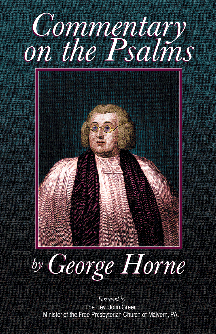
Commentary On The Psalms, George Horne, (reprinted by Old Paths Publications, $18.00, available from Reformation Heritage Books, Grand Rapids USA, www.heritagebooks.org)
Horne's Commentary on the Psalms is a devotional classic. Spurgeon wrote: "He is among the best of our English writers on this part of Scripture and certainly one of the most popular." It is a commentary intended to be of devotional value to every Christian not a learned and technical Horne believes that the Psalms are "an epitome of the Bible, adapted to the purposes of devotion". The Psalms contain that which is found elsewhere in Scripture in terms of doctrine, history, duty and prophecy but express them in the spirit of devotion. Horne's commentary explains the Psalms in "their literal or historical sense, as they relate to King David, and the people of Israel" but also spiritually in "their application to the Messiah, to the Church, and to individuals as members thereof." In his own refreshingly meditative approach, Horne finds Christ in most of the Psalms. Not limiting himself to those cited in the New Testament alone, he follows the principles underlying the apostolic interpretation of the Psalms. His approach follows from the best insights of Chrysostom and Augustine on this portion of Scripture.

Many in our own day do not recognise the sufficiency and entire relevance of the Psalms. Nothing could be better suited for the purposes of devotion. Horne notes that the "Psalms when thus applied, have advantages, which no fresh compositions, however finely executed, can possibly have...they point out the connexion between the old and new dispensations, thereby teaching us to admire and adore the wisdom of God displayed in both, and furnishing us while we read or sing them, an inexhaustible variety of the noblest matter that can engage the contemplations of man." This is a commentary designed to help the individual Christian to sing with the spirit and the understanding.

Horne (1730-1792), was a noted evangelical preacher who was Vice-Chancellor of Oxford University, Dean of Canterbury, and Bishop of Norwich. While his Anglican allegiance appears in various interpretations and expressions it is not over intrusive in the commentary which he published commentary in 1771. He comments on the pleasure that he had in meditating on the Book of Psalms in putting together the Commentary. "Happier hours than those which have been spent on these meditations on the Songs of Sion, he never expects to see in this world". It was written for those "who will exercise their faculties in discerning and contemplating the mysteries of the kingdom of heaven, and who are going on to perfection: to increase their faith, and inflame their charity: to delight them in prosperity, to comfort them in adversity, to edify them at all times". And truly if we use and apply the Psalms aright they will be blessed to us in this way.