Showing posts with label Scripture. Show all posts

Monday, September 09, 2013

the configurations of their glorie!


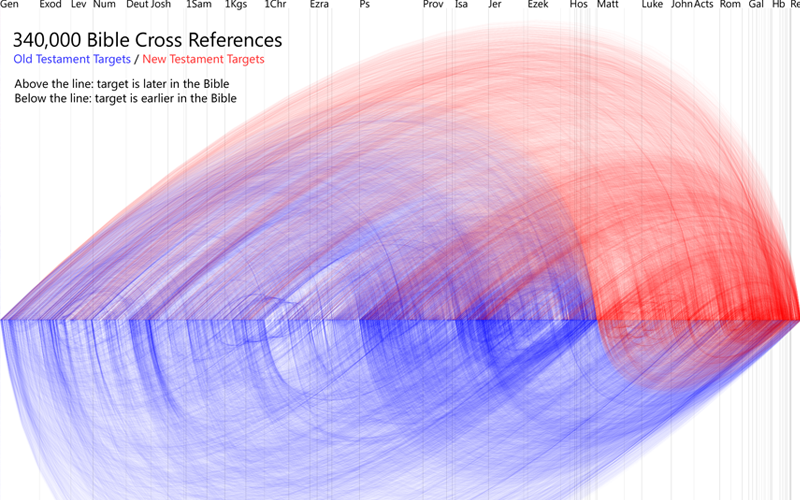
Biblical visualisations of cross-references are found here. The above rainbow shows the distance between two places among 63,779  cross-references using colour. The following one uses 340, 000 references.


Seeing not onely how each verse doth shine,
            But all the constellations of the storie.

This verse marks that, and both do make a motion
             Unto a third, that ten leaves off doth lie:

Thy words do finde me out, & parallels bring,

These are George Herbert's words from the poem on Holy Scripture. Would it not be beautiful if we could trace cross-references with our own life and experience? The "lights" and "perfections" of the Urim and Thummim found in Scripture as a lamp to our feet. What would that look like as a patchwork of colour and embroidery of light? This places the emphasis upon the word "I" at the start of Herbert's poem.

OH that I knew how all thy lights combine,
             And the configurations of their glorie!


Saturday, July 23, 2011

Mutilating the Old Testament

A bible burning event by an Anglican vicar in Wales reveals the logical conclusion of the Enlightenment biblical historical criticism. It also reveals the persistent anti-semitical streak of the higher criticism. The vicar justifies his action with a reference to a certain German philosopher. “Nietzsche said we should philosophise with a hammer, whereas I prefer to theologise with a scissors. I have not burnt a Bible, I have merely cut bits out and burned the little parts that were left over leaving most of the book intact.” The idea is to get rid of the parts of the Bible  that represent a "cruel and vile God" and that supposedly contradict the teachings of Jesus. It's all a rehash of a very old heresy, Marcionism. Coming closer to home, we heard someone at the 2011 General Assembly asserting that certain parts of Leviticus had "never been part of the Word of God". The "moral" repugnance is thrown off onto the Jews.

How is historical criticism anti-Semitic? Try William Robertson Smith and his Lectures on the Religion of the Semites, whose major theme is in showing how different Christianity has always been from the lower ‘primitive’ 'ritualistic' Semitic religion out of which it emerged. Historical criticism is the application of an evolutionary 'scientific' method. Robertson Smith's mentor was Julius Wellhausen (inventor of the documentary hypothesis), whose anti-semitism has been discussed frequently. Johann David Michaelis defined the field of historical criticism and was virulently anti-semitic.

Solomon Schechter gave an address, “Higher Criticism—Higher Anti-Semitism” in 1903. Some warning signs  had been raised. Clearly, however the intellectual climate was prepared for the rise of Hitler when Adolf von Harnack was ready to rehabilitate Marcion.

Tuesday, December 21, 2010

God speaking to us

“Therefore the second practice concerns everyone whose heart is to live for God; so that namely they may love and magnify his unique rule (Ps. 119:127, 2 Thess. 2:10). This consists in love for the divine word (a) in bowing our disposition to Scripture to such a degree that we receive Scripture as God speaking to us, as it were, with His own mouth, with such great submission of course to whatever has been commanded; with such grea0t care and aversion to whatever has been forbidden; with such great delight and desire for whatever has been promised; and finally with such great fear and anxiety of whatever has been threatened; and, as it were, we have God speaking such great things in our presence (1 Thess. 2:13).” Petrus van Mastricht

Wednesday, August 25, 2010

sola scriptura

sola Scriptura: Scripture alone; the watchword of the Reformation in its establishment of the basis for a renewed and reformed statement of Christian doctrine. We find the concept of sola Scriptura, Scripture alone as the primary and absolute norm of doctrine, at the foundation of the early Protestant attempts at theological system in the form of exegetical loci communes, or common places. In the orthodox or scholastic codification of Lutheran and Reformed doctrine, the sola Scriptura of the Reformers was elaborated as a separate doctrinal locus placed at the beginning of theological system and determinative of its contents. Scripture was identified as the principium cognoscendi, the principle of knowing or cognitive foundation of theology, and described doctrinally in terms of its authority, clarity, and sufficiency in all matters of faith and morals.

Finally, it ought to be noted that sola Scriptura was never meant as a denial of the usefulness of the Christian tradition as a subordinate norm in theology. The views of the Reformers developed out of a debate in the late medieval theology over the relation of Scripture and tradition, one party viewing the two as coequal norms, the other party viewing Scripture as the absolute and therefore prior norm, but allowing tradition a derivative but important secondary role in doctrinal statement. The Reformers and the Protestant orthodox held the latter view, on the assumption that tradition was a useful guide, that the trinitarian and christological statements of Nicaea, Constantinople, and Chalcedon were expressions of biblical truth, and that the great teachers of the church provided valuable instruction in theology that always needed to be evaluated in the light of Scripture. We encounter, particularly in the scholastic era of Protestantism, a profound interest in the patristic period and a critical, but often substantive, use of ideas and patterns enunciated by the medieval doctors.

Richard Muller, Dictionary of Latin and Greek Theological Terms: Drawn Principally from Protestant Scholastic Theology (Grand Rapids, MI: Baker, 1985), 284.

Monday, March 22, 2010

Truth bears Repetition

Repetition is a key feature of the Scriptures. It is very remarkable
because not everything that could have been has been included about
the life of Christ, the history of Israel or of the early Church. Only
that which is necessary according to divine wisdom has been included.
Repetition draws out attention to key truths. When God says something
once, we must always listen, when He says something twice (Job 33:14;
Ps. 62:11) we must pay close attention and when He speaks three times
we must give ourselves wholly to it because it is being reinforced.
Every verse and word in Scripture is essential, there is nothing
included that is non-essential or merely to provide context. There is
no such thing as mere repetition in Scripture. Some phrases are
repeated hundreds of times such as the "name of the LORD". Christ
used repetition in His ministry, declaring the same truths on numerous
occasions. The gospels repeat many incidents concerning Christ three
times amongst themselves. Typology is, as it were, a way of
reiterating truths in Scripture.

The number of times that something is repeated is not an accident but
significant and with purpose. The phrase "and God saw that it was
good" is repeated seven times in Genesis 1:4-31. The phrase "He that
hath an ear, let him hear what the Spirit saith unto the churches" is
also repeated seven times (Revelation chapters 2 & 3). There are also
seven repetitions of the word "blessed" in the book of Revelation
(1:3; 14:13; 16:15; 19:9; 20:6; 22:7, 14).

Counter-reformation Roman Catholic theologians such as Bellarmine
maintained that "many things not necessary have been written; as all
the histories of the old Testament, many of the new, some of the Acts
of the Apostles, and all the salutations in the apostolic epistles".
Post-Reformation theologians such as William Whitaker granted that
some of this information is not essential to the being of faith but it
is still essential to its wellbeing. That things are repeated in
Scripture does not make them redundant but underlines their necessity.
Whitaker states: "as to many things being frequently repeated, this
makes it still more a rule; since that repetition is
profitable to our better and surer understanding of what is said".

John Arrowsmith who was one of the Westminster Divines wrote
concerning repetition in Scripture in '"Theanthropos, God made Man."
The summary is pithy, concise and instructive.

1. In prayer, repetition serves to express fervency and earnestness.
Matthew 26:44

2. In prophecies, repetition serves to note the certainty of them. Genesis 41:22

3. In threats, repetition indicates unavoidableness and, perhaps,
suddenness. Ezekiel 21:27

4. In precepts repetition serves to note a necessity in performing
them. Psalm 47:6

5. In truths, repetition serves to show the necessity of believing
them and of knowing them. John 3:3, 5, 17

We take great exception, however, to the language of the Chicago
Statement on Biblical Inerrancy. The "Chicago Statement on Biblical
Inerrancy" was produced at an international Summit Conference of
evangelical leaders, held at the Hyatt Regency O'Hare in Chicago in
the fall of 1978. This congress was sponsored by the International
Council on Biblical Inerrancy. The Chicago Statement was signed by
nearly 300 noted evangelical scholars, including James Boice, Norman
L. Geisler, John Gerstner, Carl F. H. Henry, Kenneth Kantzer, Harold
Lindsell, John Warwick Montgomery, Roger Nicole, J. I. Packer, Robert
Preus, Earl Radmacher, Francis Schaeffer, R. C. Sproul, and John
Wenham.

The Statement says in relation to translation:

the verdict of linguistic science is that English-speaking Christians,
at least, are exceedingly well served in these days with a host of
excellent translations and have no cause for hesitating to conclude
that the true Word of God is within their reach. Indeed, in view of
the frequent repetition in Scripture of the main matters with which it
deals and also of the Holy Spirit's constant witness to and through
the Word, no serious translation of Holy Scripture will so destroy its
meaning as to render it unable to make its reader "wise for salvation
through faith in Christ Jesus" (2 Tim. 3:15).

This is evangelical reductionism gone mad and an improper deduction
from repetition in Scripture. All we need from Scripture it says is
what is necessary for salvation. You may see how far it diverges from
Whitaker's view above and instead approaches the position held by
Bellarmine. The "assured results of science" have always been less
than assured in theological matters and here no less so. The fact is
that some translations do obscure the main matters and key doctrines
through inaccurate translation or through preference for corrupted
manuscripts. Some things are reiterated but not repeated in the same
way and that is an important distinction. Yet we ought to be thankful
that there is something of the truth remaining which can be used to
make one wise for salvation.

Wednesday, July 29, 2009

Christ the scope of Scripture

The Puritan Isaac Ambrose (1604-1664). said: "Let a man have what the
world can give, yet if he have not Christ, he is nothing worth. Christ
is the marrow and fatness, the fulness and sweetness of all our
endowments, separate Christ from them and they are bitter and do not
please us, empty and do not fill us." "Surely Christ is enough to
fill all our thoughts, desires, hopes, loves, joys or whatever is
within us or without us. Christ alone comprehends all the
circumference of all our happiness. Christ is the pearl hid in the
large field of God's word Christ is the scope of all the scripture:
all things and persons in the old world were types of him; all the
prophets foretold him, all God's love runs through him, all the gifts
and graces of the Spirit flow from him, the whole eye of God is upon
him, and all his designs both in heaven and earth meet in him; the
great design of God is this, That " he might gather together in one
all things in Christ, both which are in heaven, and which are on
earth, even in him," Eph. 1:10".

He has another more well-known quotation about Scripture in this
regard: "Keep still Jesus Christ in your eye, in the perusal of the
Scriptures, as the end, scope and substance thereof: what are the
whole Scriptures, but as it were the spiritual swaddling clothes of
the holy child Jesus? 1. Christ is the truth and substance of all the
types and shadows. 2. Christ is the substance and matter of the
Covenant of Grace, and all administrations thereof; under the Old
Testament Christ is veiled, under the New Covenant revealed. 3. Christ
is the centre and meeting place of all the promises; for in him the
promises of God are yea and Amen. 4. Christ is the thing signified,
sealed and exhibited in the Sacraments of the Old and New Testament.
5. Scripture genealogies use to lead us on to the true line of Christ.
6. Scripture chronologies are to discover to us the times and seasons
of Christ. 7. Scripture-laws are our schoolmasters to bring us to
Christ, the moral by correcting, the ceremonial by directing. 8.
Scripture-gospel is Christ's light, whereby we hear and follow him;
Christ's cords of love, whereby we are drawn into sweet union and
communion with him; yea it is the very power of God unto salvation
unto all them that believe in Christ Jesus; and therefore think of
Christ as the very substance, marrow, soul and scope of the whole
Scriptures."

John Owen had a similar view, reflecting on Luke 24:27, "It is
therefore manifest that Moses, and the Prophets, and all the
Scripture, do give testimony unto him and his glory. This is the line
of life and light which runs through the whole Old Testament".

Richard Muller notes that it was common in Reformed writers to see
Christ as the "scope" of Scripture "…the theologies of the Reformers
and of their orthodox successors consistently place Christ at the
center of their discussions of redemption, consistently understand
Christ as the center and fulfillment of divine revelation, and equally
consistently understand the causality of salvation as grounded in the
divine purpose".

Muller comments on the definition of the term: "It is particularly
important that the contemporary English meaning of 'scope,' the full
extent, range, or intention of a thing, be excluded. The original
Greek (skopos) and Latin (scopus) indicates the center or bull's eye
of a target. Indeed, in the First Helvetic Confession, scopus
translates der Zweck of the German original. The term is rightly
understood, therefore, not as the aim, purpose, goal, and center,
indeed, the 'bull's eye' of the biblical target. The Latin title of
the section is simply 'scopus Scripturae,' but the German reads at
greater length and with a clearer definition of the issue, 'What the
center (Zweck) of Holy Scripture is, and toward what the Scripture
ultimately points.' The 'entire Bible' (die ganze biblische Schrift)
teaches 'that God is gracious and benevolent' and that he has bestowed
his grace upon mankind in the person of Christ, his Son, by means of
faith. Much as in Luther's statement concerning the canon and in the
Schmalkald Articles, the center of Scripture is not merely Christ
doctrinally understood, but Christ apprehended by faith as the focus
of God's work of reconciliation. The larger sense of scopus as the
divine work of reconciliation throughout Scripture is echoed in
Bullinger's use of the term to indicate the covenant - a usage that
will appear in the writings of some of the Protestant scholastic
theologians."

Ambrose applies this:

All things are summed up in this one Jesus Christ: if we look on the
creation, the whole world was made by Christ, if we look on
providences, all things subsist in Christ, they have their being, and
their well-being in him. Where may we find God but in Christ? Where
may we see God but in this essential and eternal glass? Christ is "the
face of God," 2 Cor. 4:6. " The brightness of his glory, the express
image pf his Father's person," Heb. 1:3. The Father is (as it were)
all sun, and all pearl; and Jesus Christ is the substantial rays, the
eternal and essential irradiation of the sun of glory: Christ outs God
as the seal doth the stamp: Christ reveals God, as the face of a man
doth reveal the man, so Christ to Philip," He that hath seen me, hath
seen the Father," John 14:9. q. d. I am as like the Father as God is
like himself: there is a perfect indivisible unity between the Father
and me, " I and the Father are one;" one very God, he the begetter,
and I the begotten: Christ is the substantial rose that grew out of
the Father from eternity: Christ is the essential wisdom of God;
Christ is the substantial word of God, the intellectual birth of the
Lord's infinite understanding: oh the worth of Christ! compare we
other things with Christ, and they will bear no weight at all; cast
into the balance with him, angels, they are wise, but he is wisdom;
cast into the balance with him men, they are liars, lighter than
vanity, but Christ is " the Amen, the faithful witness;" cast into the
scales kings, and all kings, and all their glory, why he is King of
kings; cast into the scale millions of talents' weight of glory; cant
in two worlds, and add to the weight millions of heavens of heavens,
and the balance cannot down, the scales are unequal, Christ outweighs
all. Shall I yet come nearer home? What is heaven but to be with
Christ? What is life eternal but to believe in God, and in hia Son
Jesus Christ? Where may we find peace with God, and reconciliation
with God, but only in Christ? "God was in Christ reconciling the world
unto himself," 2 Cor. 5:19. Where may we find compassion, mercy, and
gentleness to sinners, but only in Christ? It is Christ that takes otf
infinite wrath, and satisfies justice, and so God is a most lovely,
compassionate, desirable God in Jesus: alt the goodness of God comes
out of God through this golden pipe the Lord Jesus Christ. It is true
those essential attributes of love, grace, mercy and goodness, are
only in God, and they abide in God, yet the mediatory manifestation of
love, grace, mercy and goodness, is only in Christ; Christ alone is
treasury, store-house, and magazine of the free goodness and mercy of
the Godhead. In him we are elected, adopted, redeemed, justified,
sanctified and saved; he is the ladder, and every step of it betwixt
heaven and earth; he is the way, the truth and the life, he is honor,
riches, beauty, health, peace and salvation; he is a suitable and rich
portion to every man's soul: that which some of the Jews observe of
the manna, that it was in taste according to every man's palate, it is
really true of Christ, he is to the soul, whaisoevor the soul would
have him to hp. All the spiritual blessings wherewith we are enriched,
are in and v Christ: God hears otir prayers by Christ: God forgives us
our iniquities through Christ; all we have, and all we expect to have,
hangs only on Chtist: he is the golden hinge, upon which all our
salvation turns.

Oh! how should all hearts be taken with this Christ? Christiana! turn
your eyes upon the Lord: " Look, and look again unto Jesus," Why stand
ye gazing on the toys of this world, when such aChrist is offered to
you in the gospel? Can the world die for you? Can the world reconcile
you to the Father? Can the world advance you to the kingdom of heaven?
As Christ is all in all, so let him be the full and complete subject
of our desire, and hope, and faith, and love, and joy; let him be in
your thoughts the first in the morning, and the last at night. Shall I
speak one word more to thee that believest? Oh! apply in particular
all the transactions of Jesus Christ to thy very self; remember how he
came out of his Father's bosom for thee, wept for thee, bled for thee,
poured out his life for thee, is now risen for thee, gone to heaven
for thee, sits at God's right hand, and rules all the world for thee:
makes intercession for thee, and at the end of the world will come
again for thee, and receive thee to himself, to live with him for ever
and ever. Surely if thus thou believest and livest, thy life is
comfortable, and thy death will be sweet. If there be any heaven upon
earth, thou wilt find it in the practice and exorcise of this gospel
duty, in "Looking unto Jesus."

Thursday, November 20, 2008

Persecution of the Bible

An article recently published on the Persecution of the Bible. It looks at the persecution of the Scriptures at the time of the Reformation, those who were burnt at the stake for possessing them or translating them and how this persecution continues in our own day.

Friday, September 19, 2008

Drawing nearer heaven through maximal use of the Scriptures

The following quotation from the Westminster divine William Twisse expresses very well the Puritan attitude towards the due use of necessary means particulary maximal use of the Scriptures and submission to their authority.

"There is a...fulness of faith that we should strive unto, and of knowledge as well as of holiness: For this life is our way to heaven, and still we must draw nearer thitherwards, by knowing all that we can know by the Word, Deut 29:29" (The Scripture's Sufficiency)

It is important to not that Twisse is evidently not referring to mere head knowledge but knowledge of how to glorify and enjoy God from the only rule to direct us how we may do this.

Phillipians 3:13ff. Brethren, I count not myself to have apprehended,but this one thing I do; forgetting those things which are behind, and reaching forth unto those things which are before; I press toward the mark,for the prize of the high calling of God in Christ Jesus: Let us therefore, as many as be perfect, be thus minded
and if in anything ye be otherwise minded; God shall reveal even this unto you; Nevertheless, whereto we have already attained,let us walk by the same rule;let us mind the same thing;